Mary Ann Swetland Center for Environmental Health Research, Department of Population and Quantitative Health Sciences, Case Western Reserve University School of Medicine, Cleveland, OH 44106, USA.
Produce Perks Midwest, Cincinnati, OH 45241, USA.
Int J Environ Res Public Health. 2022 Apr 20;19(9):4977. doi: 10.3390/ijerph19094977.
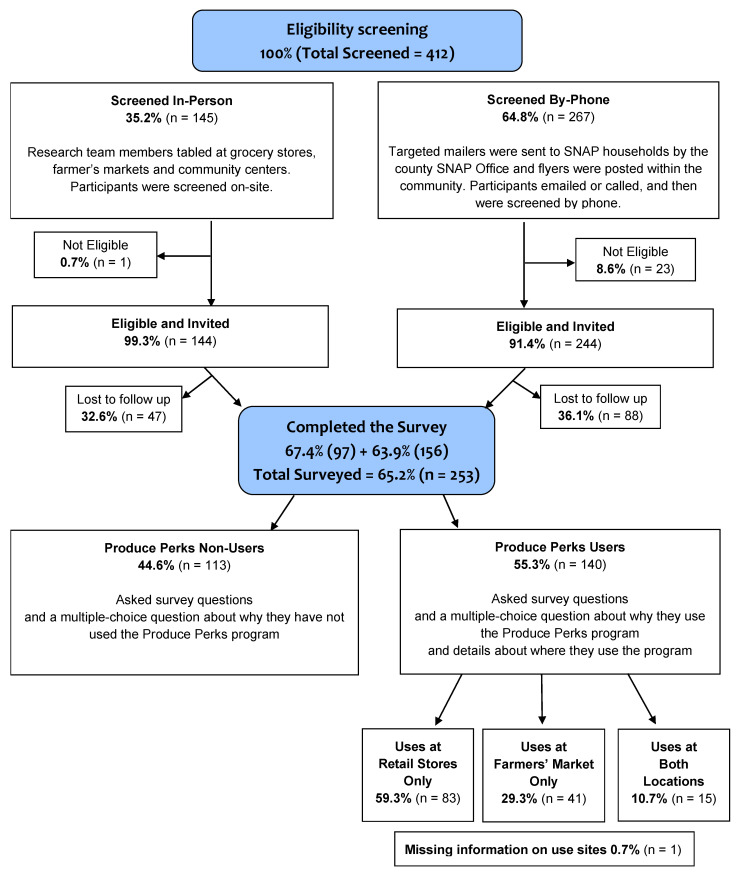
Structural barriers, such as food costs, reduce access to healthy foods for populations with limited income, including those benefitting from the Supplemental Nutrition Assistance Program (SNAP). Nutrition incentive programs seek to address this barrier. Evaluations of SNAP-based incentive programming often focus on one setting (i.e., either farmers’ markets or grocery stores). We examined use patterns, characteristics, and preferences among 253 SNAP consumers with access to incentive programming at both a farmers’ market and a grocery store located within five miles of their home. Cross-sectional survey data were collected in 2019 in two Ohio cities. Despite geographic access, 45% of those surveyed were not using the incentive program; most non-users (80.5%) were unaware of the program. Program users compared to non-users had higher household incomes (p < 0.001) and knew more people using the program (p < 0.001). Grocery stores were the most common setting of use (59%); 29% used at farmers’ markets; 11% used in both settings. User characteristics varied by store setting based on demographics, program experience, fruit and vegetable purchasing and consumption patterns, and social dynamics related to use. Our findings support comprehensive awareness-raising efforts and tailored implementation of incentive programming that attends to diverse segments of SNAP consumers to promote equity in program reach.
结构性障碍,如食品成本,限制了收入有限的人群获得健康食品的机会,包括那些受益于补充营养援助计划(SNAP)的人群。营养激励计划旨在解决这一障碍。基于 SNAP 的激励计划的评估通常集中在一个环境(即农贸市场或杂货店)。我们研究了 253 名 SNAP 消费者的使用模式、特征和偏好,这些消费者在家中五英里范围内可以获得激励计划,包括农贸市场和杂货店。2019 年在俄亥俄州的两个城市收集了横断面调查数据。尽管地理位置便利,但仍有 45%的受访者未使用激励计划;大多数非使用者(80.5%)不知道该计划。与非使用者相比,使用者的家庭收入更高(p<0.001),并且认识更多使用该计划的人(p<0.001)。超市是最常见的使用地点(59%);29%在农贸市场使用;11%在两个地点都使用。根据人口统计学、计划经验、水果和蔬菜购买和消费模式以及与使用相关的社会动态,用户特征因商店设置而异。我们的研究结果支持开展全面的提高认识的工作,并根据 SNAP 消费者的不同群体有针对性地实施激励计划,以促进计划覆盖范围的公平性。