Department of Human Biology, Faculty of Physical Education, Józef Piłsudski University of Physical Education in Warsaw, Marymoncka 34, 00-968 Warsaw, Poland.
Department of Anthropology, Faculty of Biology and Animal Science, Wroclaw University of Environmental and Life Sciences, C. K. Norwida 25, 50-375 Wroclaw, Poland.
Int J Environ Res Public Health. 2022 Apr 21;19(9):5044. doi: 10.3390/ijerph19095044.
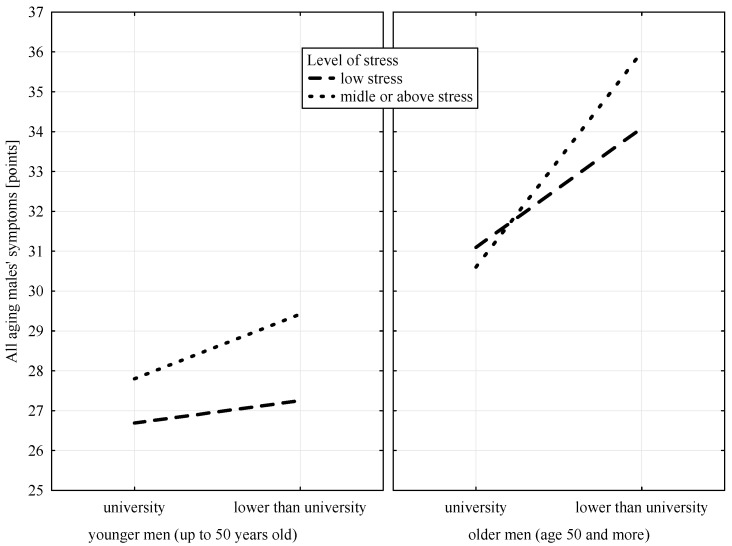
An increasing number of subjects are affected by health problems related to the advanced involutional processes. It is extremely important to identify the determinants of the rate of occurrence of physiological, psychological, and social manifestations of aging. The aim was to determine how factors such as lifestyle, level of education, or severity of stressful life events indicate the appearance of aging symptoms in adult men. The material consisted of data of ethnically homogeneous group of 355 men (32−87 years), invited to the study as a part of the Wroclaw Male Study research project. The analyzed features included (1) socioeconomic status: age, educational level, marital status, and having children; (2) elements of lifestyle: alcohol drinking, cigarette smoking, and physical activity; (3) major and most important stressful life events—the Social Readjustment Rating Scale; (4) symptoms related to male aging—the Aging Males’ Symptoms. The backward stepwise regression models, the Kruskal−Wallis test, and multiple comparisons of mean ranks were used. Noncentrality parameter δ (delta), two-tailed critical values of the test, and test power with α = 0.05 were calculated. Among the analyzed variables, age was most strongly associated with the intensity of almost all groups of andropausal symptoms in men (p = 0.0001), followed by the level of education (p = 0.0001) and the intensity of stressful life events (p = 0.0108). Selected lifestyle elements turned out to be much less important (p > 0.01). Preventive actions aimed at slowing down the intensification of involutional processes, including teaching strategies for coping with stressful life events, should be implemented in groups of men with specific risk factors from an early age.
越来越多的人受到与衰老相关的健康问题的影响。确定导致生理、心理和社会衰老表现发生率的决定因素非常重要。本研究旨在确定生活方式、教育水平或生活压力事件严重程度等因素如何表明成年男性出现衰老症状。研究材料包括 355 名男性(32-87 岁)的种族同质组的数据,这些男性被邀请参加弗罗茨瓦夫男性研究研究项目。分析的特征包括:(1)社会经济地位:年龄、教育水平、婚姻状况和子女情况;(2)生活方式因素:饮酒、吸烟和身体活动;(3)主要和最重要的生活压力事件-社会再适应评定量表;(4)与男性衰老相关的症状-男性衰老症状。使用向后逐步回归模型、Kruskal-Wallis 检验和平均秩多重比较。计算了非中心参数δ(delta)、检验的双侧临界值和α=0.05 时的检验功效。在所分析的变量中,年龄与男性雄激素缺乏症状的几乎所有组的强度最密切相关(p=0.0001),其次是教育水平(p=0.0001)和生活压力事件的强度(p=0.0108)。选定的生活方式因素则显得重要得多(p>0.01)。应该在具有特定危险因素的男性群体中,从早期开始实施旨在减缓衰老进程强化的预防措施,包括应对生活压力事件的教学策略。