Oncology Unit, Gallarate-Busto Arsizio Hospital, ASST Valle Olona, 21013 Gallarate, Italy.
Clinical Nutrition and Dietetics Unit, Fondazione IRCCS Policlinico San Matteo, 27100 Pavia, Italy.
Nutrients. 2022 Apr 26;14(9):1801. doi: 10.3390/nu14091801.
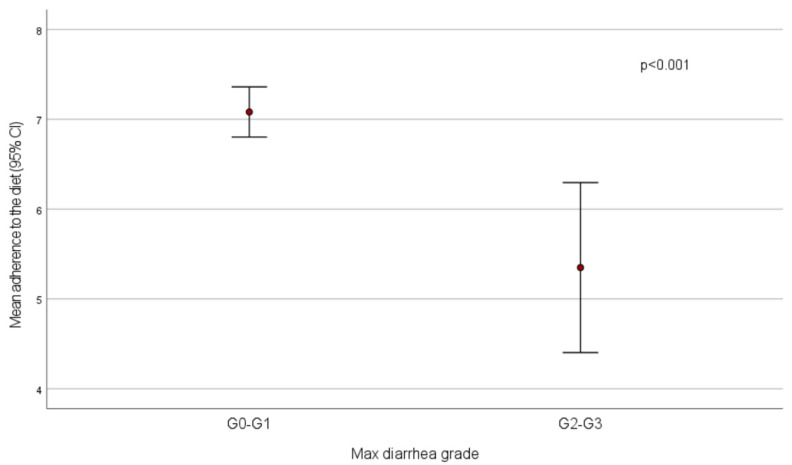
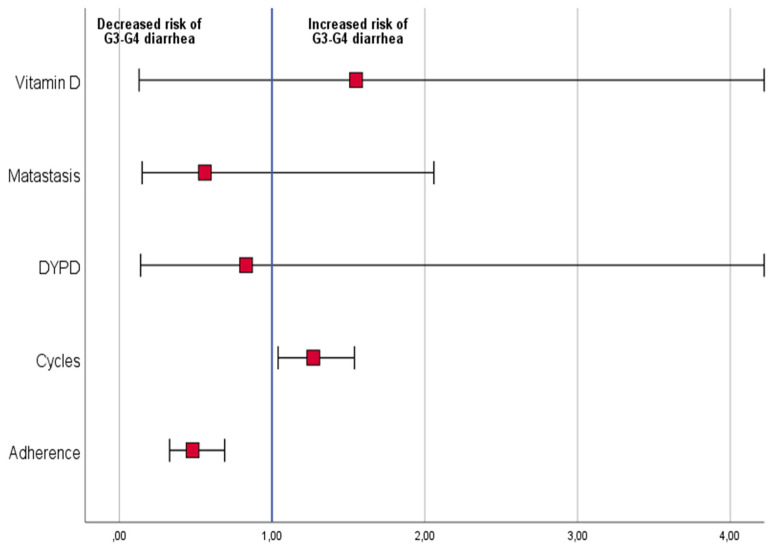
This study aimed to determine if dietary modifications using a nutritional regimen could prevent or reduce the incidence of cancer therapy-induced diarrhea in patients with metastatic colorectal cancer and to evaluate the relationship of Vitamin D blood levels with diarrhea severity. Patients with metastatic colorectal cancer were enrolled. A Mediterranean diet, containing some special limitations aiming to reduce the risk of diarrhea, was administered before and during the entire chemotherapy program. Enrolled patients numbering 60/137 (44%) had diarrhea during chemotherapy. Adherence to the diet was high in 36 (26.3%) patients, medium in 94 (68.6%), and low in 7 (5.1%). Mean adherence to the diet was significantly lower in patients who experienced diarrhea with maximum grade 2−3 compared to those who had no diarrhea or grade 1 diarrhea (score = 5.4 ± 1.9 vs. 7.1 ± 1.5, p < 0.001). Patients with higher adherence to the diet had a lower risk of grade 2−3 diarrhea (odds ratio: 0.5 (95% CI: 0.3−0.7, p < 0.001)). In addition, patients who completed a higher number of chemotherapy cycles had an increased risk of grade 2−3 diarrhea (odds ratio: 1.2 (95% CI: 1.0−1.5, p = 0.02)). Of note, a lower level of Vitamin D correlated with an increased risk of G2-G3 diarrhea (p = 0.03). A diet based on vegetables with a controlled fiber content, Mediterranean Modified Healthy Diet (MMHD), is useful to control the incidence of cancer therapy-induced diarrhea.
本研究旨在确定饮食调整是否可以通过营养方案预防或减少转移性结直肠癌患者化疗诱导性腹泻的发生率,并评估维生素 D 血液水平与腹泻严重程度的关系。入组了转移性结直肠癌患者。在整个化疗方案之前和期间,给予了地中海饮食,其中包含一些特殊的限制,旨在降低腹泻的风险。共有 60/137(44%)名患者在化疗期间发生腹泻。36 名(26.3%)患者饮食依从性高,94 名(68.6%)患者中等,7 名(5.1%)患者低。与无腹泻或腹泻 1 级的患者相比,发生 2-3 级腹泻的患者饮食依从性明显较低(评分=5.4±1.9 与 7.1±1.5,p<0.001)。饮食依从性较高的患者发生 2-3 级腹泻的风险较低(比值比:0.5(95%CI:0.3-0.7,p<0.001))。此外,完成更多化疗周期的患者发生 2-3 级腹泻的风险增加(比值比:1.2(95%CI:1.0-1.5,p=0.02))。值得注意的是,维生素 D 水平较低与发生 G2-G3 腹泻的风险增加相关(p=0.03)。基于蔬菜的受控纤维含量的地中海改良健康饮食(MMHD)是控制癌症治疗诱导性腹泻发生率的有用方法。