Physics Diagnostic Division, The First Affiliated Hospital of Zhengzhou University, Zhengzhou 450052, China.
Key Laboratory of Targeting Therapy and Diagnosis for Critical Diseases of Henan Province, School of Pharmaceutical Sciences, Zhengzhou University, Zhengzhou 450001, China.
Molecules. 2022 Apr 22;27(9):2702. doi: 10.3390/molecules27092702.
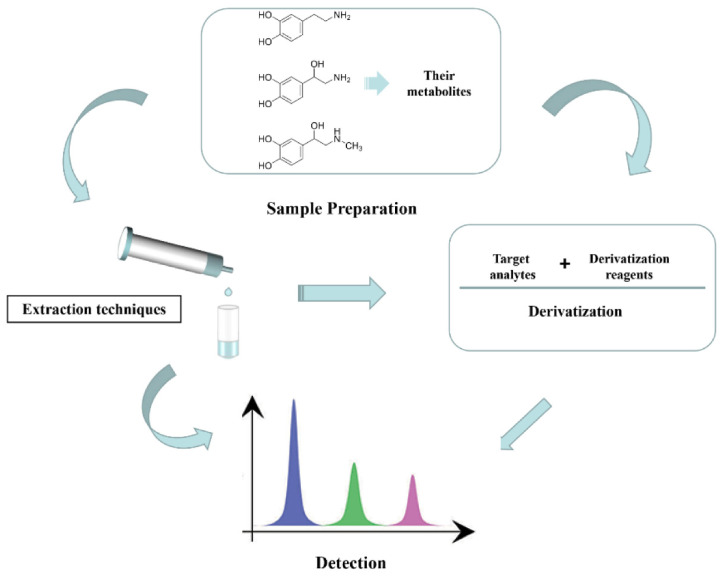
Catecholamines (CAs) and their metabolites play significant roles in many physiological processes. Changes in CAs concentration in vivo can serve as potential indicators for the diagnosis of several diseases such as pheochromocytoma and paraganglioma. Thus, the accurate quantification of CAs and their metabolites in biological samples is quite important and has attracted great research interest. However, due to their extremely low concentrations and numerous co-existing biological interferences, direct analysis of these endogenous compounds often suffers from severe difficulties. Employing suitable sample preparation techniques before instrument detection to enrich the target analytes and remove the interferences is a practicable and straightforward approach. To date, many sample preparation techniques such as solid-phase extraction (SPE), and liquid-liquid extraction (LLE) have been utilized to extract CAs and their metabolites from various biological samples. More recently, several modern techniques such as solid-phase microextraction (SPME), liquid-liquid microextraction (LLME), dispersive solid-phase extraction (DSPE), and chemical derivatizations have also been used with certain advanced features of automation and miniaturization. There are no review articles with the emphasis on sample preparations for the determination of catecholamine neurotransmitters in biological samples. Thus, this review aims to summarize recent progress and advances from 2015 to 2021, with emphasis on the sample preparation techniques combined with separation-based detection methods such capillary electrophoresis (CE) or liquid chromatography (LC) with various detectors. The current review manuscript would be helpful for the researchers with their research interests in diagnostic analysis and biological systems to choose suitable sample pretreatment and detection methods.
儿茶酚胺(CA)及其代谢物在许多生理过程中起着重要作用。体内 CA 浓度的变化可以作为几种疾病(如嗜铬细胞瘤和副神经节瘤)诊断的潜在指标。因此,准确测定生物样本中的 CA 及其代谢物非常重要,这引起了广泛的研究兴趣。然而,由于其浓度极低,并且存在许多共存的生物干扰,直接分析这些内源性化合物常常面临严重的困难。在仪器检测之前,采用合适的样品前处理技术来富集目标分析物并去除干扰物是一种可行且直接的方法。迄今为止,已经有许多样品前处理技术,如固相萃取(SPE)和液液萃取(LLE),用于从各种生物样本中提取 CA 及其代谢物。最近,几种现代技术,如固相微萃取(SPME)、液液微萃取(LLME)、分散固相萃取(DSPE)和化学衍生化,也已被用于自动化和微型化等某些先进功能。目前尚无重点关注生物样品中儿茶酚胺神经递质的测定的样品制备综述文章。因此,本综述旨在总结 2015 年至 2021 年的最新进展和进展,重点介绍与分离检测方法(如毛细管电泳(CE)或液相色谱(LC)与各种检测器相结合的样品制备技术。本综述文章将有助于对诊断分析和生物系统感兴趣的研究人员选择合适的样品预处理和检测方法。