Jung Ju-Yang, Lee Hyun-Young, Lee Eunyoung, Kim Hyoun-Ah, Yoon Dukyong, Suh Chang-Hee
Department of Rheumatology, Ajou University School of Medicine, Suwon 16499, Korea.
Department of Biomedical Informatics, Ajou University School of Medicine, Suwon 16499, Korea.
J Clin Med. 2022 Apr 25;11(9):2406. doi: 10.3390/jcm11092406.
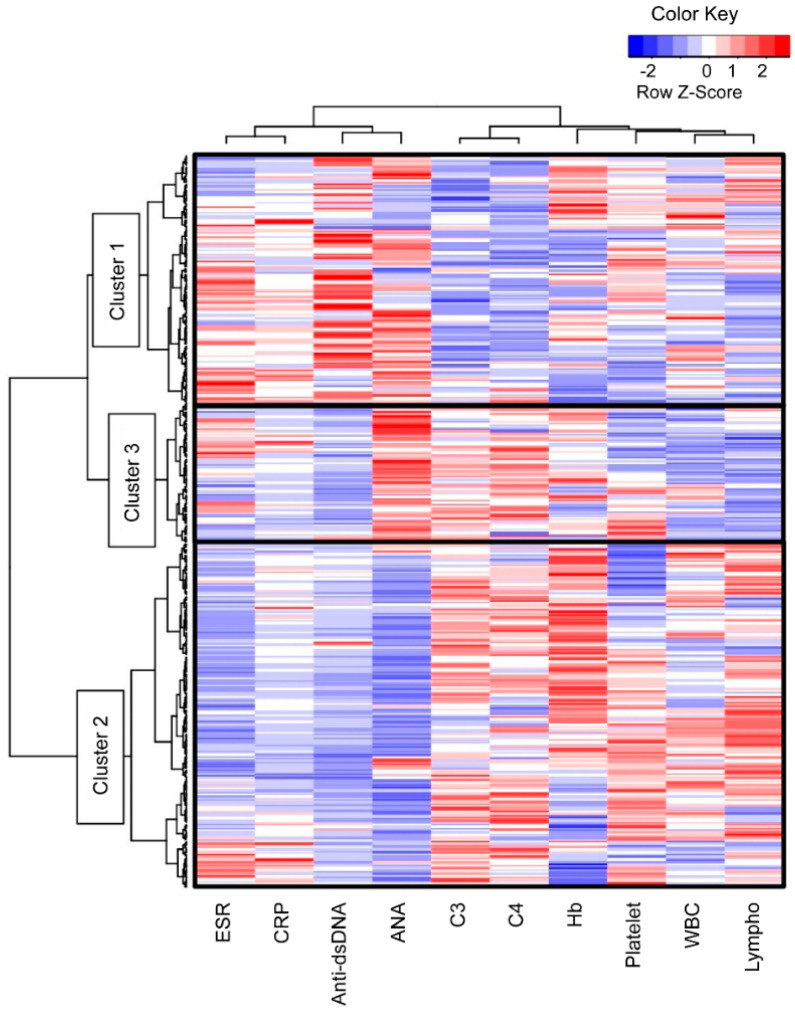
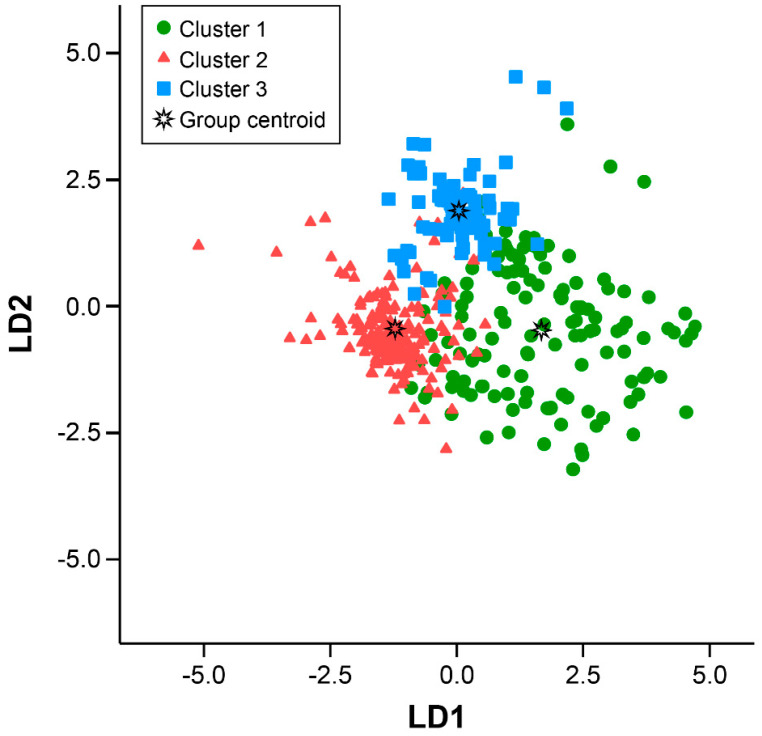
Systemic lupus erythematosus (SLE) is a heterogeneous disorder with diverse clinical manifestations. This study classified patients by combining laboratory values at SLE diagnosis via hierarchical cluster analysis. Linear discriminant analysis was performed to construct a model for predicting clusters. Cluster analysis using data from 389 patients with SLE yielded three clusters with different laboratory characteristics. Cluster 1 had the youngest age at diagnosis and showed significantly lower lymphocyte and platelet counts and hemoglobin and complement levels and the highest erythrocyte sedimentation rate (ESR) and anti-double-stranded DNA (dsDNA) antibody level. Cluster 2 showed higher white blood cell (WBC), lymphocyte, and platelet counts and lower ESR and anti-dsDNA antibody level. Cluster 3 showed the highest anti-nuclear antibody titer and lower WBC and lymphocyte counts. Within approximately 171 months, Cluster 1 showed higher SLE Disease Activity Index scores and number of cumulative manifestations, including malar rash, alopecia, arthritis, and renal disease, than did Clusters 2 and 3. However, the damage index and mortality rate did not differ significantly between them. In conclusion, the cluster analysis using the initial laboratory findings of the patients with SLE identified three clusters. While disease activities, organ involvements, and management patterns differed between the clusters, damages and mortalities did not.
系统性红斑狼疮(SLE)是一种临床表现多样的异质性疾病。本研究通过层次聚类分析,结合SLE诊断时的实验室检查值对患者进行分类。进行线性判别分析以构建预测聚类的模型。对389例SLE患者的数据进行聚类分析,得出具有不同实验室特征的三个聚类。聚类1诊断时年龄最小,淋巴细胞、血小板计数、血红蛋白和补体水平显著较低,红细胞沉降率(ESR)和抗双链DNA(dsDNA)抗体水平最高。聚类2白细胞(WBC)、淋巴细胞和血小板计数较高,ESR和抗dsDNA抗体水平较低。聚类3抗核抗体滴度最高,WBC和淋巴细胞计数较低。在大约171个月内,聚类1的SLE疾病活动指数评分和累积表现数量(包括颧部红斑、脱发、关节炎和肾脏疾病)高于聚类2和聚类3。然而,它们之间的损伤指数和死亡率没有显著差异。总之,利用SLE患者的初始实验室检查结果进行聚类分析,确定了三个聚类。虽然各聚类之间的疾病活动、器官受累情况和管理模式有所不同,但损伤和死亡率并无差异。