Ismaiel Abdulrahman, Spinu Mihail, Leucuta Daniel-Corneliu, Popa Stefan-Lucian, Chis Bogdan Augustin, Fadgyas Stanculete Mihaela, Olinic Dan Mircea, Dumitrascu Dan L
2nd Department of Internal Medicine, "Iuliu Hatieganu" University of Medicine and Pharmacy, 400006 Cluj-Napoca, Romania.
Medical Clinic No. 1, "Iuliu Hatieganu" University of Medicine and Pharmacy, 400006 Cluj-Napoca, Romania.
J Clin Med. 2022 Apr 28;11(9):2488. doi: 10.3390/jcm11092488.
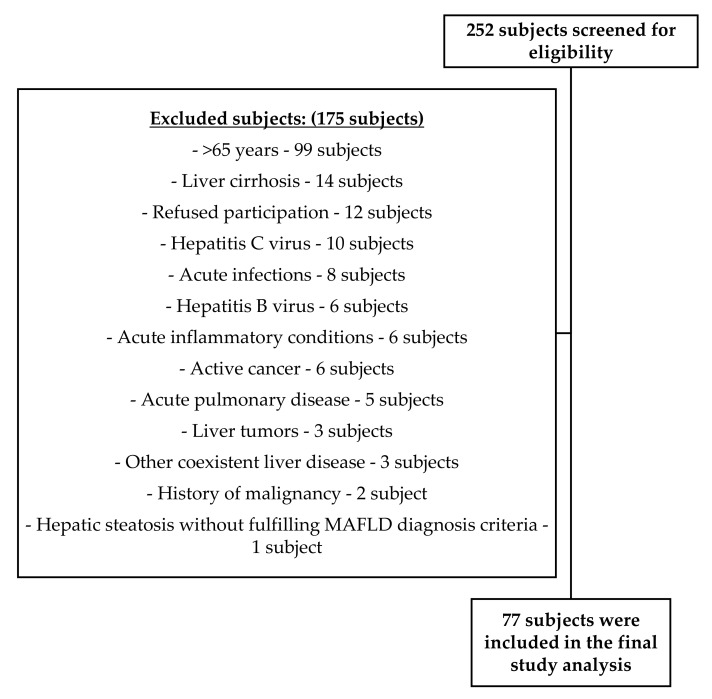
(1) Background: The relationship between anxiety and depression in metabolic-dysfunction-associated fatty liver disease (MAFLD) and cardiovascular (CV) risk remains uncertain. Therefore, we aimed to assess whether anxiety and depression are associated with increased CV risk in MAFLD. (2) Methods: We conducted a cross-sectional observational study involving 77 subjects (39 MAFLD patients, 38 controls), between January and September 2020. Hepatic steatosis was assessed using a combination of hepatic ultrasonography and SteatoTest. CV parameters were evaluated using echocardiography and Doppler ultrasound. Self-reported questionnaires pertaining to symptoms of anxiety and depression were used. Anxiety was evaluated using Lehrer Woolfolk Anxiety Symptom Questionnaire (LWASQ), further divided into somatic, behavioral, and cognitive factors, as well as a global score, and depression using Beck Depression Inventory (BDI). (3) Results: MAFLD patients presented significantly higher BDI scores (-value 0.009) and LWASQ global scores (-value 0.045) than controls. LWASQ somatic factor was significantly associated with global longitudinal strain (GLS) in linear analysis (-0.0404, -value = 0.002), while it lost significance following multivariate analysis (-0.0166, -value = 0.124). Although group (MAFLD vs. controls) predicted BDI, LWASQ global score, and LWASQ somatic factor in linear regression, they lost significance in multivariate analysis. Moreover, the relationship between interventricular septal wall thickness (IVSWT) and BDI, LWASQ global score, and LWASQ somatic factor was significant in linear analysis, but statistical significance disappeared after multivariate analysis. (4) Conclusions: Although MAFLD patients presented increased anxiety and depression risk in univariate analysis, this association lost significance in multivariate analysis. A significant association between GLS levels and LWASQ somatic factor, in addition to IVSWT in anxiety and depression in univariate analysis, was observed, but was lost after multivariate analysis.
(1) 背景:代谢功能障碍相关脂肪性肝病(MAFLD)中焦虑与抑郁的关系以及心血管(CV)风险仍不确定。因此,我们旨在评估焦虑和抑郁是否与MAFLD患者心血管风险增加相关。(2) 方法:我们在2020年1月至9月期间进行了一项横断面观察性研究,纳入77名受试者(39名MAFLD患者,38名对照)。采用肝脏超声检查和SteatoTest联合评估肝脂肪变性。使用超声心动图和多普勒超声评估心血管参数。使用与焦虑和抑郁症状相关的自我报告问卷。使用莱勒·伍尔福克焦虑症状问卷(LWASQ)评估焦虑,进一步分为躯体、行为和认知因素以及总体评分,使用贝克抑郁量表(BDI)评估抑郁。(3) 结果:MAFLD患者的BDI评分(P值0.009)和LWASQ总体评分(P值0.045)显著高于对照组。线性分析中,LWASQ躯体因素与整体纵向应变(GLS)显著相关(-0.0404,P值 = 0.002),但多变量分析后失去显著性(-0.0166,P值 = 0.124)。虽然在直线回归中,组别(MAFLD与对照组)可预测BDI、LWASQ总体评分和LWASQ躯体因素,但在多变量分析中失去显著性。此外,室间隔厚度(IVSWT)与BDI、LWASQ总体评分和LWASQ躯体因素之间的关系在直线分析中显著,但多变量分析后统计学显著性消失。(4) 结论:虽然在单变量分析中MAFLD患者的焦虑和抑郁风险增加,但在多变量分析中这种关联失去显著性。在单变量分析中观察到GLS水平与LWASQ躯体因素以及IVSWT在焦虑和抑郁之间存在显著关联,但多变量分析后失去显著性。