Department of Neurology, Division of Neurogeriatrics, Medical University of Graz, Auenbruggerplatz 22, Graz 8036, Austria.
Department of Neurology, Division of Neurogeriatrics, Medical University of Graz, Auenbruggerplatz 22, Graz 8036, Austria; Institute for Medical Informatics, Statistics and Documentation, Medical University of Graz, Graz, Austria.
Neuroimage. 2022 Aug 15;257:119303. doi: 10.1016/j.neuroimage.2022.119303. Epub 2022 May 12.
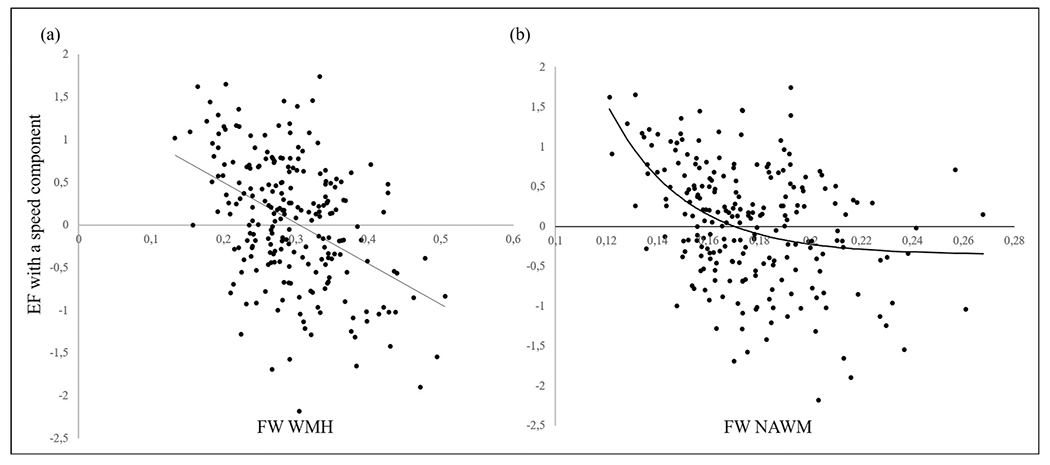
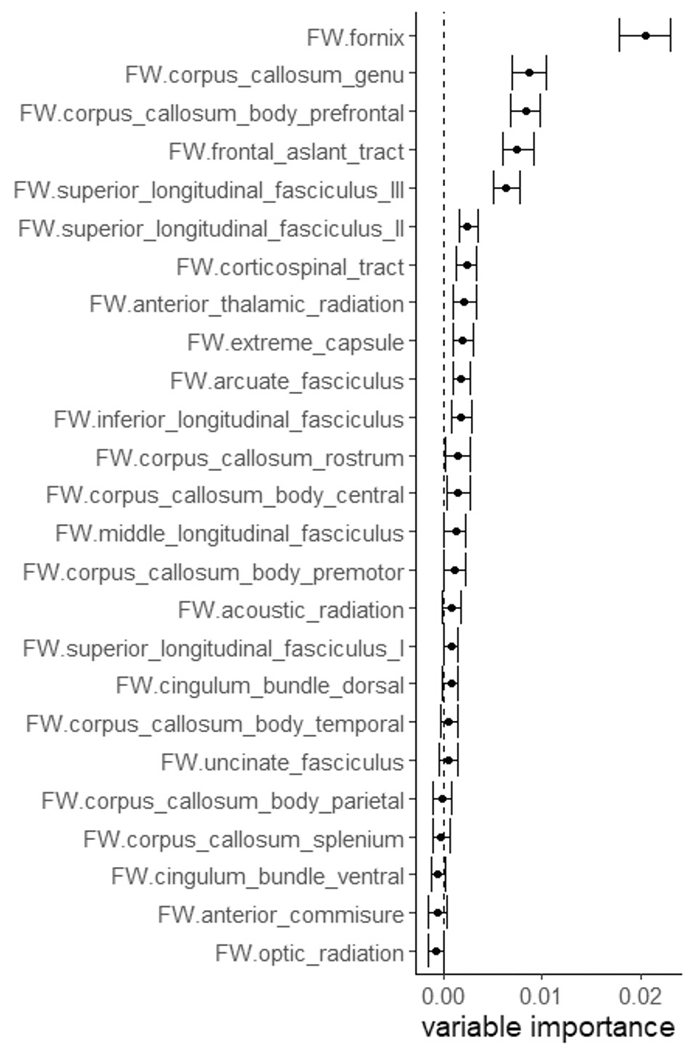
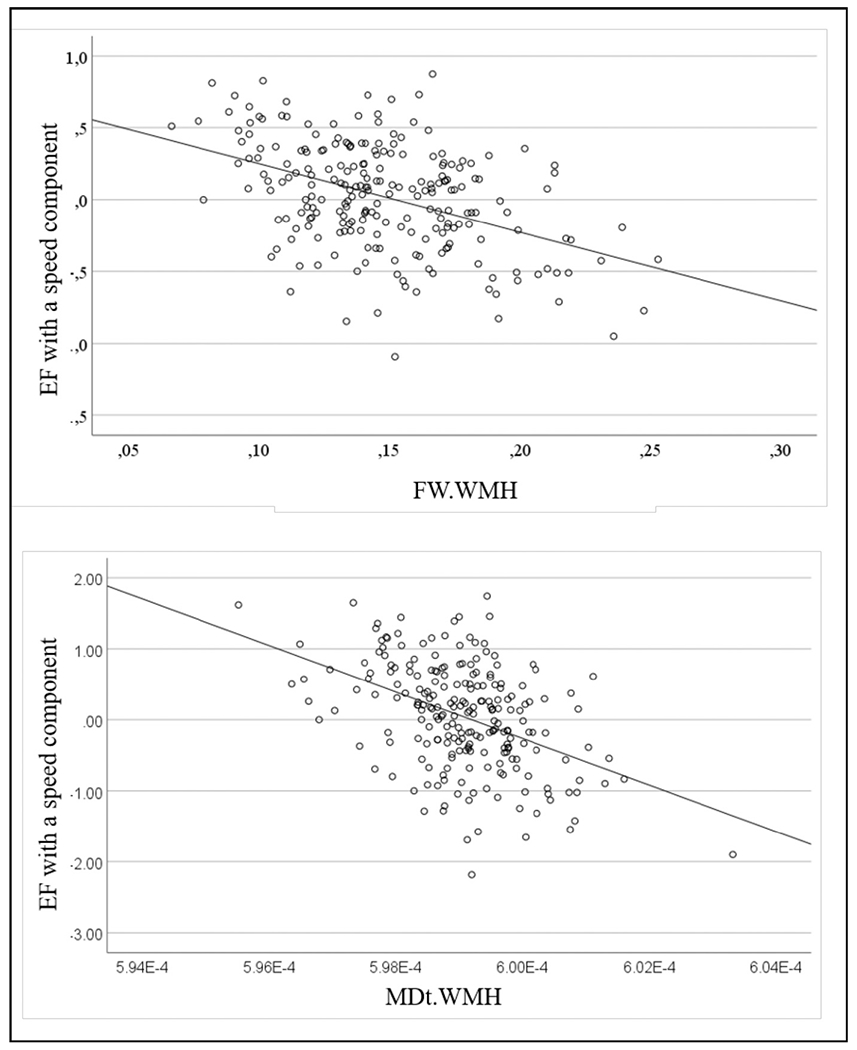
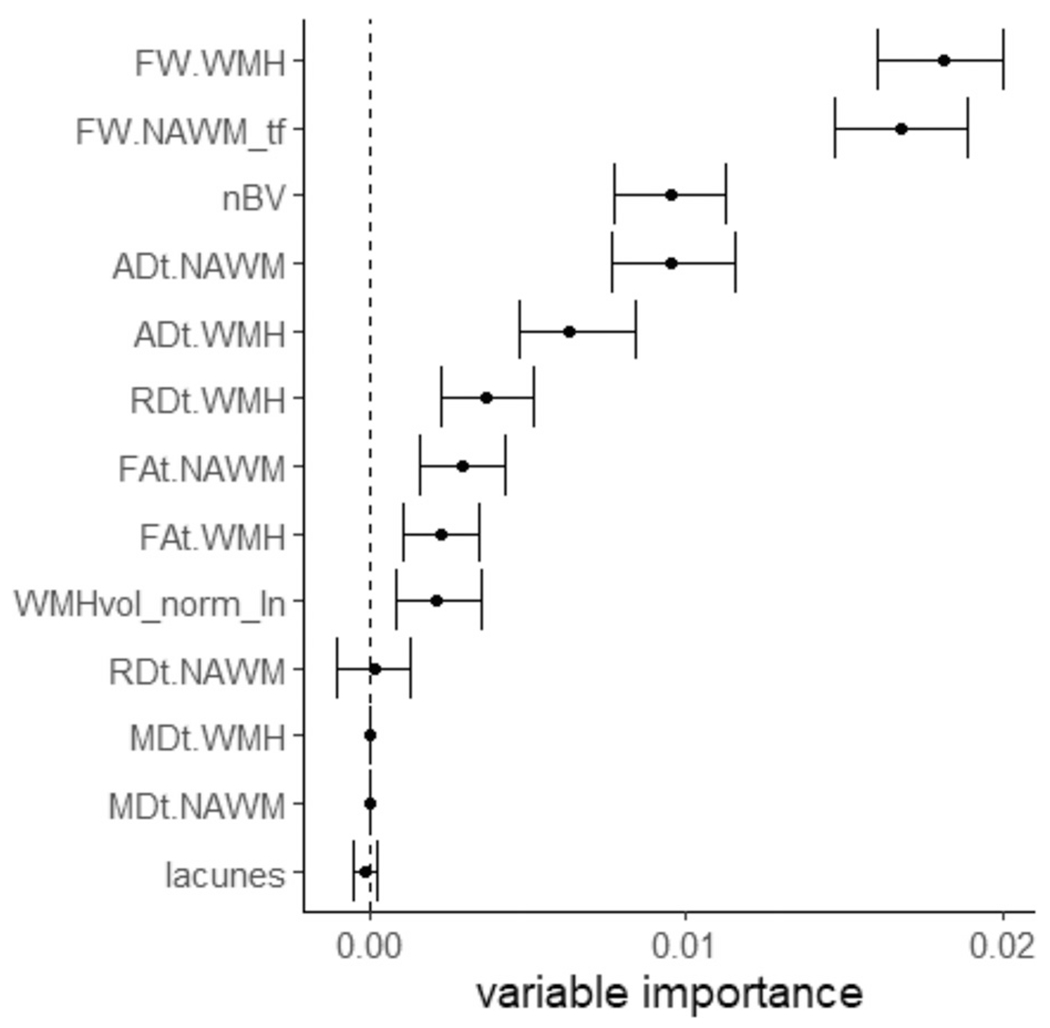
Extracellular free water (FW) increases are suggested to better provide pathophysiological information in brain aging than conventional biomarkers such as fractional anisotropy. The aim of the present study was to determine the relationship between conventional biomarkers, FW in white matter hyperintensities (WMH), FW in normal appearing white matter (NAWM) and in white matter tracts and executive functions (EF) with a speed component in elderly persons. We examined 226 healthy elderly participants (median age 69.83 years, IQR: 56.99-74.42) who underwent brain MRI and neuropsychological examination. FW in WMH and in NAWM as well as FW corrected diffusion metrics and measures derived from conventional MRI (white matter hyperintensities, brain volume, lacunes) were used in partial correlation (adjusted for age) to assess their correlation with EF with a speed component. Random forest analysis was used to assess the relative importance of these variables as determinants. Lastly, linear regression analyses of FW in white matter tracts corrected for risk factors of cognitive and white matter deterioration, were used to examine the role of specific tracts on EF with a speed component, which were then ranked with random forest regression. Partial correlation analyses revealed that almost all imaging metrics showed a significant association with EF with a speed component (r = -0.213 - 0.266). Random forest regression highlighted FW in WMH and in NAWM as most important among all diffusion and structural MRI metrics. The fornix (R=0.421, p = 0.018) and the corpus callosum (genu (R = 0.418, p = 0.021), prefrontal (R = 0.416, p = 0.026), premotor (R = 0.418, p = 0.021)) were associated with EF with a speed component in tract based regression analyses and had highest variables importance. In a normal aging population FW in WMH and NAWM is more closely related to EF with a speed component than standard DTI and brain structural measures. Higher amounts of FW in the fornix and the frontal part of the corpus callosum leads to deteriorating EF with a speed component.
细胞外自由水 (FW) 的增加被认为比分数各向异性等传统生物标志物更好地提供脑老化的病理生理学信息。本研究的目的是确定常规生物标志物、脑白质高信号区 (WMH) 中的 FW、正常表现白质 (NAWM) 中的 FW 以及与白质束和执行功能 (EF) 与速度成分的关系在老年人中。我们检查了 226 名健康的老年参与者(中位年龄 69.83 岁,IQR:56.99-74.42),他们接受了脑部 MRI 和神经心理学检查。WMH 和 NAWM 中的 FW 以及经 FW 校正的扩散指标和来自常规 MRI 的测量值(脑白质高信号、脑容量、腔隙)用于部分相关分析(调整年龄),以评估它们与 EF 与速度成分的相关性。随机森林分析用于评估这些变量作为决定因素的相对重要性。最后,使用线性回归分析校正认知和白质恶化的危险因素后,白质束中的 FW,以检查特定束对 EF 与速度成分的作用,然后使用随机森林回归对其进行排序。部分相关分析显示,几乎所有成像指标均与 EF 与速度成分呈显著相关性(r=-0.213-0.266)。随机森林回归突出显示 WMH 和 NAWM 中的 FW 在所有扩散和结构 MRI 指标中最重要。穹窿(R=0.421,p=0.018)和胼胝体(膝部(R=0.418,p=0.021)、前额叶(R=0.416,p=0.026)、运动前(R=0.418,p=0.021))与基于束的回归分析中的 EF 与速度成分相关,并且具有最高的变量重要性。在正常衰老人群中,WMH 和 NAWM 中的 FW 与 EF 与速度成分的关系比标准 DTI 和脑结构测量更密切。穹窿和胼胝体前部 FW 含量增加会导致 EF 与速度成分恶化。