School of Biochemistry and Immunology, Trinity Biomedical Sciences Institute, Trinity College Dublin, Dublin 2, Ireland.
Eur J Immunol. 2022 Jul;52(7):1024-1034. doi: 10.1002/eji.202149410. Epub 2022 May 24.
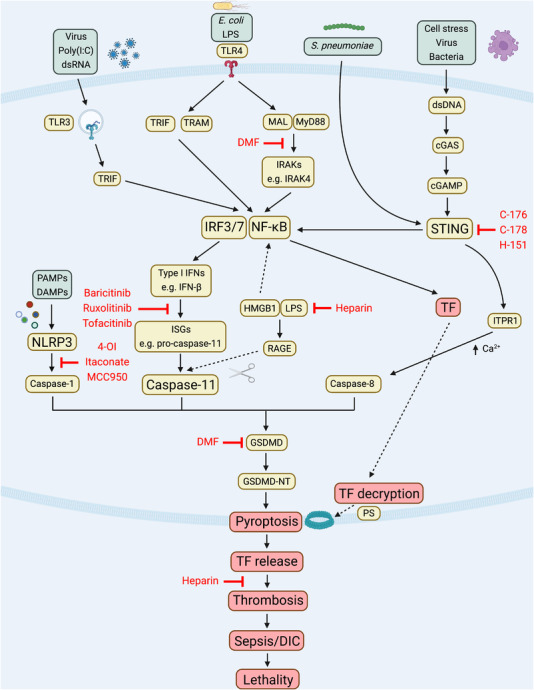
Activation of the coagulation cascade is a critical, evolutionarily conserved mechanism that maintains hemostasis by rapidly forming blood clots in response to blood-borne infections and damaged blood vessels. Coagulation is a key component of innate immunity since it prevents bacterial dissemination and can provoke inflammation. The term immunothrombosis describes the process by which the innate immune response drives aberrant coagulation, which can result in a lethal condition termed disseminated intravascular coagulation, often seen in sepsis. In this review, we describe the recently uncovered molecular mechanisms underlying inflammasome- and STING-driven immunothrombosis induced by bacterial and viral infections, culminating in tissue factor (TF) activation and release. Current anticoagulant therapeutics, while effective, are associated with a life-threatening bleeding risk, requiring the urgent development of new treatments. Targeting immunothrombosis may provide a safer option. Thus, we highlight preclinical tools which target TF and/or block canonical (NLRP3) or noncanonical (caspase-11) inflammasome activation as well as STING-driven TF release and discuss clinically approved drugs which block key immunothrombotic processes and, therefore, may be redeployed as safer anticoagulants.
凝血级联的激活是一种关键的、进化上保守的机制,通过迅速形成血凝块来响应血液传播的感染和受损的血管,从而维持止血。凝血是先天免疫的关键组成部分,因为它可以防止细菌传播并引发炎症。免疫血栓形成一词描述了先天免疫反应驱动异常凝血的过程,这可能导致一种称为弥散性血管内凝血的致命情况,这种情况通常在败血症中出现。在这篇综述中,我们描述了最近发现的细菌和病毒感染引起的炎症小体和 STING 驱动的免疫血栓形成的分子机制,最终导致组织因子 (TF) 的激活和释放。目前的抗凝治疗药物虽然有效,但与危及生命的出血风险相关,因此迫切需要开发新的治疗方法。针对免疫血栓形成可能是一种更安全的选择。因此,我们重点介绍了针对 TF 以及阻断经典(NLRP3)或非经典(caspase-11)炎症小体激活和 STING 驱动的 TF 释放的临床前工具,并讨论了可阻断关键免疫血栓形成过程的临床批准药物,因此可重新用作更安全的抗凝剂。