Han Yupeng, Qiu Liangcheng, Wu Haixing, Song Zhiwei, Ke Peng, Wu Xiaodan
Department of Anesthesiology, Fujian Provincial Hospital, Shengli Clinical Medical College of Fujian Medical University, Fuzhou, Fujian, People's Republic of China.
Fujian Provincial Key Laboratory of Critical Care Medicine, Fuzhou, Fujian, People's Republic of China.
J Inflamm Res. 2024 Jun 5;17:3629-3639. doi: 10.2147/JIR.S465978. eCollection 2024.
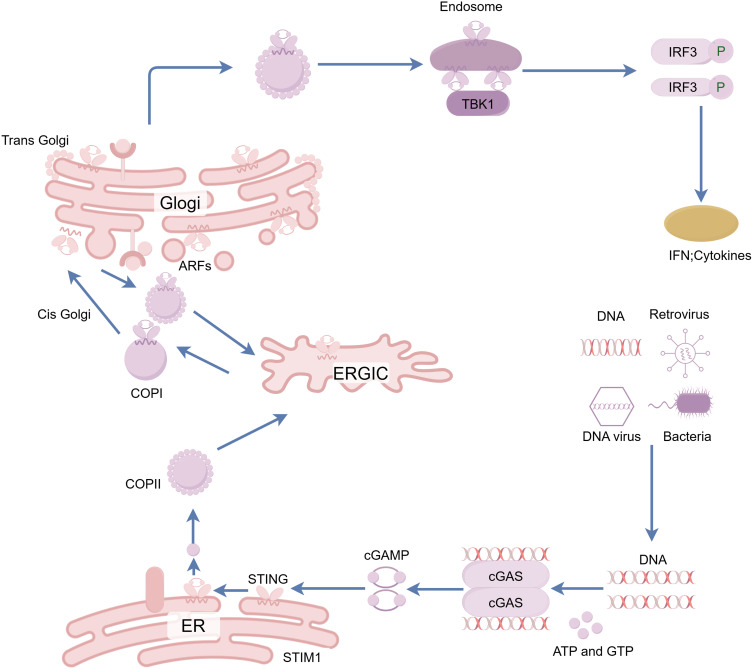
Sepsis is a severe systemic inflammatory response commonly occurring in infectious diseases, caused by infection with virulent pathogens. In the pathogenesis of sepsis, the cyclic guanosine monophosphate (GMP)-adenosine monophosphate (AMP) synthase-stimulator of interferon genes (cGAS-STING) signaling pathway serves a crucial role as a fundamental immunoregulatory mechanism. This signaling pathway activates STING upon recognizing intracellular DNA damage and pathogen-derived DNA, subsequently inducing the production of numerous inflammatory mediators, including interferon and inflammatory cytokines, which in turn trigger an inflammatory response. The aim of this paper is to explore the activation mechanism of the cGAS-STING signaling pathway in sepsis and its impact on inflammatory regulation. By delving into the mechanism of action of the cGAS-STING signaling pathway in sepsis, we aim to identify new therapeutic strategies for the treatment and prevention of sepsis.
脓毒症是一种严重的全身炎症反应,常见于传染病中,由感染毒性病原体引起。在脓毒症的发病机制中,环磷酸鸟苷(GMP)-环磷酸腺苷(AMP)合成酶-干扰素基因刺激因子(cGAS-STING)信号通路作为一种基本的免疫调节机制发挥着关键作用。该信号通路在识别细胞内DNA损伤和病原体衍生的DNA后激活STING,随后诱导包括干扰素和炎性细胞因子在内的多种炎性介质的产生,进而引发炎症反应。本文旨在探讨脓毒症中cGAS-STING信号通路的激活机制及其对炎症调节的影响。通过深入研究cGAS-STING信号通路在脓毒症中的作用机制,我们旨在确定治疗和预防脓毒症的新治疗策略。