Departamento de Métodos Quantitativos, Centro de Ciências Exatas e Tecnologia, Universidade Federal do Estado do Rio de Janeiro, Rio de Janeiro, Brazil.
Escola de Medicina e Cirurgia, Universidade Federal do Estado do Rio de Janeiro, Rio de Janeiro, Brazil.
J Infect Public Health. 2022 Jun;15(6):621-627. doi: 10.1016/j.jiph.2022.04.013. Epub 2022 Apr 28.
COVID-19 has shown a broad clinical spectrum, ranging from asymptomatic to mild, moderate, and severe infections. Many symptoms have already been identified as typical of COVID-19, but few studies show how they can be useful in identifying clusters of patients with different severity of illness. This interpretation may help to recognize the different profiles of symptoms of COVID-19 expressed in a population at certain time. The aim of this study was to identify symptom-based clusters of hospitalized patients with severe acute respiratory illness by SARS-CoV-2 in Brazil. The clusters were evaluated based on sociodemographic characteristics, admission to the Intensive Care Unit (ICU), use of respiratory support, and outcome.
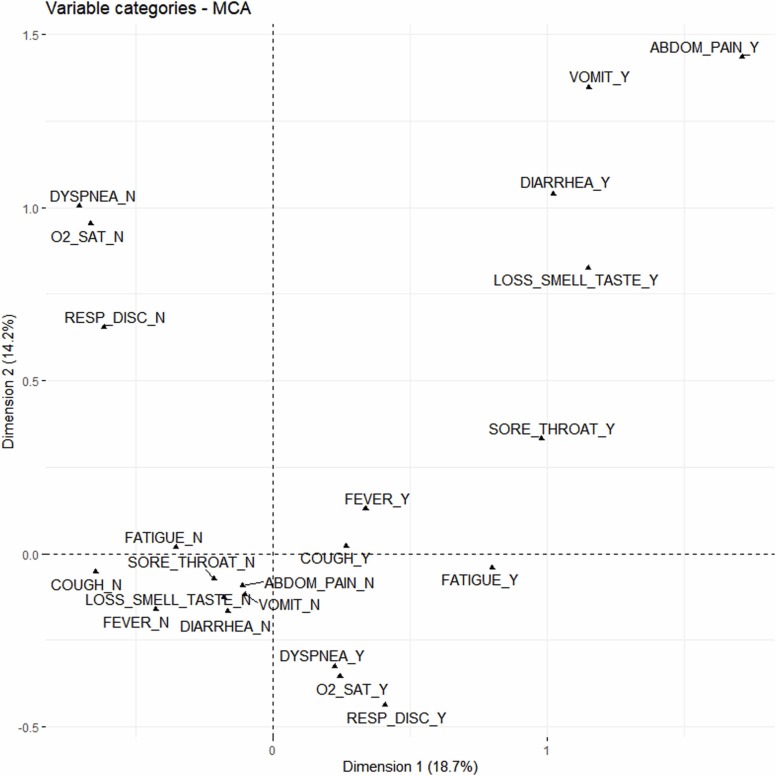
The Multiple Correspondence Analysis (MCA)-based cluster analysis was applied to symptoms presented before admission. Pearson's chi-square test was used to compare the proportions of symptoms between the clusters and to examine differences in the calculated rates for the following variables: sex, age group, race, Brazilian region, use of respiratory support, admission to the ICU and outcome.
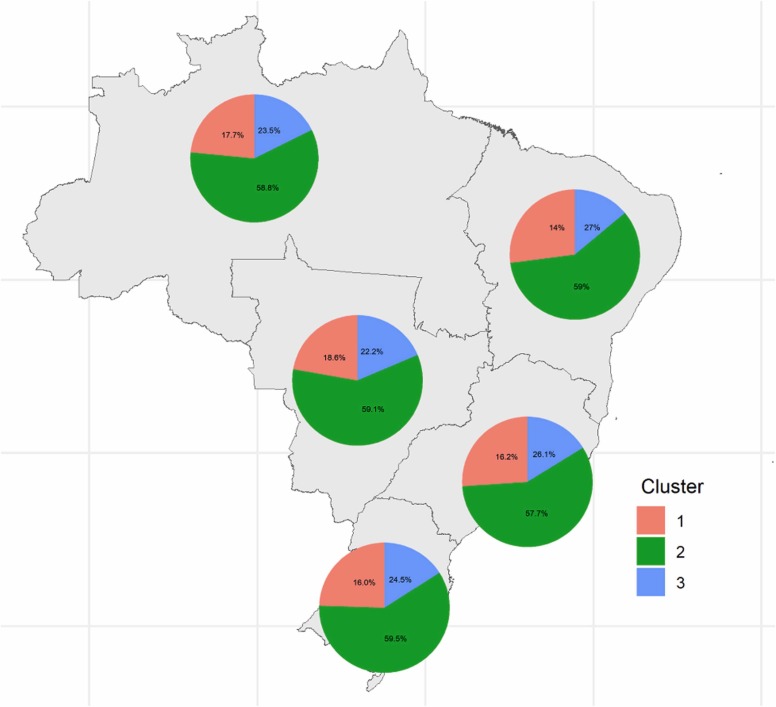
Three COVID-19 clusters with distinct symptom profiles were identified by MCA-based cluster analysis. Cluster 1 had the mildest severity profile, with the lowest frequencies for most symptoms investigated. Cluster 2 had a severe respiratory profile, with the highest frequencies of patients with dyspnea, respiratory discomfort and O2 saturation< 95%. Cluster 2 was also the most prevalent in all Brazilian regions and had the highest percentages of patients who used invasive respiratory support (27.4%) (p-value<0.001), were admitted to the ICU (42.6%) (p -value<0.001) and died (39.0%) (p-value<0.001). Cluster 3 had a prominent profile of gastrointestinal symptoms.
The study identified three distinct COVID-19 clusters based on the symptoms presented by patients with severe acute respiratory illness by SARS-CoV-2, but without distinction in their prevalence in the Brazilian regions.
COVID-19 表现出广泛的临床谱,从无症状到轻度、中度和重度感染不等。许多症状已被确定为 COVID-19 的典型症状,但很少有研究表明它们如何有助于识别不同严重程度疾病患者的聚类。这种解释可能有助于识别在特定时间内人群中 COVID-19 表达的不同症状特征。本研究旨在识别巴西因 SARS-CoV-2 导致严重急性呼吸道疾病住院患者的基于症状的聚类。这些聚类是基于社会人口统计学特征、入住重症监护病房(ICU)、使用呼吸支持和结局进行评估的。
应用基于多元对应分析(MCA)的聚类分析方法对入院前出现的症状进行分析。采用 Pearson 卡方检验比较聚类之间症状的比例,并检查以下变量的计算率之间的差异:性别、年龄组、种族、巴西地区、呼吸支持的使用、入住 ICU 和结局。
通过 MCA 聚类分析确定了三个具有不同症状特征的 COVID-19 聚类。聚类 1 具有最轻微的严重程度特征,大多数研究的症状频率最低。聚类 2 具有严重的呼吸系统特征,呼吸困难、呼吸不适和 O2 饱和度<95%的患者频率最高。聚类 2 也是所有巴西地区最常见的,使用有创性呼吸支持的患者比例最高(27.4%)(p 值<0.001),入住 ICU 的比例最高(42.6%)(p 值<0.001),死亡率最高(39.0%)(p 值<0.001)。聚类 3 具有突出的胃肠道症状特征。
本研究根据 SARS-CoV-2 导致严重急性呼吸道疾病患者的症状,识别了三个不同的 COVID-19 聚类,但在巴西地区的流行率方面没有区别。