
基于非靶向血清代谢组学研究绿豆肽对高脂饮食诱导的胰岛素抵抗小鼠的改善作用
Improvement in Mung Bean Peptide on High-Fat Diet-Induced Insulin Resistance Mice Using Untargeted Serum Metabolomics.
作者信息
Li Lina, Tian Yu, Feng Yuchao, Zhang Shu, Jiang Yingjun, Zhang Yiwei, Zhan Yuanyuan, Wang Changyuan
机构信息
College of Food, Heilongjiang Bayi Agricultural University, Daqing, China.
Library, Heilongjiang Bayi Agricultural University, Daqing, China.
出版信息
Front Nutr. 2022 Apr 29;9:893270. doi: 10.3389/fnut.2022.893270. eCollection 2022.
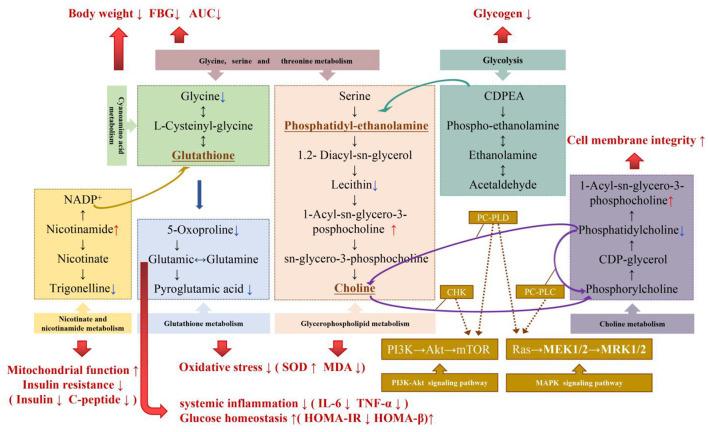
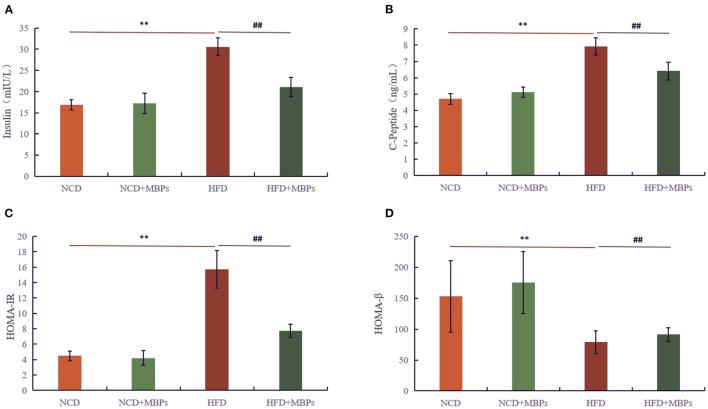
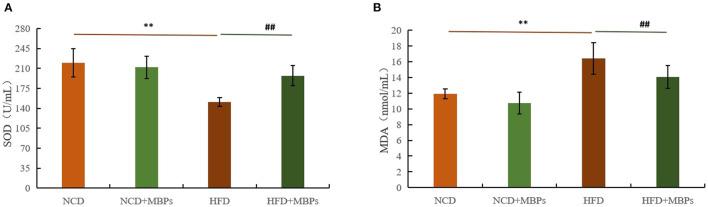
This study aimed to elucidate the potential regulatory mechanism of mung bean peptides (MBPs) on glucolipid metabolism in insulin-resistant mice induced by high-fat diet (HFD) using untargeted serum metabolomics, enzyme linked immunosorbent assay (ELISA), intraperitoneal injection glucose tolerance test (IPGTT), insulin tolerance test (IPITT), and hematoxylin-eosin staining (H&E). The regulatory effect of MBPs for alleviating insulin resistance was studied by measuring body weight, fasting blood glucose (FBG) and serum insulin levels, C-Peptide levels, inflammatory and antioxidant factors, and histopathological observation of C57BL/6 mice. The experimental results showed that dietary intervention with MBPs (245 mg/kg/d) for 5 weeks significantly relieved insulin resistance in HFD mice. The body weight, insulin resistance index, and the levels of FBG, C-Peptide, IL-6, TNF-α, and MDA in the serum of HFD mice significantly decreased ( < 0.05). Conversely, SOD content and pancreatic β cell function index significantly increased ( < 0.05), and the damaged pancreatic tissue was repaired. One biomarker associated with insulin resistance was glycine. In addition, there were four important differential metabolites: pyroglutamate, D-glutamine, aminoadipic acid, and nicotinamide, involved in 12 metabolic pathway changes. It was found that MBPs may regulate amino acid, glycerol phospholipid, fatty acid, alkaloid, and nicotinamide metabolism to regulate the metabolic profile of HFD mice in a beneficial direction.
本研究旨在利用非靶向血清代谢组学、酶联免疫吸附测定(ELISA)、腹腔注射葡萄糖耐量试验(IPGTT)、胰岛素耐量试验(IPITT)和苏木精-伊红染色(H&E),阐明绿豆肽(MBPs)对高脂饮食(HFD)诱导的胰岛素抵抗小鼠糖脂代谢的潜在调控机制。通过测量C57BL/6小鼠的体重、空腹血糖(FBG)、血清胰岛素水平、C肽水平、炎症和抗氧化因子以及组织病理学观察,研究了MBPs对缓解胰岛素抵抗的调节作用。实验结果表明,用MBPs(245mg/kg/d)进行5周的饮食干预可显著缓解HFD小鼠的胰岛素抵抗。HFD小鼠的体重、胰岛素抵抗指数以及血清中FBG、C肽、IL-6、TNF-α和MDA的水平显著降低(<0.05)。相反,超氧化物歧化酶(SOD)含量和胰腺β细胞功能指数显著升高(<0.05),受损的胰腺组织得到修复。一种与胰岛素抵抗相关的生物标志物是甘氨酸。此外,有四种重要的差异代谢物:焦谷氨酸、D-谷氨酰胺、氨基己二酸和烟酰胺,参与了12条代谢途径的变化。研究发现,MBPs可能通过调节氨基酸、甘油磷脂、脂肪酸、生物碱和烟酰胺代谢,使HFD小鼠的代谢谱向有益方向转变。





 Zotero 插件