De Lorenzo Rebecca, Montagna Marco, Bossi Eleonora, Vitali Giordano, Taino Alba, Cilla Marta, Pata Giulia, Lazorova Ludmilla, Pesenti Riccardo, Pomaranzi Chiara, Bussolari Cecilia, Martinenghi Sabina, Bordonaro Nicoletta, Di Napoli Davide, Rizzardini Giuliano, Cogliati Chiara, Morici Nuccia, Rovere-Querini Patrizia
School of Medicine, Vita-Salute San Raffaele University, Milan, Italy.
Unit of Hospital-Primary Care Embedding, San Raffaele Hospital, Milan, Italy.
Front Med (Lausanne). 2022 Apr 27;9:892962. doi: 10.3389/fmed.2022.892962. eCollection 2022.
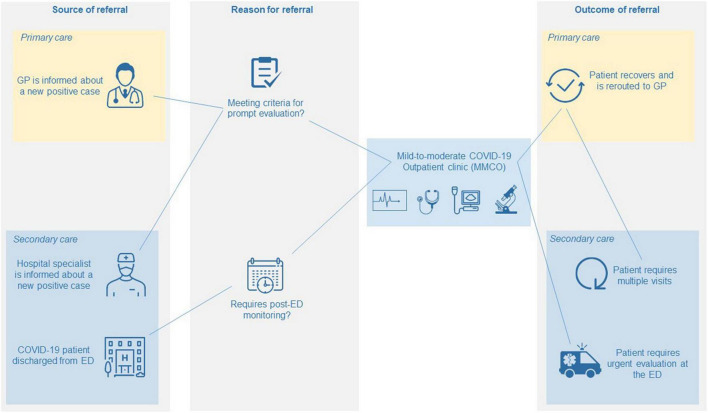
To report a preliminary experience of outpatient management of patients with Coronavirus disease 2019 (COVID-19) through an innovative approach of healthcare delivery.
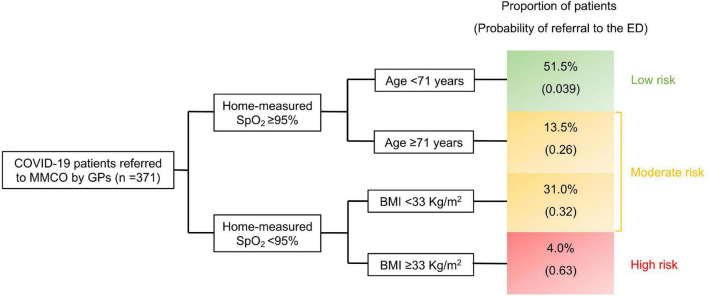
Patients evaluated at the Mild-to-Moderate COVID-19 Outpatient clinics (MMCOs) of San Raffaele University Hospital and Luigi Sacco University Hospital in Milan, Italy, from 1 October 2020 to 31 October 2021 were included. Patients were referred by general practitioners (GPs), Emergency Department (ED) physicians or hospital specialists (HS) in case of moderate COVID-19. A classification and regression tree (CART) model predicting ED referral by MMCO physicians was developed to aid GPs identify those deserving immediate ED admission. Cost-effectiveness analysis was also performed.
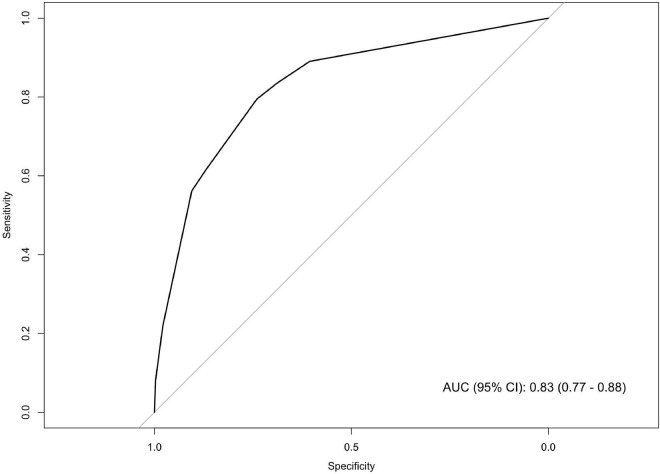
A total of 660 patients were included. The majority (70%) was referred by GPs, 21% by the ED and 9% by HS. Patients referred by GPs had more severe disease as assessed by peripheral oxygen saturation (SpO), ratio of arterial oxygen partial pressure to fractional inspired oxygen (PaO/FiO), C-reactive protein (CRP) levels and interstitial involvement at lung ultrasound. Among them, 18% were addressed to the ED following MMCO assessment. CART analysis identified three independent predictors, namely home-measured SpO, age and body mass index (BMI), that robustly divide patients into risk groups of COVID-19 severity. Home-measured SpO < 95% and BMI ≥ 33 Kg/m defined the group. The model yielded an accuracy (95% CI) of 83 (77-88)%. Outpatient management of COVID-19 patients allowed the national healthcare system to spare 1,490,422.05 € when compared with inpatient care.
Mild-to-moderate COVID-19 outpatient clinics were effective and sustainable in managing COVID-19 patients and allowed to alleviate pressure on EDs and hospital wards, favoring effort redirection toward non-COVID-19 patients.
报告通过创新的医疗服务方式对2019冠状病毒病(COVID-19)患者进行门诊管理的初步经验。
纳入2020年10月1日至2021年10月31日在意大利米兰圣拉斐尔大学医院和路易吉·萨科大学医院的轻至中度COVID-19门诊(MMCO)接受评估的患者。中度COVID-19患者由全科医生(GP)、急诊科(ED)医生或医院专科医生(HS)转诊。开发了一种预测MMCO医生将患者转诊至急诊科的分类回归树(CART)模型,以帮助全科医生识别那些需要立即入住急诊科的患者。还进行了成本效益分析。
共纳入660例患者。大多数(70%)由全科医生转诊,21%由急诊科转诊,9%由医院专科医生转诊。根据外周血氧饱和度(SpO)、动脉血氧分压与吸入氧分数之比(PaO/FiO)、C反应蛋白(CRP)水平和肺部超声检查的间质受累情况评估,由全科医生转诊的患者病情更严重。其中,18%的患者在MMCO评估后被送往急诊科。CART分析确定了三个独立预测因素,即家庭自测SpO、年龄和体重指数(BMI),这些因素可将患者有力地分为COVID-19严重程度的风险组。家庭自测SpO<95%且BMI≥33 Kg/m²定义为高危组。该模型的准确率(95%CI)为83(77-88)%。与住院治疗相比,COVID-19患者的门诊管理使国家医疗系统节省了1,490,422.