De Lorenzo Rebecca, Magnaghi Cristiano, Cinel Elena, Vitali Giordano, Martinenghi Sabina, Mazza Mario G, Nocera Luigi, Cilla Marta, Damanti Sarah, Compagnone Nicola, Ferrante Marica, Conte Caterina, Benedetti Francesco, Ciceri Fabio, Rovere-Querini Patrizia
Medical Residency Program, Vita-Salute San Raffaele University, Milan, Italy.
Division of Immunology, Transplantation and Infectious Diseases, San Raffaele Hospital, Milan, Italy.
Front Med (Lausanne). 2022 Feb 23;9:781410. doi: 10.3389/fmed.2022.781410. eCollection 2022.
To assess the prevalence of respiratory sequelae of Coronavirus disease 2019 (COVID-19) survivors at 6 months after hospital discharge and develop a model to identify at-risk patients.
In this prospective cohort study, hospitalized, non-critical COVID-19 patients evaluated at 6-month follow-up between 26 August, 2020 and 16 December, 2020 were included. Primary outcome was respiratory dysfunction at 6 months, defined as at least one among tachypnea at rest, percent predicted 6-min walking distance at 6-min walking test (6MWT) ≤ 70%, pre-post 6MWT difference in Borg score ≥ 1 or a difference between pre- and post-6MWT oxygen saturation ≥ 5%. A nomogram-based multivariable logistic regression model was built to predict primary outcome. Validation relied on 2000-resample bootstrap. The model was compared to one based uniquely on degree of hypoxemia at admission.
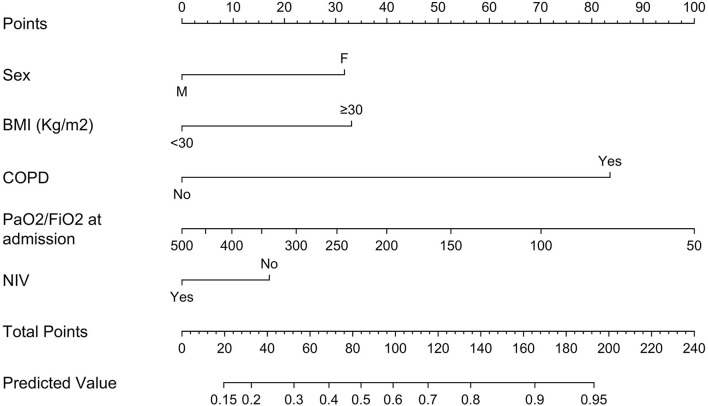
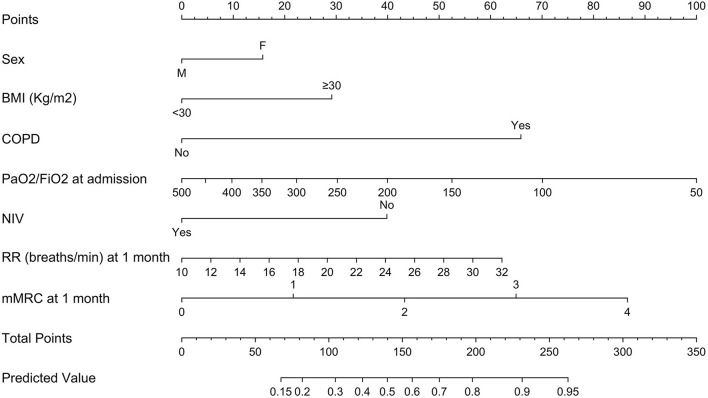
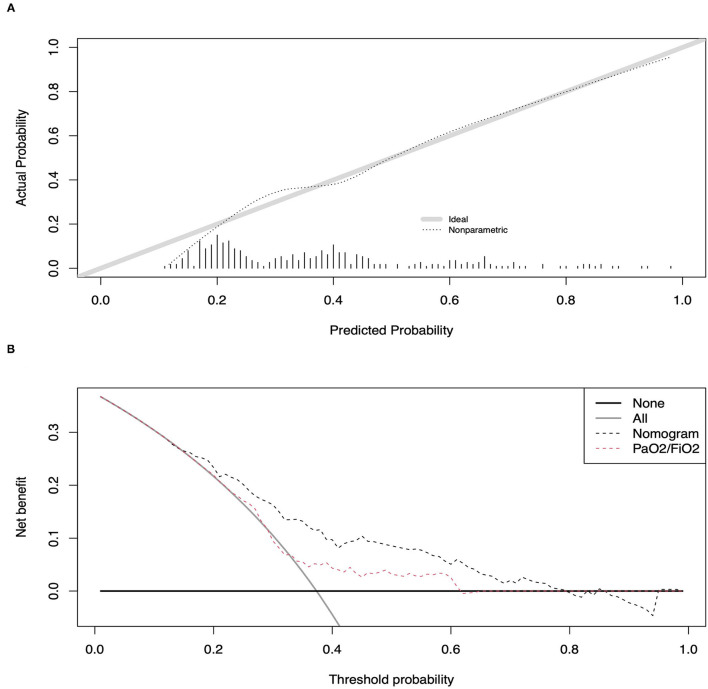
Overall, 316 patients were included, of whom 118 (37.3%) showed respiratory dysfunction at 6 months. The nomogram relied on sex, obesity, chronic obstructive pulmonary disease, degree of hypoxemia at admission, and non-invasive ventilation. It was 73.0% (95% confidence interval 67.3-78.4%) accurate in predicting primary outcome and exhibited minimal departure from ideal prediction. Compared to the model including only hypoxemia at admission, the nomogram showed higher accuracy (73.0 vs 59.1%, < 0.001) and greater net-benefit in decision curve analyses. When the model included also respiratory data at 1 month, it yielded better accuracy (78.2 vs. 73.2%) and more favorable net-benefit than the original model.
The newly developed nomograms accurately identify patients at risk of persistent respiratory dysfunction and may help inform clinical priorities.
评估2019冠状病毒病(COVID-19)幸存者出院6个月后呼吸后遗症的患病率,并建立一个模型来识别高危患者。
在这项前瞻性队列研究中,纳入了2020年8月26日至2020年12月16日期间在6个月随访时接受评估的住院非重症COVID-19患者。主要结局是6个月时的呼吸功能障碍,定义为静息时呼吸急促、6分钟步行试验(6MWT)中预测的6分钟步行距离百分比≤70%、6MWT前后Borg评分差异≥1或6MWT前后血氧饱和度差异≥5%中的至少一项。构建了基于列线图的多变量逻辑回归模型来预测主要结局。验证依赖于2000次重采样自助法。将该模型与仅基于入院时低氧血症程度的模型进行比较。
总体而言,纳入了316例患者,其中118例(37.3%)在6个月时出现呼吸功能障碍。列线图基于性别、肥胖、慢性阻塞性肺疾病、入院时低氧血症程度和无创通气。其预测主要结局的准确率为73.0%(95%置信区间67.3-78.4%),与理想预测的偏差最小。与仅包括入院时低氧血症的模型相比,列线图在决策曲线分析中显示出更高的准确率(73.0%对59.1%,P<0.001)和更大的净效益。当模型还纳入1个月时的呼吸数据时,其准确率(78.2%对73.2%)更高,净效益比原始模型更有利。
新开发的列线图准确识别了有持续呼吸功能障碍风险的患者,并可能有助于确定临床优先事项。