He Yu, Zhang Yuni, Li Fang, Shi Yuan
Department of Neonatology, Children's Hospital of Chongqing Medical University, Chongqing, China.
Chongqing Key Laboratory of Pediatrics, Children's Hospital of Chongqing Medical University, Chongqing, China.
Front Neurosci. 2022 Apr 29;16:849372. doi: 10.3389/fnins.2022.849372. eCollection 2022.
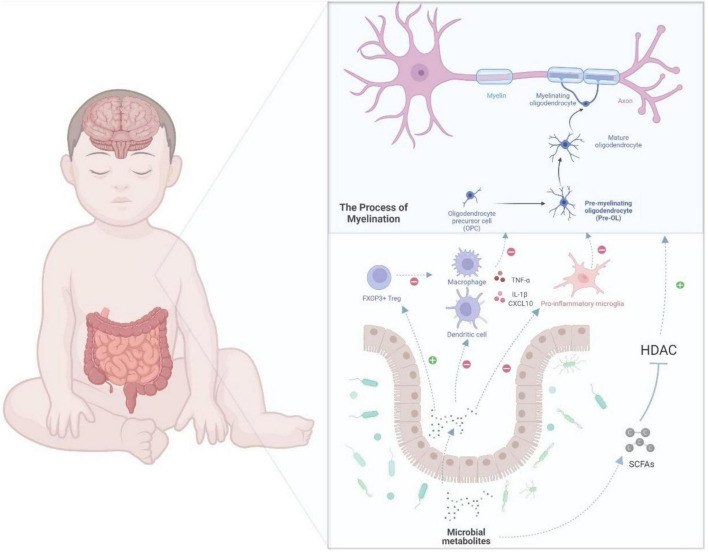
Very preterm infants who survive are at high risk of white matter injury (WMI). With a greater understanding of the pathogenesis of WMI, the gut microbiota has recently drawn increasing attention in this field. This review tries to clarify the possible mechanisms behind the communication of the gut bacteria and the immature brain the gut-brain axis. The gut microbiota releases signals, such as microbial metabolites. These metabolites regulate inflammatory and immune responses characterized by microglial activation, which ultimately impact the differentiation of pre-myelinating oligodendrocytes (pre-OLs) and lead to WMI. Moreover, probiotics and prebiotics emerge as a promising therapy to improve the neurodevelopmental outcome. However, future studies are required to clarify the function of these above products and the optimal time for their administration within a larger population. Based on the existing evidence, it is still too early to recommend probiotics and prebiotics as effective treatments for WMI.
存活的极早产儿有发生白质损伤(WMI)的高风险。随着对WMI发病机制的深入了解,肠道微生物群最近在该领域受到越来越多的关注。这篇综述试图阐明肠道细菌与未成熟大脑之间通讯——即肠-脑轴背后的可能机制。肠道微生物群会释放信号,如微生物代谢产物。这些代谢产物调节以小胶质细胞激活为特征的炎症和免疫反应,最终影响少突胶质前体细胞(pre-OLs)的分化并导致WMI。此外,益生菌和益生元作为改善神经发育结局的一种有前景的疗法出现。然而,需要未来的研究在更大规模人群中阐明上述产品的功能及其给药的最佳时间。基于现有证据,推荐将益生菌和益生元作为WMI的有效治疗方法仍为时过早。