Duarte-Silva Eduardo, Meuth Sven G, Peixoto Christina Alves
Laboratory of Ultrastructure, Aggeu Magalhães Institute (IAM), Recife, Brazil.
Postgraduate Program in Biosciences and Biotechnology for Health (PPGBBS), Oswaldo Cruz Foundation (FIOCRUZ-PE)/Aggeu Magalhães Institute (IAM), Recife, Brazil.
Front Neurosci. 2022 Apr 28;16:885031. doi: 10.3389/fnins.2022.885031. eCollection 2022.
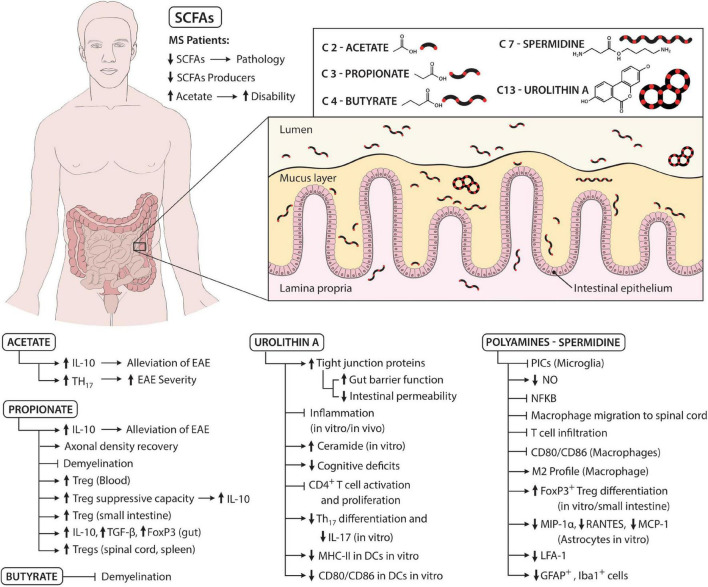
Metabolites produced by the gut microbiota have been shown to play an important role in numerous inflammatory, neuropsychiatric, and neurodegenerative diseases. Specifically, microbial metabolites have been implicated in the modulation of innate and adaptive immunity, especially in the generation of regulatory T cells (Tregs), which are key regulators of multiple sclerosis (MS) pathogenesis. Furthermore, they affect processes relevant to MS pathophysiology, such as inflammation and demyelination, which makes them attractive molecules to be explored as therapeutics in MS. In this review, we discuss the importance of these metabolites as factors contributing to disease pathogenesis and as therapeutic targets in MS. Establishing an improved understanding of these gut-microbiota derived metabolites may provide new avenues for the treatment of MS.
肠道微生物群产生的代谢产物已被证明在众多炎症性、神经精神性和神经退行性疾病中发挥重要作用。具体而言,微生物代谢产物与先天性和适应性免疫的调节有关,尤其是在调节性T细胞(Tregs)的产生中,而调节性T细胞是多发性硬化症(MS)发病机制的关键调节因子。此外,它们还影响与MS病理生理学相关的过程,如炎症和脱髓鞘,这使得它们成为有吸引力的、可作为MS治疗药物进行探索的分子。在这篇综述中,我们讨论了这些代谢产物作为导致疾病发病的因素以及作为MS治疗靶点的重要性。更好地了解这些源自肠道微生物群的代谢产物可能为MS的治疗提供新途径。