Stolper Hanna, van Doesum Karin, Steketee Majone
Department of Psychology Education and Child Studies, Erasmus University Rotterdam, Rotterdam, Netherlands.
Department of Clinical Psychology, Radboud University Nijmegen, Nijmegen, Netherlands.
Front Psychiatry. 2022 Apr 28;13:781556. doi: 10.3389/fpsyt.2022.781556. eCollection 2022.
A multiple case-study in which each case was evaluated by adult and child mental health professionals who used an integrated family approach in their treatments. In this approach, treatment focuses on the mental disorders of the parents as well as on the development of the young child and family relationships. This study evaluated the experiences of professionals from adult and child mental health services using this approach. The aim of the study is identifying key elements of this approach, processes involved in treatment, and barriers to its success, with the aim of contributing to the development of practice based integrated mental health care for the whole family.
Parental mental disorders have an impact on parenting and child development. To stop detrimental cascade effects and prevent parent and child from being caught up in the intergenerational transmission of psychopathology, an integrated family approach in mental health care is needed. Methods: A qualitative case study design using a grounded theory approach. Data were collected through 19 group interviews of professionals ( = 37) from adult and infant mental health teams who worked together in the treatment of a family.
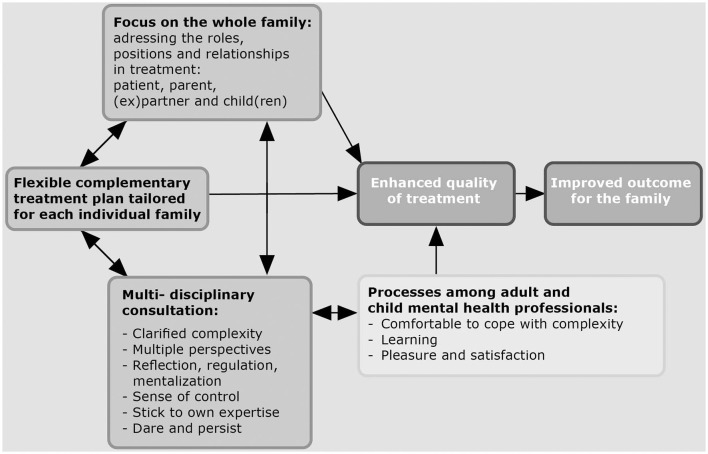
Professionals from the two services were comfortable coping with complexity and felt supported to perform their treatments by staying in touch with each other in multi-disciplinary consultations. They indicated that by attuning the treatment components to each other and tailoring them to the capabilities of the family, their treatments had more impact. A flexible attitude of all involved professionals and commitment to the interest of all family members was essential.
According to professionals, treatment with an integrated family approach in mental health care is of value for families by addressing the distinct roles, positions and relationships, by implementing a flexible complementary treatment plan, and by empowering professionals by multi-disciplinary consultations.
一项多案例研究,其中每个案例均由成人和儿童心理健康专业人员进行评估,他们在治疗中采用综合家庭治疗方法。在这种方法中,治疗重点关注父母的精神障碍以及幼儿的发展和家庭关系。本研究评估了使用这种方法的成人和儿童心理健康服务专业人员的经验。该研究的目的是确定这种方法的关键要素、治疗过程以及成功的障碍,以期为基于实践的全家庭综合精神卫生保健的发展做出贡献。
父母的精神障碍会对养育子女和儿童发展产生影响。为了阻止有害的连锁反应,并防止父母和子女陷入精神病理学的代际传递,需要在精神卫生保健中采用综合家庭治疗方法。方法:采用扎根理论方法的定性案例研究设计。通过对来自成人和婴儿心理健康团队的专业人员(n = 37)进行19次小组访谈收集数据,这些专业人员共同参与一个家庭的治疗。
来自这两种服务的专业人员能够从容应对复杂性,并通过在多学科咨询中相互保持联系而感到在进行治疗时有支持。他们表示,通过使治疗组件相互协调并根据家庭的能力进行调整,他们的治疗效果更佳。所有相关专业人员的灵活态度以及对所有家庭成员利益的承诺至关重要。
专业人员认为,在精神卫生保健中采用综合家庭治疗方法对家庭具有价值,因为它解决了不同的角色、地位和关系,实施了灵活的补充治疗计划,并通过多学科咨询增强了专业人员的能力。