Yong Loo Lin School of Medicine, National University of Singapore, Singapore, Singapore.
Division of Respiratory & Critical Care Medicine, Department of Medicine, National University Hospital, Singapore, Singapore.
J Med Internet Res. 2022 May 16;24(5):e33380. doi: 10.2196/33380.
The recent focus on the critical setting, especially with the COVID-19 pandemic, has highlighted the need for minimizing contact-based care and increasing robotic use. Robotics is a rising field in the context of health care, and we sought to evaluate the use of robots in critical care settings.
Although robotic presence is prevalent in the surgical setting, its role in critical care has not been well established. We aimed to examine the uses and limitations of robots for patients who are critically ill.
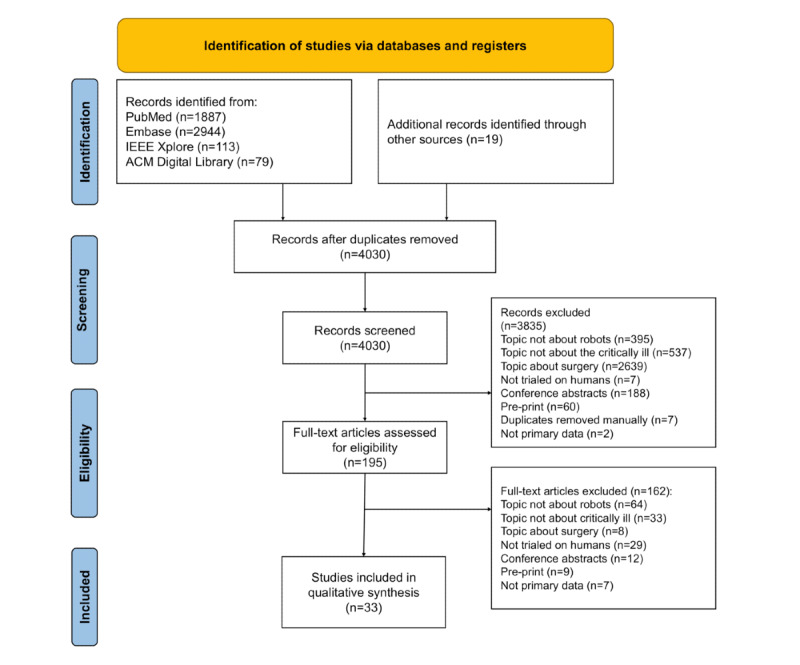
This systematic review was performed according to the PRISMA (Preferred Reporting Items for Systematic Reviews and Meta-Analyses) guidelines. MEDLINE, Embase, IEEE Xplore, and ACM Library were searched from their inception to December 23, 2021. Included studies involved patients requiring critical care, both in intensive care units or high-dependency units, or settings that required critical care procedures (eg, intubation and cardiopulmonary resuscitation). Randomized trials and observational studies were included.
A total of 33 studies were included. The greatest application of robots in the intensive care unit was in the field of telepresence, whereby robots proved advantageous in providing a reduced response time, earlier intervention, and lower mortality rates. Challenges of telepresence included regulatory and financial barriers. In therapy and stroke rehabilitation, robots achieved superior clinical outcomes safely. Robotic use in patient evaluation and assessment was mainly through ultrasound evaluation, obtaining satisfactory to superior results with the added benefits of remote assessment, time savings, and increased efficiency. Robots in drug dispensing and delivery increased efficiency and generated cost savings. All the robots had technological limitations and hidden costs.
Overall, our results show that robotic use in critical care settings is a beneficial, effective, and well-received intervention that delivers significant benefits to patients, staff, and hospitals. Looking ahead, it is necessary to form strong ethical and legislative frameworks and overcome various regulatory and financial barriers.
PROSPERO International Prospective Register of Systematic Reviews CRD42021234162; https://www.crd.york.ac.uk/prospero/display_record.php?RecordID=234162.
最近对关键环境的关注,尤其是在 COVID-19 大流行期间,突出了减少基于接触的护理和增加机器人使用的必要性。机器人在医疗保健领域是一个新兴的领域,我们试图评估机器人在重症监护环境中的使用情况。
虽然机器人在手术环境中已经很普遍,但它们在重症监护中的作用尚未得到很好的确定。我们旨在研究机器人在重症患者中的使用和局限性。
本系统评价按照 PRISMA(系统评价和荟萃分析的首选报告项目)指南进行。从创建到 2021 年 12 月 23 日,在 MEDLINE、Embase、IEEE Xplore 和 ACM 库中进行了搜索。纳入的研究涉及需要重症监护的患者,包括在重症监护病房或高依赖病房,或需要重症监护程序(如插管和心肺复苏)的环境。纳入了随机试验和观察性研究。
共纳入 33 项研究。机器人在重症监护病房的最大应用是在远程临场领域,机器人在提供更短的响应时间、更早的干预和更低的死亡率方面具有优势。远程临场的挑战包括监管和财务障碍。在治疗和中风康复中,机器人安全地实现了更好的临床结果。机器人在患者评估和评估中的使用主要是通过超声评估,取得了令人满意到卓越的结果,并具有远程评估、节省时间和提高效率的额外好处。机器人在药物配药和输送方面提高了效率并节省了成本。所有机器人都存在技术限制和隐藏成本。
总的来说,我们的研究结果表明,机器人在重症监护环境中的使用是一种有益、有效且广受欢迎的干预措施,可为患者、工作人员和医院带来显著益处。展望未来,有必要制定强有力的伦理和立法框架,并克服各种监管和财务障碍。
PROSPERO 国际前瞻性系统评价注册库 CRD42021234162;https://www.crd.york.ac.uk/prospero/display_record.php?RecordID=234162。