Lee Young-Seok, Lee Dong-Hyun, Cho Dae-Chul, Han Inbo, Kim Chi Heon, Kwon Heum-Dai, Kim Kyoung-Tae
Department of Neurosurgery, Chung-Ang University College of Medicine, Seoul, Korea.
Department of Neurosurgery, Bio-Medical Research Institute Kyungpook National University Hospital, Daegu, Korea.
Neurospine. 2022 Sep;19(3):492-500. doi: 10.14245/ns.2143274.637. Epub 2022 May 13.
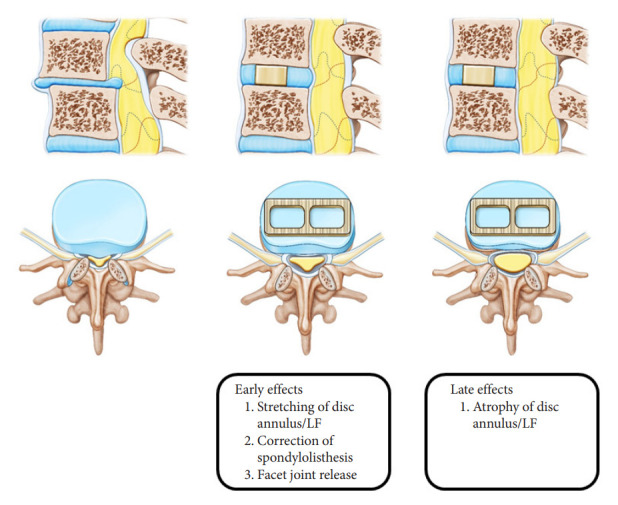
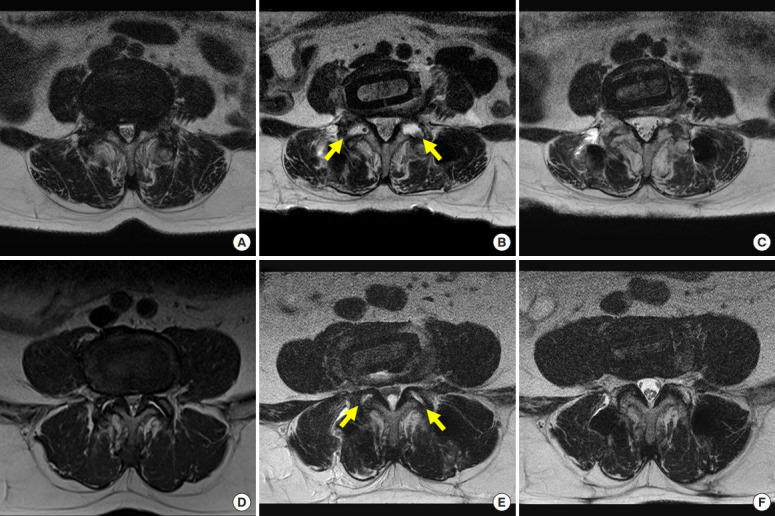
Oblique lumbar interbody fusion (OLIF) involves inserting large cages into the interbody disc space. This expands the spinal canal and neural foramen by stretching the ligament flavum and releasing the facet joint, resulting in indirect neural decompression. Our objective was to investigate the changes in the spinal canal and ligament flavum over time after OLIF.
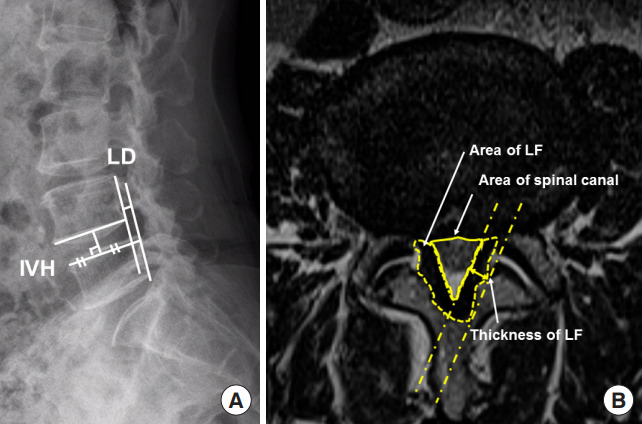
This was a prospective observational study involving 30 patients who underwent OLIF L4-5 between 2015 and 2018. In total, 27 of the 30 patients underwent preoperative, early follow-up ( < 5 days), and late follow-up (10-14 months) magnetic resonance imaging to measure the area of the spinal canal and ligament flavum. Based on the results, the patients were divided into subsidence and nonsubsidence groups for further analysis.
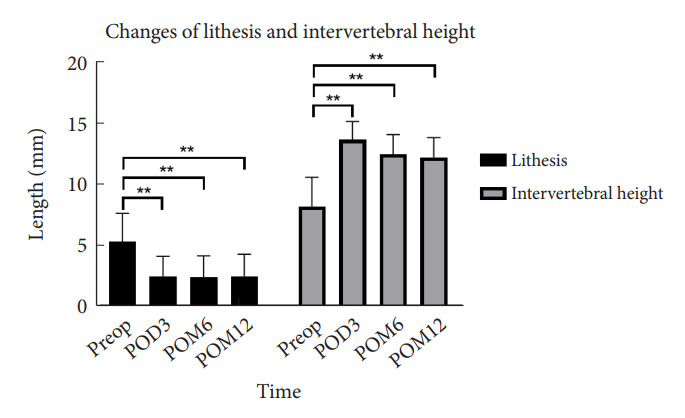
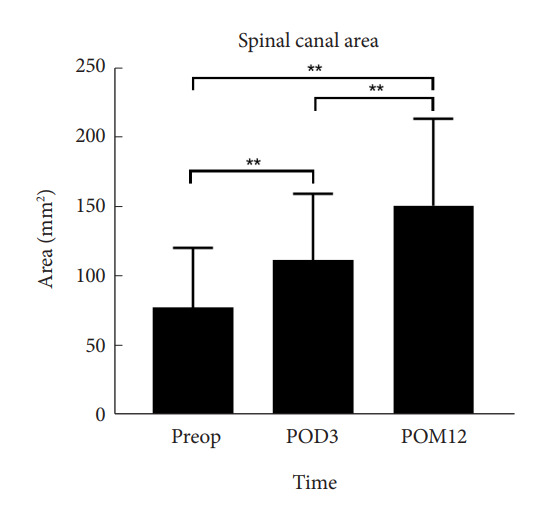
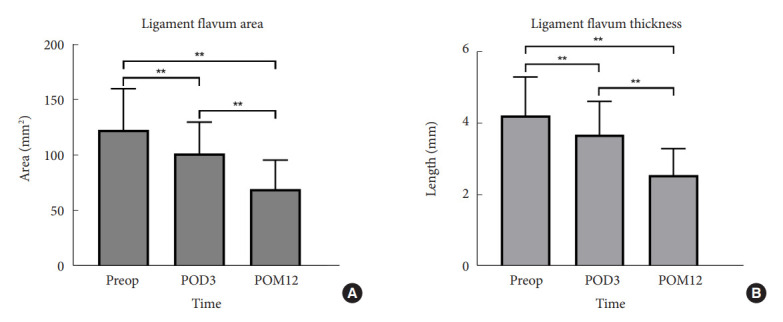
After OLIF, the spinal canal area gradually increased during the preoperative, early postoperative, and late postoperative periods (p < 0.001). The thickness and area of the ligament flavum decreased gradually over the same periods (p < 0.001). Low-grade subsidence (2-4.4 mm) did not influence the effects on the spinal canal and ligament.
After OLIF, the spinal canal and ligament flavum gradually change, which is effective for indirect neural decompression. In addition, the effects of low-grade subsidence on the remodeling of the spinal canal and ligament flavum are insignificant.
斜外侧腰椎椎间融合术(OLIF)需要将大型椎间融合器植入椎间间隙。这通过拉伸黄韧带和松解小关节来扩大椎管和神经孔,从而实现间接神经减压。我们的目的是研究OLIF术后椎管和黄韧带随时间的变化。
这是一项前瞻性观察性研究,纳入了2015年至2018年间接受L4-5节段OLIF手术的30例患者。30例患者中共有27例接受了术前、早期随访(<5天)和晚期随访(10-14个月)的磁共振成像检查,以测量椎管和黄韧带的面积。根据结果,将患者分为沉降组和非沉降组进行进一步分析。
OLIF术后,椎管面积在术前、术后早期和晚期逐渐增加(p<0.001)。黄韧带的厚度和面积在同一时期逐渐减小(p<0.001)。低度沉降(2-4.4mm)对椎管和韧带的影响不大。
OLIF术后,椎管和黄韧带逐渐发生变化,这对间接神经减压有效。此外,低度沉降对椎管和黄韧带重塑的影响不显著。