Dana-Farber/Boston Children's Cancer and Blood Disorders Center, Boston, MA.
Keck School of Medicine of USC, Los Angeles, CA.
J Clin Oncol. 2022 Sep 10;40(26):3047-3056. doi: 10.1200/JCO.22.00098. Epub 2022 May 17.
The utility of circulating tumor DNA (ctDNA) analyses has not been established in the risk stratification of Wilms tumor (WT). We evaluated the detection of ctDNA and selected risk markers in the serum and urine of patients with WT and compared findings with those of matched diagnostic tumor samples.
Fifty of 395 children with stage III or IV WT enrolled on Children's Oncology Group trial AREN0533 had banked pretreatment serum, urine, and tumor available. Next-generation sequencing was used to detect ctDNA. Copy-number changes in 1q, 16q, and 1p, and single-nucleotide variants in serum and urine were compared with tumor biopsy data. Event-free survival (EFS) was compared between patients with and without ctDNA detection.
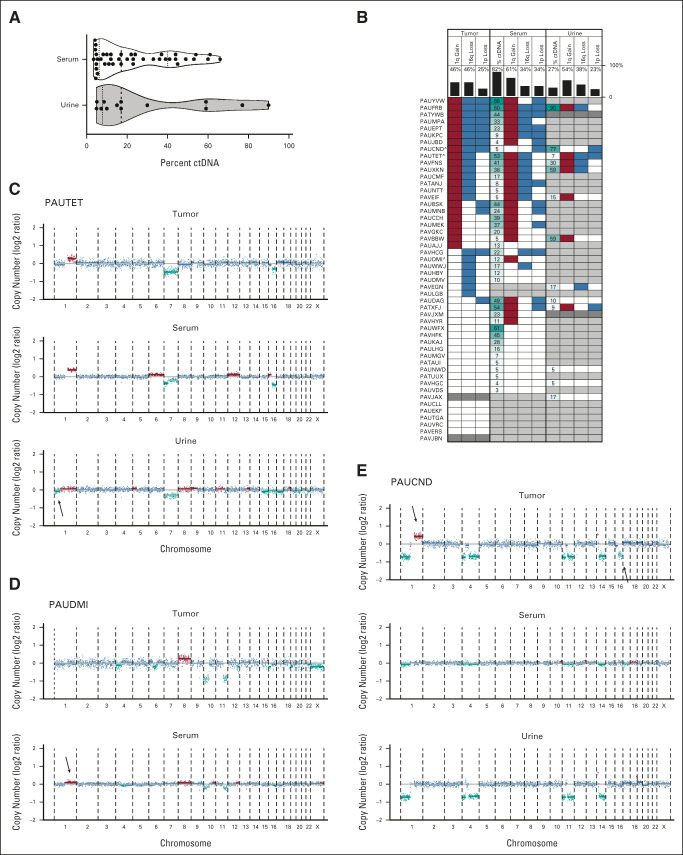
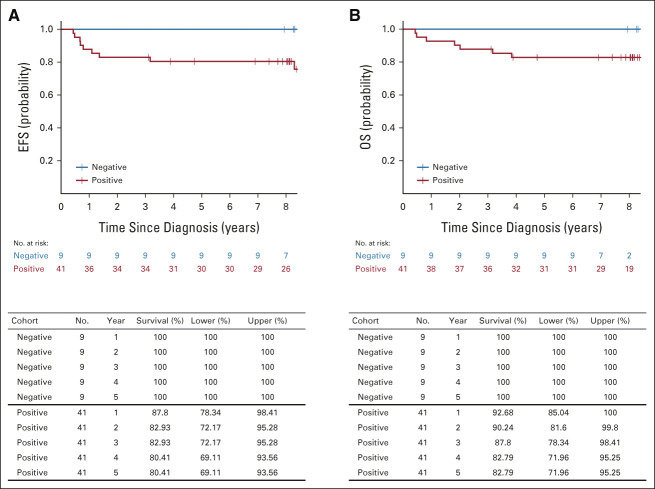
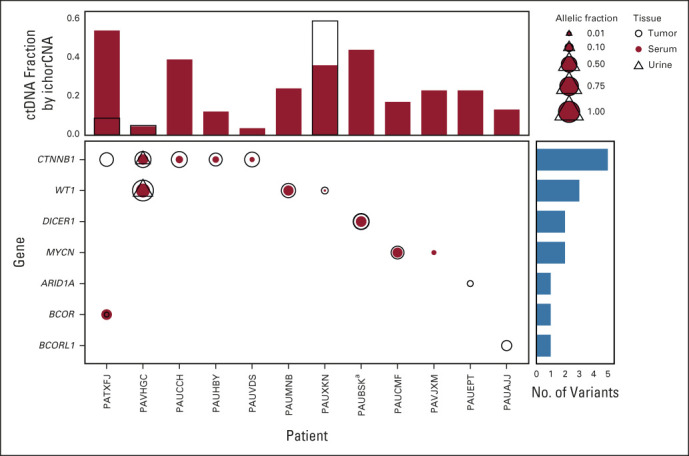
ctDNA was detected in the serum of 41/50 (82%) and in the urine in 13/50 (26%) patients. Agreement between serum ctDNA detection and tumor sequencing results was as follows: 77% for 1q gain, 88% for 16q deletions, and 70% for 1p deletions, with ĸ-coefficients of 0.56, 0.74, and 0.29, respectively. Sequencing also demonstrated that single-nucleotide variants detected in tumors could be identified in the ctDNA. There was a trend toward worse EFS in patients with ctDNA detected in the serum (4-year EFS 80% 100%, = .14).
ctDNA demonstrates promise as an easily accessible prognostic biomarker with potential to detect tumor heterogeneity. The observed trend toward more favorable outcome in patients with undetectable ctDNA requires validation. ctDNA profiling should be further explored as a noninvasive diagnostic and prognostic tool in the risk-adapted treatment of patients with WT.
循环肿瘤 DNA(ctDNA)分析在 Wilms 瘤(WT)的风险分层中的效用尚未得到证实。我们评估了 ctDNA 在 WT 患者血清和尿液中的检测,并与匹配的诊断肿瘤样本进行了比较。
395 名患有 III 或 IV 期 WT 的儿童中有 50 名参加了儿童肿瘤学组试验 AREN0533,他们在治疗前有保存的血清、尿液和肿瘤样本。使用下一代测序来检测 ctDNA。比较血清和尿液中的 1q、16q 和 1p 的拷贝数变化,以及血清和尿液中的单核苷酸变体与肿瘤活检数据。比较有和无 ctDNA 检测的患者无事件生存(EFS)。
41/50(82%)患者的血清中检测到 ctDNA,13/50(26%)患者的尿液中检测到 ctDNA。血清 ctDNA 检测与肿瘤测序结果的一致性如下:1q 增益为 77%,16q 缺失为 88%,1p 缺失为 70%,κ 系数分别为 0.56、0.74 和 0.29。测序还表明,在肿瘤中检测到的单核苷酸变体可在 ctDNA 中识别。在血清中检测到 ctDNA 的患者 EFS 较差(4 年 EFS 80%vs.100%,=0.14)。
ctDNA 作为一种易于获得的预后生物标志物具有潜力,有可能检测肿瘤异质性。在无法检测到 ctDNA 的患者中观察到的更有利的结果趋势需要验证。ctDNA 谱分析应进一步探索作为一种非侵入性诊断和预后工具,用于 WT 患者的风险适应治疗。