Department of Internal Medicine and Radboud Institute for Molecular Life Sciences (RIMLS), Radboud University Medical Centre, Geert Grooteplein Zuid 8, 6525 GA, Nijmegen, The Netherlands.
Department of Cardiology, Radboud University Medical Centre, Nijmegen, The Netherlands.
Basic Res Cardiol. 2022 May 17;117(1):28. doi: 10.1007/s00395-022-00935-6.
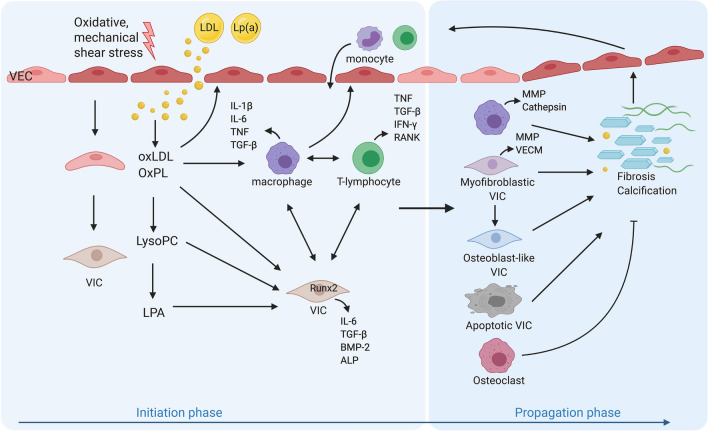
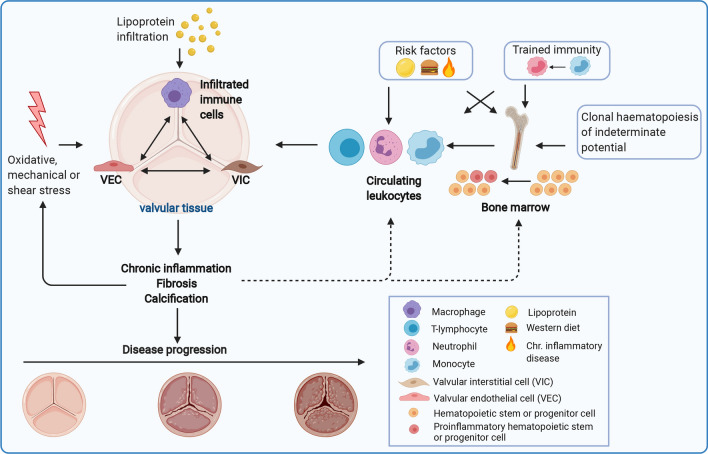
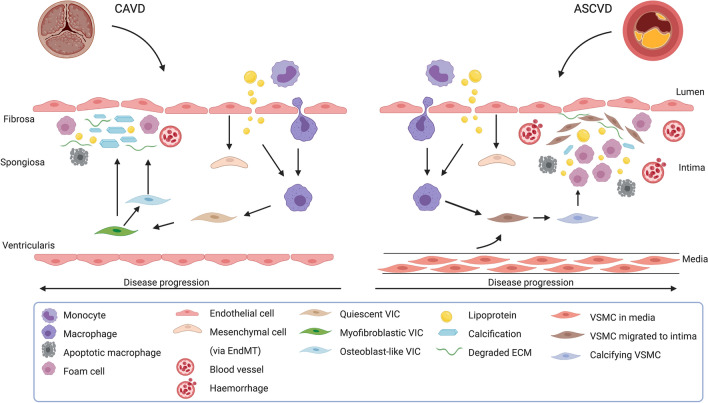
Calcific aortic valve disease (CAVD) is the most common valvular disease in the developed world with currently no effective pharmacological treatment available. CAVD results from a complex, multifactorial process, in which valvular inflammation and fibro-calcific remodelling lead to valve thickening and cardiac outflow obstruction. The exact underlying pathophysiology of CAVD is still not fully understood, yet the development of CAVD shows many similarities with the pathophysiology of atherosclerotic cardiovascular disease (ASCVD), such as coronary artery disease. Innate immune cells play a crucial role in ASCVD and might also play a pivotal role in the development of CAVD. This review summarizes the current knowledge on the role of innate immune cells, both in the circulation and in the aortic valve, in the development of CAVD and the similarities and differences with ASCVD. Trained immunity and clonal haematopoiesis of indeterminate potential are proposed as novel immunological mechanisms that possibly contribute to the pathophysiology of CAVD and new possible treatment targets are discussed.
钙化性主动脉瓣疾病(CAVD)是发达国家最常见的瓣膜病,目前尚无有效的药物治疗方法。CAVD 是一种复杂的多因素过程,其中瓣膜炎症和纤维钙化重塑导致瓣膜增厚和心输出道阻塞。CAVD 的确切潜在病理生理学仍不完全清楚,但 CAVD 的发展与动脉粥样硬化性心血管疾病(ASCVD)的病理生理学有许多相似之处,如冠状动脉疾病。先天免疫细胞在 ASCVD 中起着至关重要的作用,在 CAVD 的发展中也可能起着关键作用。这篇综述总结了先天免疫细胞在 CAVD 发展中的作用,包括循环中和主动脉瓣中的作用,以及与 ASCVD 的相似性和差异。训练有素的免疫和不确定潜能的克隆性造血被认为是可能导致 CAVD 病理生理学的新的免疫机制,并讨论了新的可能治疗靶点。