Center for Neuroinflammation and Neurotherapeutics, and Multiple Sclerosis Division, Department of Neurology, Perelman School of Medicine, University of Pennsylvania, Philadelphia, PA, USA/Montreal Neurological Institute, McGill University, Montreal, QC, Canada.
Oxford Autoimmune Neurology Group, Nuffield Department of Clinical Neurosciences, University of Oxford, Oxford, UK.
Mult Scler. 2022 Oct;28(11):1697-1709. doi: 10.1177/13524585221093789. Epub 2022 May 17.
Myelin oligodendrocyte glycoprotein antibody-associated disease (MOGAD) is now recognized as distinct from multiple sclerosis (MS).
To evaluate the importance of considering myelin oligodendrocyte glycoprotein (MOG)-immunoglobulin-G (IgG) serology when applying MS diagnostic criteria in children.
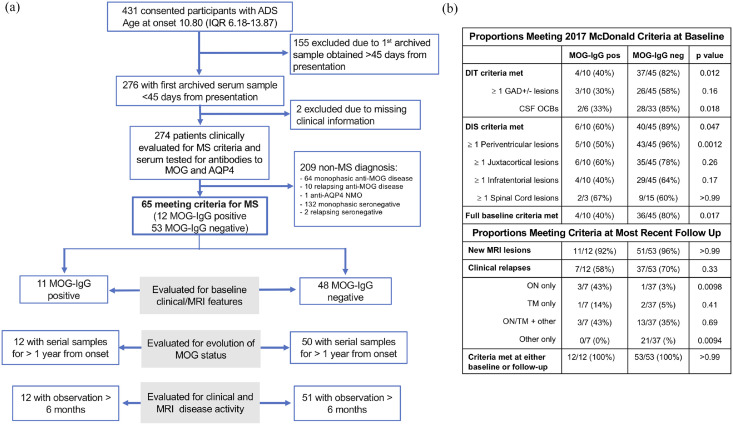
Within a prospective cohort of children meeting MS criteria (median follow-up = 6 years, interquartile range (IQR) = 4-9), we measured MOG-IgG in serial archived serum obtained from presentation, and compared imaging and clinical features between seropositive and seronegative participants.
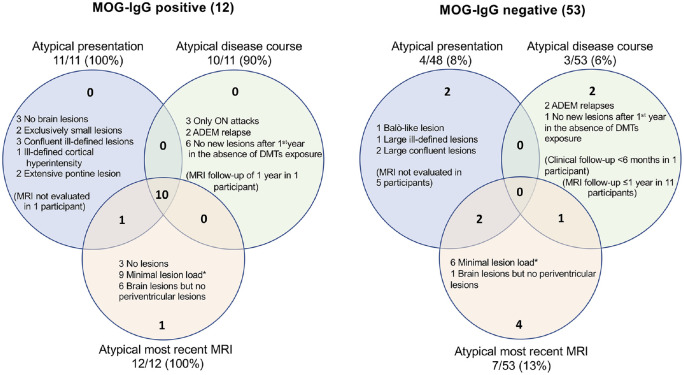
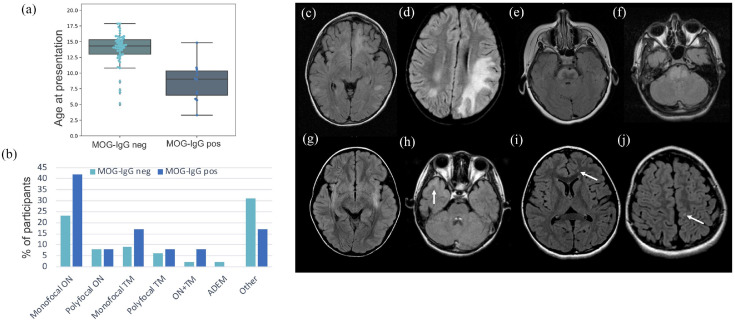
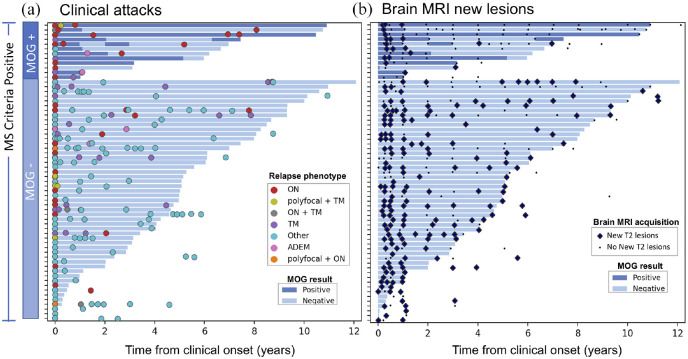
Of 65 children meeting MS criteria (median age = 14.0 years, IQR = 10.9-15.1), 12 (18%) had MOG-IgG at disease onset. Seropositive participants were younger, had brain magnetic resonance imaging (MRI) features atypical for MS, rarely had cerebrospinal fluid (CSF) oligoclonal bands (2/8, 25%), and accumulated fewer T2 lesions over time. On serial samples, 5/12 (42%) were persistently seropositive, 5/12 (42%) became seronegative, and 2/12 (17%) had fluctuating results. All 12 children experienced a disease course different from typical MS.
While children with MOG-IgG can have clinical, CSF, and MRI features conforming to MS criteria, the presence of MOG-IgG is associated with atypical features and predicts a non-MS disease course. Given MOG-IgG seropositivity can wane over time, testing at first attack is of considerable importance for the diagnosis of MOGAD.
髓鞘少突胶质细胞糖蛋白抗体相关疾病(MOGAD)现已被认为与多发性硬化症(MS)不同。
评估在应用 MS 诊断标准时考虑髓鞘少突胶质细胞糖蛋白(MOG)-免疫球蛋白 G(IgG)血清学的重要性。
在符合 MS 标准的儿童前瞻性队列中(中位随访时间为 6 年,四分位间距[IQR]为 4-9 年),我们在发病时检测了连续存档的血清中的 MOG-IgG,并比较了血清阳性和血清阴性参与者的影像学和临床特征。
在符合 MS 标准的 65 名儿童中(中位年龄为 14.0 岁,IQR 为 10.9-15.1 岁),12 名(18%)在发病时出现 MOG-IgG。血清阳性参与者更年轻,脑部磁共振成像(MRI)特征不典型,很少有脑脊液(CSF)寡克隆带(2/8,25%),并且随着时间的推移,T2 病变积累更少。在连续样本中,5/12(42%)持续血清阳性,5/12(42%)转为血清阴性,2/12(17%)结果波动。所有 12 名儿童的疾病过程均与典型 MS 不同。
虽然 MOG-IgG 患儿可能具有符合 MS 标准的临床、CSF 和 MRI 特征,但 MOG-IgG 的存在与不典型特征相关,并预测为非 MS 疾病过程。鉴于 MOG-IgG 阳性可能随时间减弱,在首次发作时进行检测对于 MOGAD 的诊断具有重要意义。