Lo Nigro Cristiana, Rusmini Marta, Ceccherini Isabella
Laboratory Department, S. Croce & Carle Teaching Hospital, Cuneo 12100, Italy.
U.O.C. Medical Genetics, IRCCS Istituto Giannina Gaslini, Genoa 16147, Italy.
Cancer Drug Resist. 2019 Dec 19;2(4):1136-1152. doi: 10.20517/cdr.2019.66. eCollection 2019.
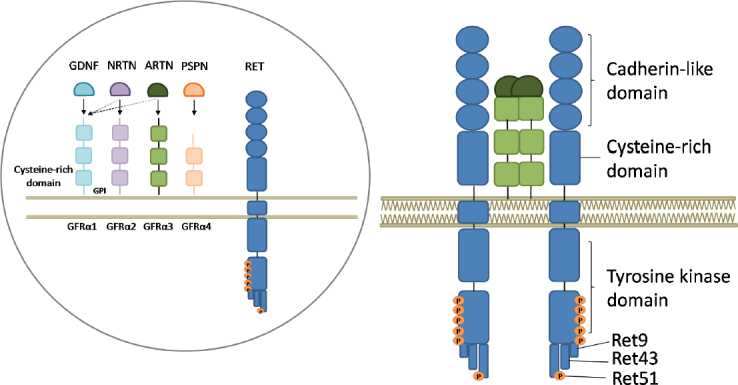
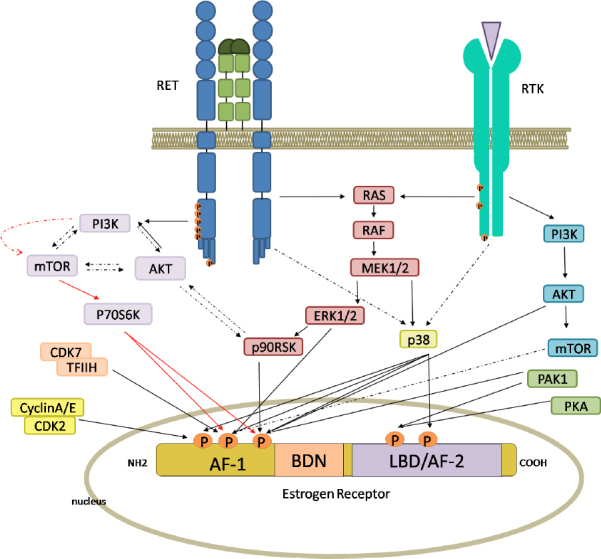
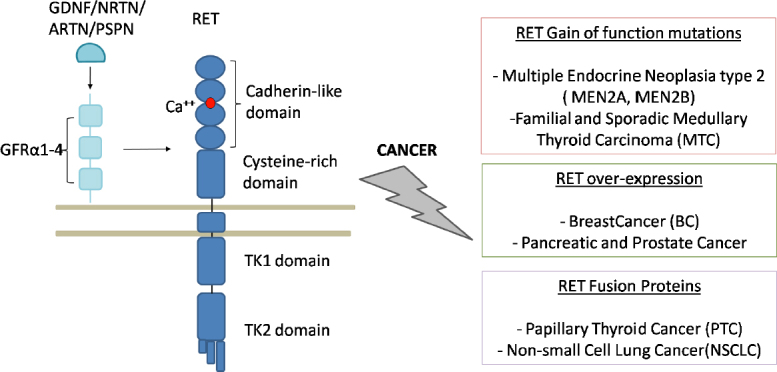
Initiation, progression, outcome and sensibility to therapies in breast cancer (BC), the most frequent cancer in women, are driven by somatic and germline mutations. Although the effectiveness of hormonal therapies is well-founded, it is prescribed for cancers which express steroid hormone receptors, such as estrogen receptor (ER). is a proto-oncogene encoding a transmembrane tyrosine kinase receptor that is activated by one of its four ligands (GDNF, neurturin, artemin or persephin) and one of its coreceptors (Gfrα1-4). Loss-of-function mutations in RET are responsible for Hirschsprung disease, while gain-of-function mutations for multiple endocrine neoplasia type 2. In addition, deregulation of its intracellular signaling, due to mutations, gene rearrangements, overexpression or transcriptional upregulation, can cause several neuroendocrine and epithelial tumors. In BC, amplification of receptor tyrosine kinases, such as ERBB2, EGFR, IGFR and FGFR1, and/or their upregulation contribute to cancer initiation and progression. RET can also have an important role in BC, but only in the subset of ER-positive (ER+) tumors, where it is found overexpressed. Targeting the RET pathway and shedding light on molecular basis of the resistance to hormone therapy may lead to new therapies in ER+ BC, improving treatment outcome and preventing tumor-related events. Thus, here, we review the state of the art of RET biology in BC and agents targeting RET tested in the clinical trials and discuss the specificity of the still available RET inhibitors and the molecular mechanisms underlying the BC resistance to endocrine therapy.
乳腺癌(BC)是女性中最常见的癌症,其发病、进展、预后及对治疗的敏感性均由体细胞和种系突变驱动。尽管激素疗法的有效性有充分依据,但它仅用于表达类固醇激素受体的癌症,如雌激素受体(ER)。RET是一种原癌基因,编码一种跨膜酪氨酸激酶受体,该受体可被其四种配体(胶质细胞源性神经营养因子、神经营养素、artemin或persephin)之一及其共受体(Gfrα1 - 4)之一激活。RET功能丧失突变会导致先天性巨结肠病,而功能获得性突变则会引发2型多发性内分泌肿瘤。此外,由于突变、基因重排、过表达或转录上调导致其细胞内信号失调,可引发多种神经内分泌和上皮肿瘤。在乳腺癌中,受体酪氨酸激酶如ERBB2、EGFR、IGFR和FGFR1的扩增和/或上调会促进癌症的发生和进展。RET在乳腺癌中也可能发挥重要作用,但仅在雌激素受体阳性(ER +)肿瘤亚组中发现其过表达。靶向RET通路并阐明激素治疗耐药的分子基础可能会带来雌激素受体阳性乳腺癌的新疗法,改善治疗效果并预防肿瘤相关事件。因此,在此我们综述了乳腺癌中RET生物学以及在临床试验中测试过的靶向RET的药物的最新进展,并讨论了现有RET抑制剂的特异性以及乳腺癌内分泌治疗耐药的分子机制。