Lester and Sue Smith Breast Center, Baylor College of Medicine, Houston, Texas.
Graduate Program in Translational Biology and Molecular Medicine, Baylor College of Medicine, Houston Texas.
Cancer Res. 2023 Oct 2;83(19):3237-3251. doi: 10.1158/0008-5472.CAN-22-3484.
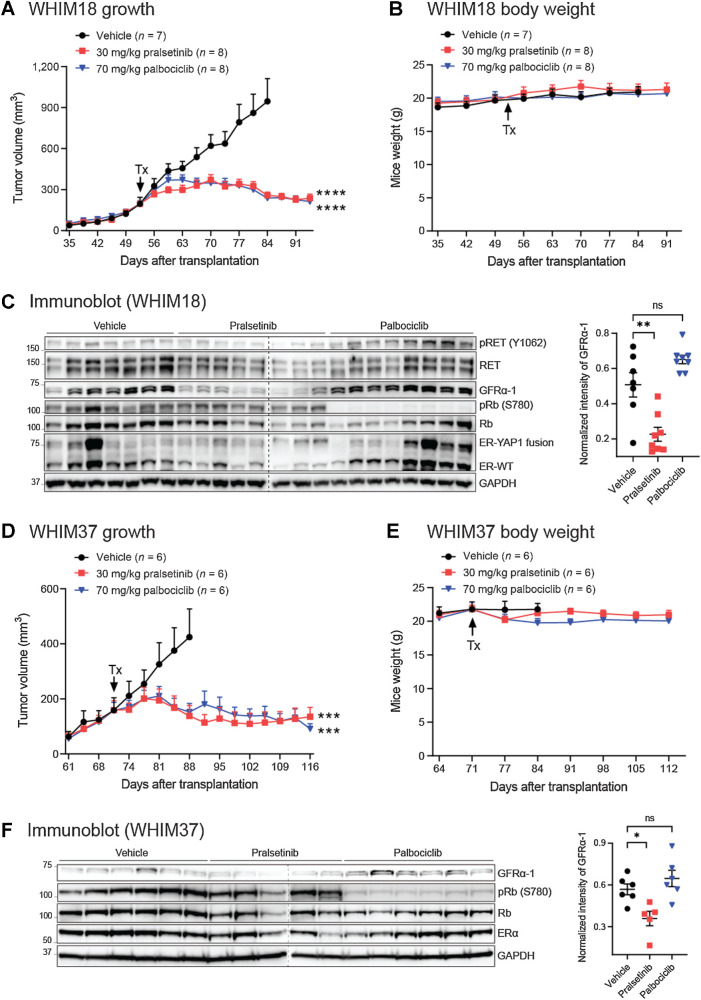
Transcriptionally active ESR1 fusions (ESR1-TAF) are a potent cause of breast cancer endocrine therapy (ET) resistance. ESR1-TAFs are not directly druggable because the C-terminal estrogen/anti-estrogen-binding domain is replaced with translocated in-frame partner gene sequences that confer constitutive transactivation. To discover alternative treatments, a mass spectrometry (MS)-based kinase inhibitor pulldown assay (KIPA) was deployed to identify druggable kinases that are upregulated by diverse ESR1-TAFs. Subsequent explorations of drug sensitivity validated RET kinase as a common therapeutic vulnerability despite remarkable ESR1-TAF C-terminal sequence and structural diversity. Organoids and xenografts from a pan-ET-resistant patient-derived xenograft model that harbors the ESR1-e6>YAP1 TAF were concordantly inhibited by the selective RET inhibitor pralsetinib to a similar extent as the CDK4/6 inhibitor palbociclib. Together, these findings provide preclinical rationale for clinical evaluation of RET inhibition for the treatment of ESR1-TAF-driven ET-resistant breast cancer.
Kinome analysis of ESR1 translocated and mutated breast tumors using drug bead-based mass spectrometry followed by drug-sensitivity studies nominates RET as a therapeutic target. See related commentary by Wu and Subbiah, p. 3159.
转录激活的 ESR1 融合(ESR1-TAF)是导致乳腺癌内分泌治疗(ET)耐药的一个重要原因。ESR1-TAF 不能直接用药物治疗,因为 C 端雌激素/抗雌激素结合域被替换为易位的框架内伙伴基因序列,这些序列赋予了组成型的转录激活。为了发现替代治疗方法,采用基于质谱(MS)的激酶抑制剂下拉测定(KIPA)来鉴定被不同 ESR1-TAF 上调的可药物治疗的激酶。随后对药物敏感性的探索验证了 RET 激酶是一种常见的治疗弱点,尽管 ESR1-TAF C 端序列和结构多样性显著。源自携带 ESR1-e6>YAP1 TAF 的泛 ET 耐药患者衍生的异种移植模型的类器官和异种移植,被选择性 RET 抑制剂 pralsetinib 以类似于 CDK4/6 抑制剂 palbociclib 的程度协同抑制。这些发现为临床评估 RET 抑制治疗 ESR1-TAF 驱动的 ET 耐药性乳腺癌提供了临床前依据。
使用基于药物珠的质谱对 ESR1 易位和突变的乳腺癌进行激酶组分析,然后进行药物敏感性研究,将 RET 鉴定为治疗靶点。见 Wu 和 Subbiah 的相关评论,第 3159 页。