Department of Molecular Medicine, Morsani College of Medicine, University of South Floridagrid.170693.a, Tampa, Florida, USA.
Microbiol Spectr. 2022 Jun 29;10(3):e0026322. doi: 10.1128/spectrum.00263-22. Epub 2022 May 18.
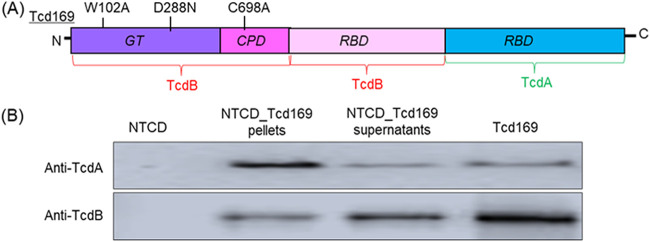
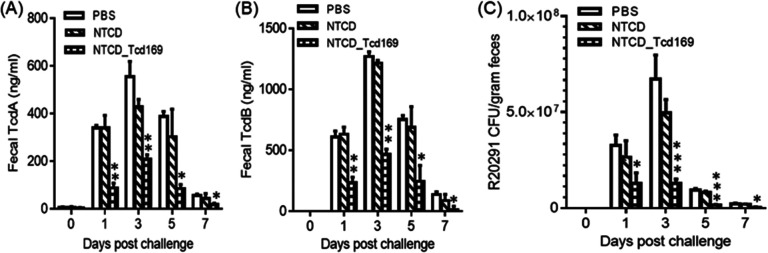
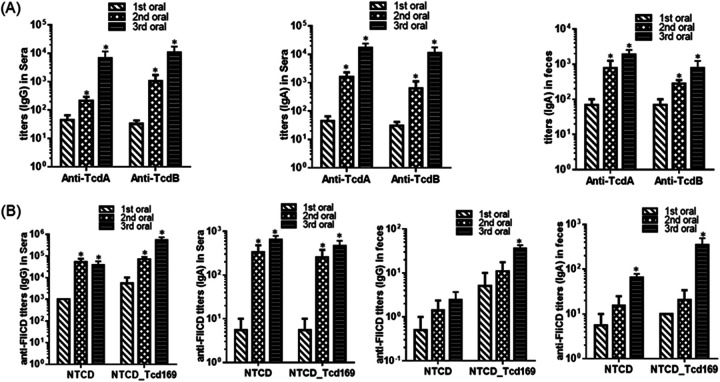
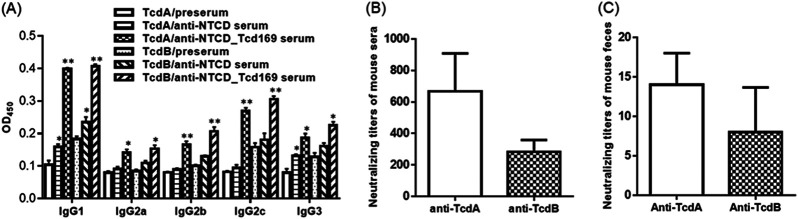
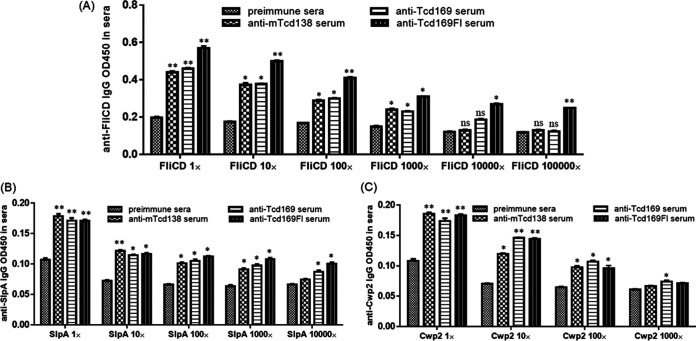
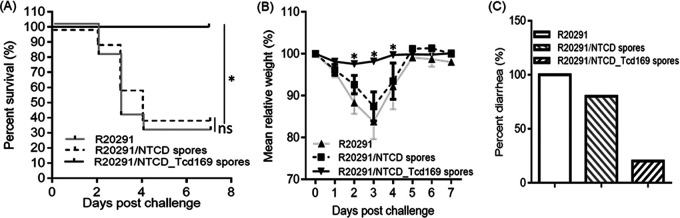
The symptoms of Clostridioides difficile infection (CDI) are largely attributed to two toxins, TcdA and TcdB. Significant efforts have been devoted to developing vaccines targeting both toxins through parenteral immunization routes. Recently, we generated a novel chimeric protein (designated Tcd169), comprised of the glucosyltransferase domain (GT), the cysteine protease domain (CPD), and the receptor binding domain (RBD) of TcdB, and the RBD of TcdA. Parenteral immunizations with Tcd169 provide mice effective protection against infection with a ribotype (RT) 027 strain. In this study, we expressed Tcd169 in a nontoxigenic CCUG37785 strain (designated NTCD), resulting in strain NTCD_Tcd169 to develop an oral vaccine that can target both toxins and colonization/adhesion factors. Oral immunizations with NTCD_Tcd169 spores induced systematic and mucosal antibody responses against, not only both toxins, but also C. difficile flagellins (FliC/FliD). Intriguingly yet importantly, anti-Tcd169 sera raised against Tcd169 protein were significantly cross-reactive with FliC/FliD and two surface layer proteins (SlpA and Cwp2). Oral immunizations with NTCD_Tcd169 spores provided mice effective protection against infection with a hypervirulent RT027 strain R20291and significantly reduced R20291spore numbers in feces compared with NTCD or PBS immunized mice. These results imply that the genetically modified, nontoxigenic strain expressing Tcd169 may represent a novel mucosal vaccine candidate against CDI. Clostridioides difficile is an enteric pathogen, and symptoms of C. difficile infection (CDI) are mainly by two exotoxins TcdA and TcdB. Active vaccination is cost-effective approach to prevent CDI and high rates of recurrence. Ideally, vaccines should target both C. difficile toxins and cell/spore colonization. In this study, we expressed immunodominant fragments of TcdA and TcdB (i.e., Tcd169) in a nontoxigenic CCUG37785 strain, generating a promising oral/mucosal vaccine candidate against CDI, by targeting both toxins and colonization of pathogenic C. difficile strains. Importantly, anti-Tcd169 sera raised against Tcd169 protein were significantly cross-reactive with FliC/FliD and two surface layer proteins (SlpA and Cwp2), and all of which are involved in C. difficile adhesion/colonization and .
艰难梭菌感染(CDI)的症状主要归因于两种毒素,TcdA 和 TcdB。人们已经投入大量精力通过肠外免疫途径开发针对这两种毒素的疫苗。最近,我们生成了一种新型嵌合蛋白(命名为 Tcd169),由 TcdB 的葡糖基转移酶结构域(GT)、半胱氨酸蛋白酶结构域(CPD)和受体结合结构域(RBD)以及 TcdA 的 RBD 组成。用 Tcd169 进行肠外免疫可使小鼠有效抵抗 RT027 株的感染。在这项研究中,我们在非产毒的 CCUG37785 株(命名为 NTCD)中表达 Tcd169,从而产生 NTCD_Tcd169 孢子以开发可针对两种毒素和定植/黏附因子的口服疫苗。用 NTCD_Tcd169 孢子进行口服免疫会引起针对两种毒素以及艰难梭菌鞭毛(FliC/FliD)的系统和黏膜抗体应答。有趣且重要的是,针对 Tcd169 蛋白产生的抗 Tcd169 血清与 FliC/FliD 和两种表面层蛋白(SlpA 和 Cwp2)有显著的交叉反应性。用 NTCD_Tcd169 孢子进行口服免疫可使小鼠有效抵抗产毒 RT027 株 R20291 的感染,与 NTCD 或 PBS 免疫的小鼠相比,粪便中 R20291 孢子的数量显著减少。这些结果表明,表达 Tcd169 的遗传修饰非产毒株可能代表针对 CDI 的新型黏膜疫苗候选物。艰难梭菌是一种肠道病原体,艰难梭菌感染(CDI)的症状主要由两种外毒素 TcdA 和 TcdB 引起。主动免疫是预防 CDI 和高复发率的经济有效的方法。理想情况下,疫苗应同时针对艰难梭菌毒素和细胞/孢子定植。在这项研究中,我们在非产毒的 CCUG37785 株中表达了 TcdA 和 TcdB 的免疫显性片段(即 Tcd169),通过针对两种毒素和产毒艰难梭菌菌株的定植,生成了一种有前途的针对 CDI 的口服/黏膜疫苗候选物。重要的是,针对 Tcd169 蛋白产生的抗 Tcd169 血清与 FliC/FliD 和两种表面层蛋白(SlpA 和 Cwp2)有显著的交叉反应性,而这两者都与艰难梭菌的黏附/定植有关。