Santos Mafalda, Fidalgo Ana, Varanda Ana Sofia, Soares Ana Raquel, Almeida Gabriela M, Martins Diana, Mendes Nuno, Oliveira Carla, Santos Manuel A S
Expression Regulation in Cancer, Instituto de Investigação e Inovação em Saúde, University of Porto, Porto, Portugal.
Institute of Molecular Pathology and Immunology University of Porto (IPATIMUP), Porto, Portugal.
Front Mol Biosci. 2022 May 2;9:809985. doi: 10.3389/fmolb.2022.809985. eCollection 2022.
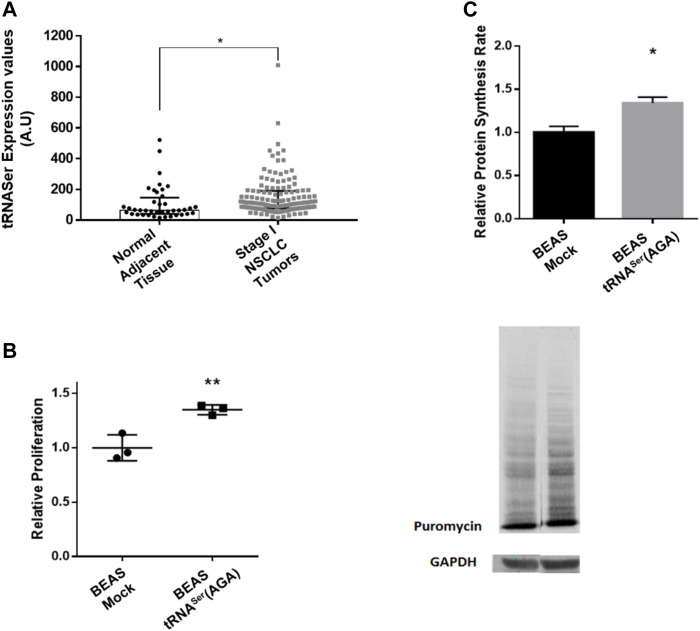
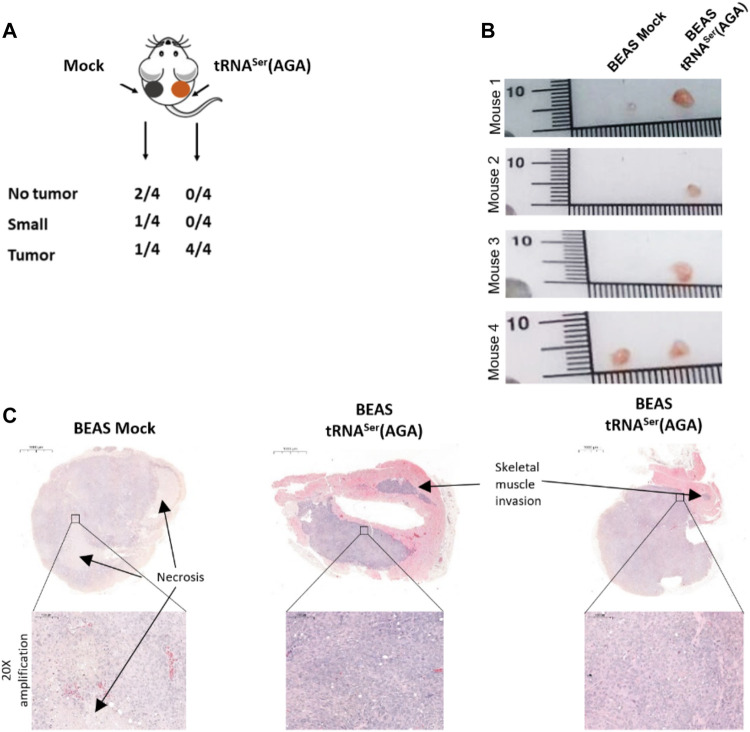
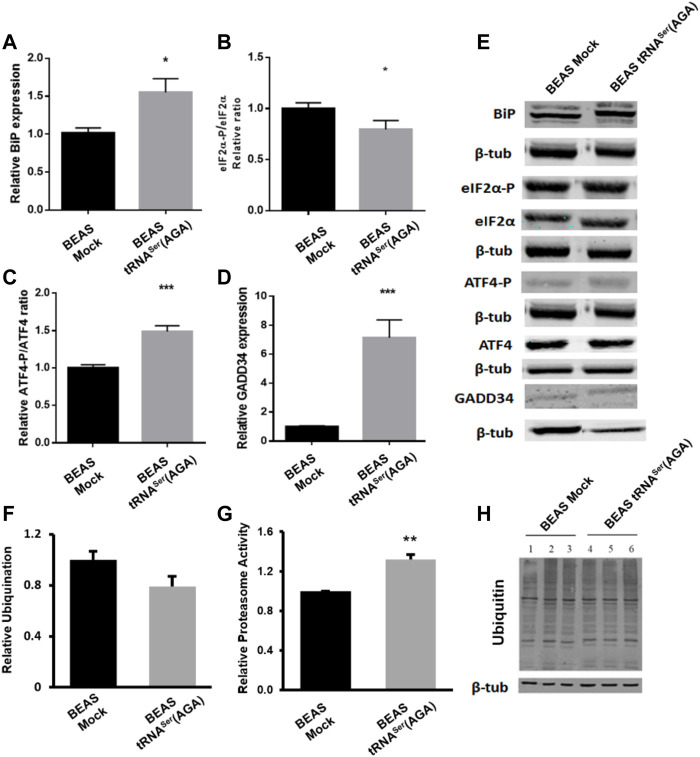
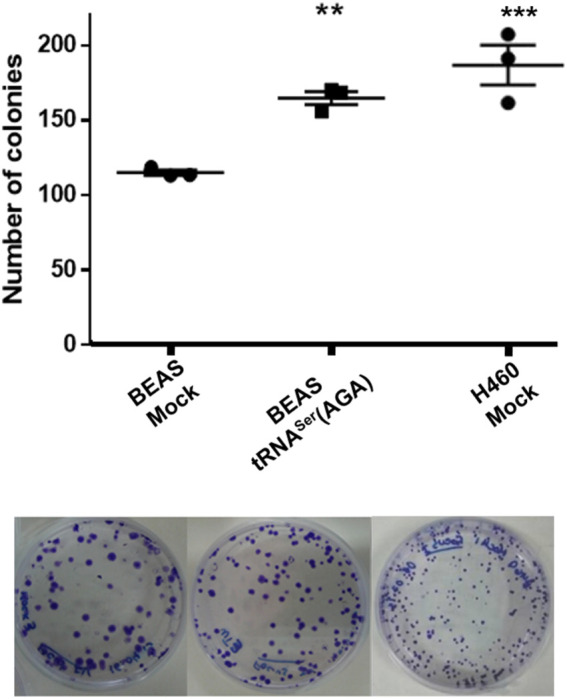
Serine tRNAs (tRNA) are frequently overexpressed in tumors and associated with poor prognosis and increased risk of recurrence in breast cancer. Impairment of tRNA biogenesis and abundance also impacts proteome homeostasis, and activates protein quality control systems. Herein, we aimed at testing whether increasing tRNA abundance could foster tumor establishment through activation of the UPR. In order to do so, firstly we confirmed that the expression of tRNA-Ser-AGA-2-1 [hereafter tRNA(AGA)] was upregulated by 1.79-fold in Stage I NSCLC tumors when compared to normal adjacent tissue. To study the impact of tRNA(AGA) in early stage tumorigenesis, we induced its upregulation in a non-tumoral bronchial cell line, BEAS-2B. Upregulation of this tRNA increased cellular proliferation and protein synthesis rate, driven by eIF2 dephosphorylation and ATF4 activation downstream of PERK signaling. Futhermore, tRNA(AGA) enhanced transformation potential , and promoted the establishment of slow growing tumors with aggressive features in nude mice. Our work highlights the importance of studying tRNA deregulation on early stage tumorigenesis, as they may be potential malignancy and aggressiveness biomarkers.
丝氨酸转运RNA(tRNA)在肿瘤中经常过度表达,与乳腺癌预后不良和复发风险增加相关。tRNA生物合成和丰度的受损也会影响蛋白质组稳态,并激活蛋白质质量控制系统。在此,我们旨在测试增加tRNA丰度是否能通过激活未折叠蛋白反应(UPR)促进肿瘤形成。为了做到这一点,首先我们证实,与相邻正常组织相比,I期非小细胞肺癌(NSCLC)肿瘤中tRNA-Ser-AGA-2-1(以下简称tRNA(AGA))的表达上调了1.79倍。为了研究tRNA(AGA)在早期肿瘤发生中的作用,我们在非肿瘤性支气管细胞系BEAS-2B中诱导其上调。这种tRNA的上调增加了细胞增殖和蛋白质合成速率,这是由PERK信号下游的eIF2去磷酸化和ATF4激活驱动的。此外,tRNA(AGA)增强了转化潜能,并促进了裸鼠中具有侵袭性特征的缓慢生长肿瘤的形成。我们的工作强调了研究tRNA失调对早期肿瘤发生的重要性,因为它们可能是潜在的恶性和侵袭性生物标志物。