Gudeta Tolesa Gemeda, Terefe Ayana Benti, Mengistu Girma Teferi, Sori Seboka Abebe
Department of Nursing, College of Medicine and Health Sciences, Wolkite University, Wolkite, Ethiopia.
Department of Midwifery, College of Medicine and Health Sciences, Wolkite University, Wolkite, Ethiopia.
Obstet Gynecol Int. 2022 May 9;2022:8086793. doi: 10.1155/2022/8086793. eCollection 2022.
Dietary diversification is considered the proxy indicator of dietary quality and nutrient adequacy during pregnancy. Pregnant women have been considered susceptible to malnutrition because of their increased nutrient demands and thus consuming a variety of foods in their diet plays a lion's role in ensuring adequate nutrient intake. So understanding bottleneck factors associated with dietary diversity practice is very crucial to encouraging adequate dietary diversity practice. Therefore, this paper aimed to assess determinants of dietary diversity practice among pregnant women in the Gurage zone, Southwest Ethiopia.
A community-based cross-sectional analytical study was conducted among 726 pregnant women, 13 key informants, and 27 focus group discussion in the Gurage zone, southwest Ethiopia, from 1 September to 1 November 2021. A face-to-face interviewer-administered questionnaire was used to collect the data. According to the Minimum Dietary Diversity Score for Women (MDD-W) tool, women who consumed more than or equal to 5 of 10 food groups in the previous 24 hours had a diverse diet. Epi data version 3.1 was used for data entry, while SPSSversion 26 was used for analysis. To determine factors associated with dietary diversity, bivariate and multivariable logistic regression models were used to obtain crude odds ratio (COR), adjusted odds ratios (AOR), and 95 percent confidence intervals (CIs). Statistical significance was determined using adjusted odds ratios (AORs) with 95 percent confidence intervals (CIs) and values less than 0.05. In narrative form, qualitative results were triangulated with quantitative data.
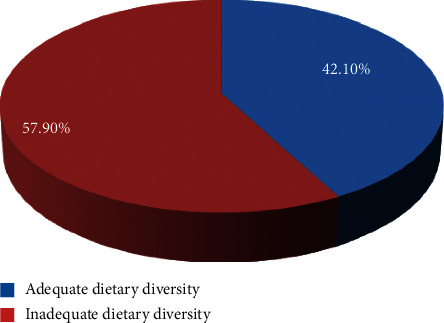
The overall prevalence of the adequate dietary diversity practice was found to be 42.1% with 95% CI (48.4-46.1%) and the mean dietary diversity score was 5.30 ± 1.49 standard deviation (SD). Multivariable analysis revealed that primary school level [AOR = 6.471 (2.905, 12.415)], secondary school level (9-12) [AOR = 7.169 (4.001, 12.846)], college and above level [AOR = 32.27 (15.044, 69.221)], women with higher empowerment [AOR = 3.497 (2.301, 5.315)], women with a favorable attitude toward dietary diversity [AOR = 1.665 (1.095, 2.529)], women from wealthier households [AOR = 2.025 (1.252, 3.278)], and having well-secured food status [AOR = 3.216 (1.003, 10.308)] were variables that influence dietary diversity practice. Three FGD and 13 key informant interviews were conducted, and the results of qualitative data generated three major themes.
The overall prevalence of adequate dietary diversity practice was found to be low in this study when compared to studies conducted in Ethiopia. Maternal educations, mothers' attitudes toward dietary diversity, women empowerment, food security status, and wealth index level of the household were determinant factors that influence dietary diversity practice in this study. Therefore, programs aimed to improve pregnant women's dietary diversity practice should focus on improving the socioeconomic status and creating a congenial environment to promote women's empowerment.
饮食多样化被视为孕期饮食质量和营养充足的替代指标。孕妇因其营养需求增加而被认为易患营养不良,因此在饮食中摄入多种食物对确保充足的营养摄入起着关键作用。所以,了解与饮食多样化实践相关的瓶颈因素对于鼓励充分的饮食多样化实践至关重要。因此,本文旨在评估埃塞俄比亚西南部古拉格地区孕妇饮食多样化实践的决定因素。
2021年9月1日至11月1日,在埃塞俄比亚西南部古拉格地区对726名孕妇、13名关键信息提供者和27个焦点小组进行了一项基于社区的横断面分析研究。采用面对面访谈式问卷收集数据。根据妇女最低饮食多样性评分(MDD-W)工具,在过去24小时内食用了10个食物组中5种或更多种食物的妇女饮食多样化。使用Epi数据3.1版本进行数据录入,而SPSS 26版本用于分析。为了确定与饮食多样化相关的因素,采用二元和多变量逻辑回归模型来获得粗比值比(COR)、调整比值比(AOR)和95%置信区间(CI)。使用调整比值比(AOR)和95%置信区间(CI)以及小于0.05的值来确定统计学意义。以叙述形式将定性结果与定量数据进行三角验证。
充足饮食多样化实践的总体患病率为42.1%,95%CI为(48.4 - 46.1%),平均饮食多样性评分为5.30±1.49标准差(SD)。多变量分析显示,小学学历[AOR = 6.471(2.905,12.415)]、初中学历(9 - 12年级)[AOR = 7.169(4.001,12.846)]、大专及以上学历[AOR = 32.27(15.044, 69.221)]、赋权程度较高的妇女[AOR = 3.497(2.301,5.315)]、对饮食多样化持积极态度的妇女[AOR = 1.665(1.095,2.529)]、来自较富裕家庭的妇女[AOR = 2.025(1.252,3.278)]以及食物安全状况良好的妇女[AOR = 3.216(1.00本研究中影响饮食多样化实践的变量。进行了3次焦点小组讨论和13次关键信息提供者访谈,定性数据的结果产生了三个主要主题。
与在埃塞俄比亚进行的研究相比,本研究中充足饮食多样化实践的总体患病率较低。母亲的教育程度、母亲对饮食多样化的态度、妇女赋权、粮食安全状况以及家庭的财富指数水平是本研究中影响饮食多样化实践的决定因素。因此,旨在改善孕妇饮食多样化实践的项目应侧重于提高社会经济地位并创造一个有利于促进妇女赋权的环境。
