Gu Lihu, Fu Rongrong, Hong Jiaze, Ni Haixiang, Yu Kepin, Lou Haiying
Department of General Surgery, HwaMei Hospital, University of Chinese Academy of Sciences, Ningbo, China.
The First Clinical Medical College, Zhejiang Chinese Medical University, Hangzhou, China.
Front Nutr. 2022 May 2;9:871682. doi: 10.3389/fnut.2022.871682. eCollection 2022.
The popularity of applying intermittent fasting (IF) has increased as more and more people are trying to avoid or alleviate obesity and metabolic disease. This study aimed to systematically explore the effects of various IF in humans.
The randomized controlled trials (RCTs) related to IF vs. non-intervention diet or caloric restriction (CR) were retrieved in PubMed, Web of Science, Cochrane Library database, and Embase. Extraction outcomes included, but were not limited to, weight, body mass index (BMI), waist circumference (WC), fasting glucose, and triglyceride (TG).
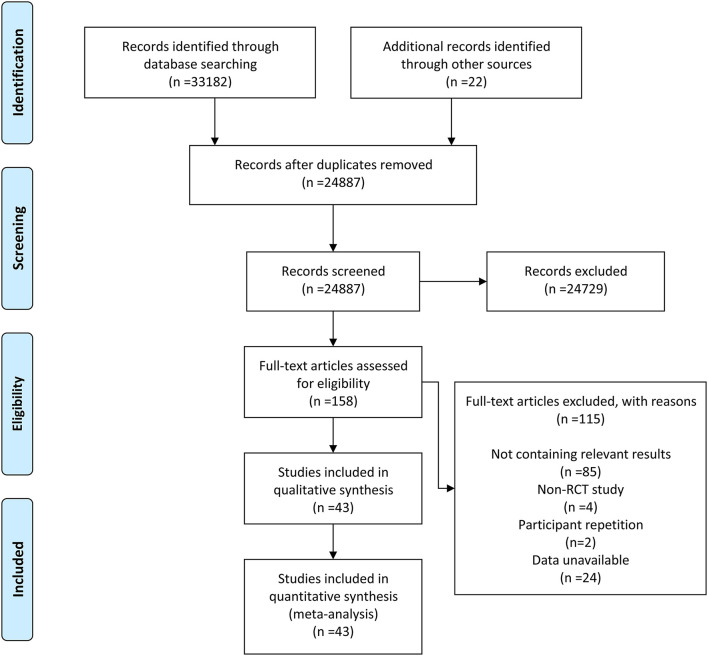
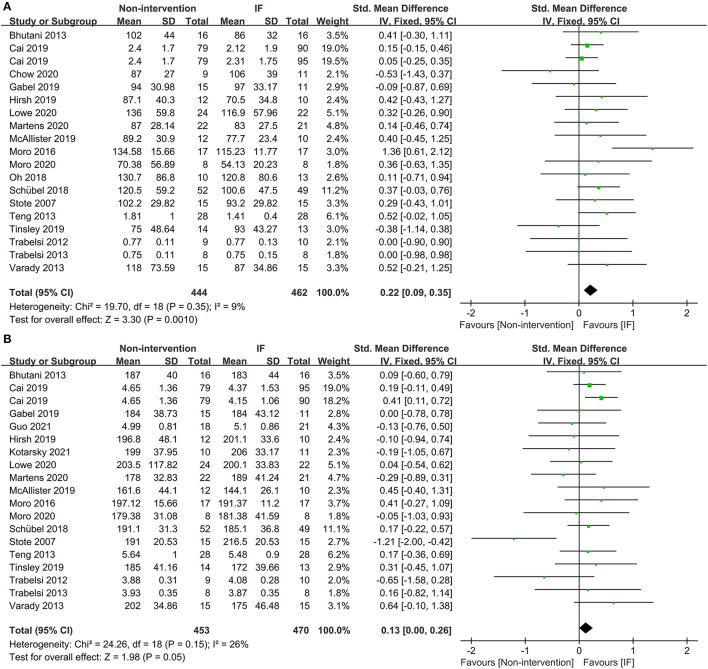
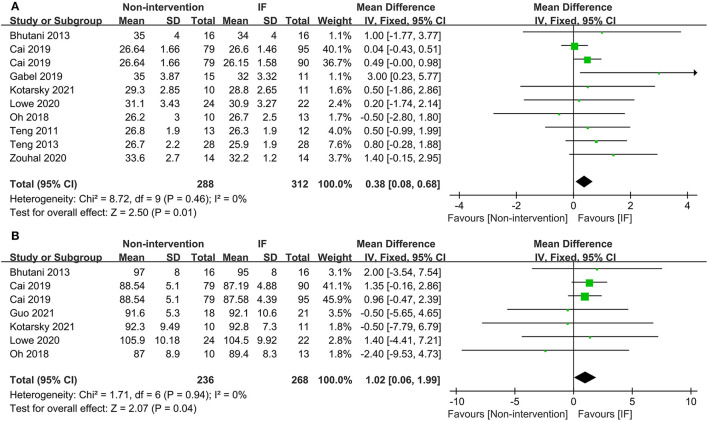
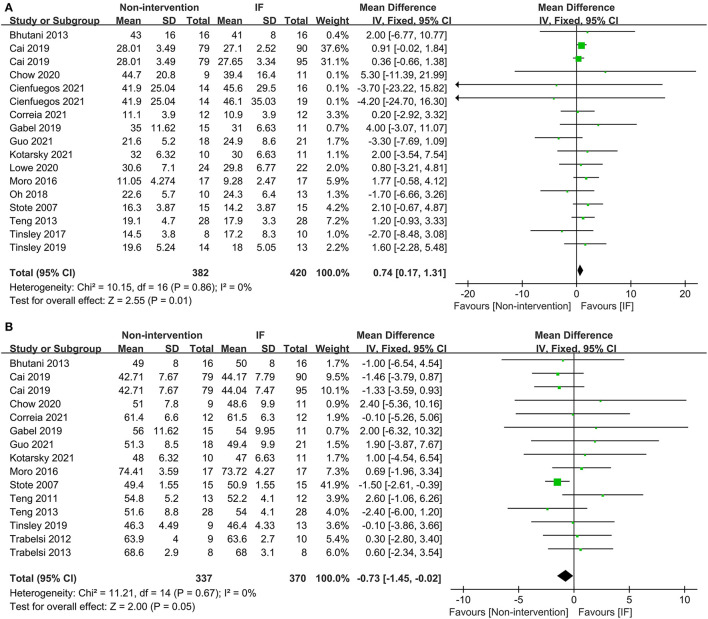
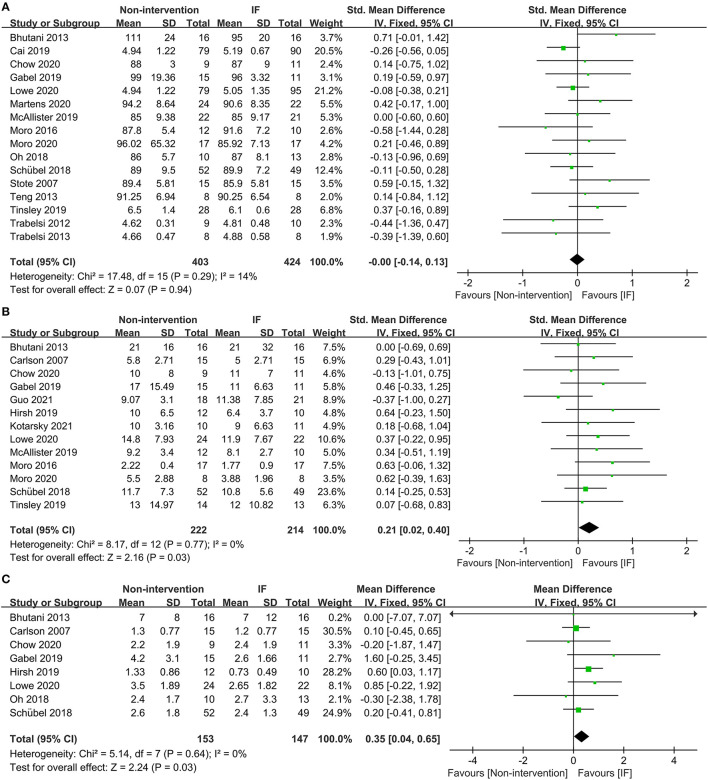
This study includes 43 RCTs with 2,483 participants. The intervention time was at least 1 month, and the median intervention time was 3 months. Contrasting results between IF and non-intervention diet showed that participants had lower weight (weighted mean difference (WMD) = 1.10, 95% CI: 0.09-2.12, = 0.03) and BMI after IF (WMD = 0.38, 95% CI: 0.08-0.68, = 0.01). The WC of participants after IF decreased significantly compared with the non-intervention diet (WMD = 1.02, 95% CI: 0.06-1.99, = 0.04). IF regulated fat mass (FM) more effectively than non-intervention diet (WMD = 0.74, 95% CI: 0.17-1.31, = 0.01). The fat-free mass of people after IF was higher (WMD = -0.73, 95% CI: (-1.45)-(-0.02), = 0.05). There was no difference in fasting blood glucose concentrations between participants in the after IF and non-intervention diet groups. The results of insulin concentrations and HOMA-IR, though, indicated that IF was significantly more beneficial than non-intervention diet (standard mean difference (SMD) = -0.21, 95% CI: 0.02-0.40, = 0.03, and WMD = 0.35, 95% CI: 0.04-0.65, = 0.03, respectively). Cholesterol and TG concentrations in participants after IF were also lower than that after a nonintervention diet (SMD = 0.22, 95% CI: 0.09-0.35, = 0.001 and SMD = 0.13, 95% CI: 0.00-0.26, = 0.05, respectively). IF outcomes did not differ from CR except for reduced WC.
Intermittent fasting was more beneficial in reducing body weight, WC, and FM without affecting lean mass compared to the non-intervention diet. IF also effectively improved insulin resistance and blood lipid conditions compared with non-intervention diets. However, IF showed less benefit over CR.
随着越来越多的人试图避免或减轻肥胖及代谢性疾病,间歇性禁食(IF)的应用愈发普遍。本研究旨在系统探讨不同类型的间歇性禁食对人体的影响。
在PubMed、科学网、Cochrane图书馆数据库和Embase中检索与间歇性禁食对比非干预饮食或热量限制(CR)的随机对照试验(RCT)。提取的结果包括但不限于体重、体重指数(BMI)、腰围(WC)、空腹血糖和甘油三酯(TG)。
本研究纳入43项RCT,共2483名参与者。干预时间至少为1个月,中位干预时间为3个月。间歇性禁食与非干预饮食的对比结果显示,间歇性禁食后参与者体重更低(加权均数差(WMD)=1.10,95%置信区间:0.09 - 2.12,P = 0.03),BMI也更低(WMD = 0.38,95%置信区间:0.08 - 0.68,P = 0.01)。与非干预饮食相比,间歇性禁食后参与者的腰围显著减小(WMD = 1.02,95%置信区间:0.06 - 1.99,P = 0.04)。间歇性禁食比非干预饮食更有效地调节脂肪量(FM)(WMD = 0.74,95%置信区间:0.17 - 1.31,P = 0.01)。间歇性禁食后人群的去脂体重更高(WMD = -0.73,95%置信区间:(-1.45)-(-0.02),P = 0.05)。间歇性禁食组与非干预饮食组参与者的空腹血糖浓度无差异。然而,胰岛素浓度和胰岛素抵抗指数(HOMA-IR)的结果表明,间歇性禁食比非干预饮食显著更有益(标准化均数差(SMD)= -0.21,95%置信区间:0.02 - 0.40,P = 0.03;WMD = 0.35,95%置信区间:0.04 - 0.65,P = 0.03)。间歇性禁食后参与者的胆固醇和甘油三酯浓度也低于非干预饮食后(SMD = 0.22,95%置信区间:0.09 - 0.35,P = 0.001;SMD = 0.13,95%置信区间:0.00 - 0.26,P = 0.05)。除腰围减小外,间歇性禁食的结果与热量限制无差异。
与非干预饮食相比,间歇性禁食在减轻体重、腰围和脂肪量方面更有益,且不影响瘦体重。与非干预饮食相比,间歇性禁食还能有效改善胰岛素抵抗和血脂状况。然而,与热量限制相比,间歇性禁食的益处较小。