Independent Consultant for the School of Public Health, Oregon Health & Science University, Portland, Oregon, United States of America.
Tropical and Highlands Veterinary Research Institute, University of San Marcos, Lima, Peru.
PLoS Comput Biol. 2022 May 19;18(5):e1010118. doi: 10.1371/journal.pcbi.1010118. eCollection 2022 May.
The Taenia solium tapeworm is responsible for cysticercosis, a neglected tropical disease presenting as larvae in the body of a host following taenia egg ingestion. Neurocysticercosis (NCC), the name of the disease when it affects the human central nervous system, is a major cause of epilepsy in developing countries, and can also cause intracranial hypertension, hydrocephalus and death. Simulation models can help identify the most cost-effective interventions before their implementation. Modelling NCC should enable the comparison of a broad range of interventions, from treatment of human taeniasis (presence of an adult taenia worm in the human intestine) to NCC mitigation. It also allows a focus on the actual impact of the disease, rather than using proxies as is the case for other models.
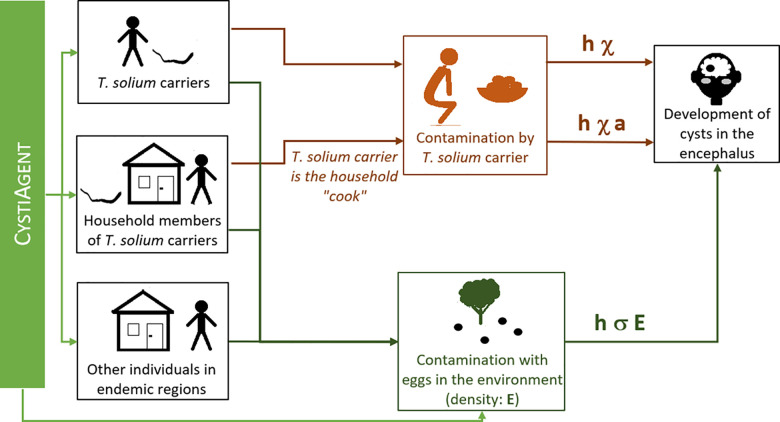
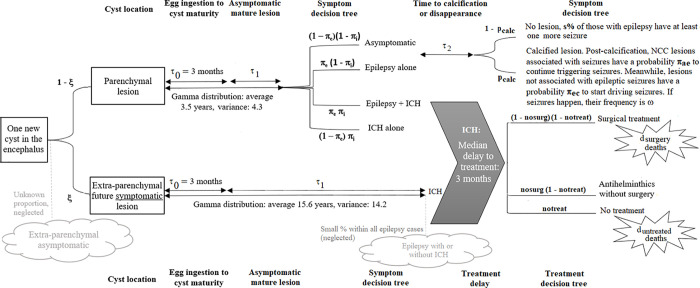
This agent-based model is the first model that simulates human NCC and associated pathologies. It uses the output of another model, CystiAgent, which simulates the evolution of pig cysticercosis and human taeniasis, adding human and cyst agents, including a model of cyst location and stage, human symptoms, and treatment. CystiHuman also accounts for delays in the appearance of NCC-related symptoms. It comprises three modules detailing cyst development, seizure probability and timing, and intracranial hypertension/hydrocephalus, respectively. It has been implemented in Java MASON and calibrated in three endemic villages in Peru, then applied to another village (Rica Playa) to compare simulation results with field data in that village.
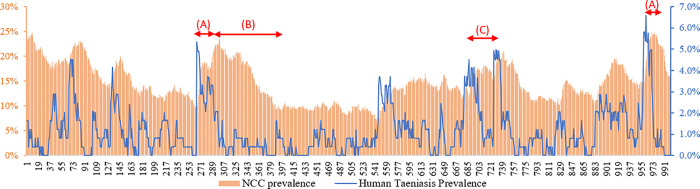
Despite limitations in available field data, parameter values found through calibration are plausible and simulated outcomes in Rica Playa are close to actual values for NCC prevalence and the way it increases with age and cases with single lesions. Initial simulations further suggest that short-term interventions followed by a rapid increase in taeniasis prevalence back to original levels may have limited impacts on NCC prevalence.
猪带绦虫是导致囊尾蚴病的元凶,这是一种被忽视的热带病,当人们摄入含有绦虫卵的食物后,幼虫会在宿主体内发育。当囊尾蚴病侵犯人体中枢神经系统时,被称为神经囊尾蚴病,是发展中国家癫痫的主要病因之一,还可引起颅内压升高、脑积水和死亡。模拟模型可以帮助在实施之前确定最具成本效益的干预措施。模拟囊尾蚴病应该能够比较从治疗人体带绦虫病(人肠内存在成虫绦虫)到减轻囊尾蚴病负担的广泛干预措施。它还可以关注疾病的实际影响,而不是像其他模型那样使用替代指标。
这个基于主体的模型是第一个模拟人类囊尾蚴病和相关病变的模型。它使用另一个模型 CystiAgent 的输出,该模型模拟猪囊尾蚴病和人类带绦虫病的演变,增加了人类和囊虫主体,包括囊虫位置和阶段、人类症状和治疗的模型。CystiHuman 还考虑了与囊尾蚴病相关症状出现之间的延迟。它由三个模块组成,分别详细描述了囊肿发育、癫痫发作的概率和时间,以及颅内压升高/脑积水。它已在 Java MASON 中实现,并在秘鲁的三个流行村庄进行了校准,然后应用于另一个村庄(Rica Playa),将模拟结果与该村庄的实地数据进行比较。
尽管现有实地数据存在局限性,但通过校准找到的参数值是合理的,并且 Rica Playa 的模拟结果与囊尾蚴病的流行率以及其随年龄和单个病变病例增加的方式非常接近。初步模拟进一步表明,短期干预后,带绦虫病的流行率迅速增加到原来的水平,可能对囊尾蚴病的流行率影响有限。