Department of Parasitology, Bangladesh Agricultural University, Mymensingh, Bangladesh.
Institute of Parasitology, Justus Liebig University Giessen, Giessen, Germany.
Parasit Vectors. 2023 Oct 24;16(1):380. doi: 10.1186/s13071-023-05989-6.
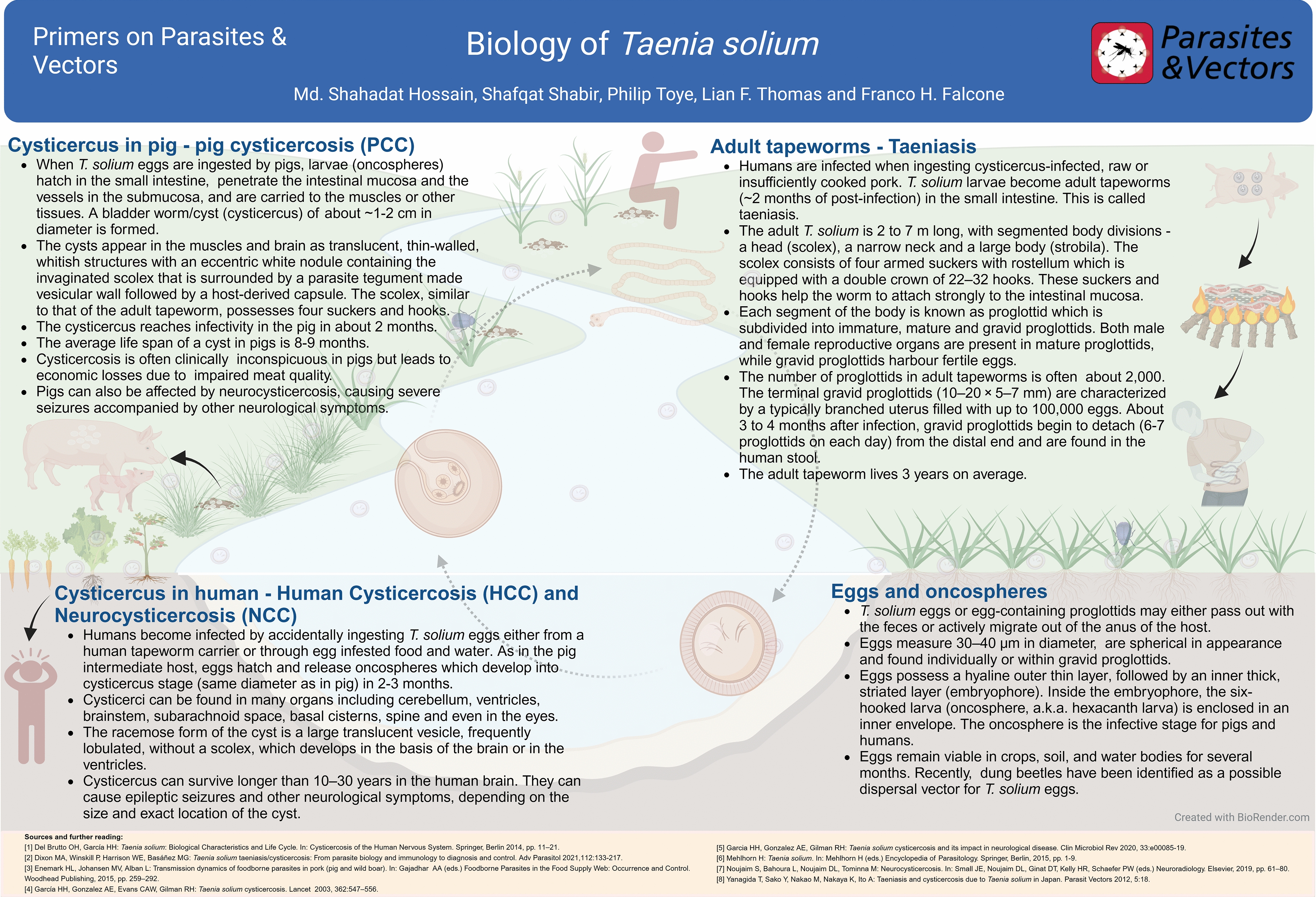
Taenia solium taeniasis/cysticercosis (TSTC) is a foodborne, zoonotic neglected tropical disease affecting predominately low- and middle-income countries. Humans are definitive hosts for T. solium, whereas pigs act as intermediate hosts. Taeniasis, i.e. intestinal infection with adult T. solium in the human host, occurs through ingestion of undercooked pork infected with the larval stage (porcine cysticercosis, PCC). Human cysticercosis occurs after humans ingest T. solium eggs, acting as accidental intermediate hosts. Migration of cysticerci to the human brain results in neurocysticercosis (NCC), manifesting in a variety of clinical symptoms, most notably epilepsy. NCC is the leading cause of acquired epilepsy cases in endemic areas. PCC results in reduced pork value because of condemnation or the risk of condemnation of the meat. Available serological diagnostic tests for porcine and human cysticercosis are characterized by low sensitivity and are not cost-effective. An effective vaccine for T. solium cysticercosis in pigs has been developed, although it is not yet commercially available in all endemic countries, and still no vaccine is available for use in humans. This primer highlights the recent development in the field of diagnostic tests and vaccine production and explores possible strategies for future control and eradication of T. solium. In the absence of highly specific diagnostic tests and human vaccines, treatment of infected pigs and tapeworm carriers and prevention of disease transmission remain the principal means to interrupt the zoonotic cycle of T. solium in endemic countries.
猪带绦虫病/囊尾蚴病(TSTC)是一种食源性、动物源性、被忽视的热带病,主要影响低收入和中等收入国家。人类是猪带绦虫的终末宿主,而猪则是中间宿主。带绦虫病,即人类宿主感染猪带绦虫的成虫,是通过摄入未煮熟的感染幼虫阶段(猪囊尾蚴病,PCC)的猪肉而发生的。人类囊尾蚴病是在人类摄入猪带绦虫卵后发生的,人类充当偶然的中间宿主。囊尾蚴迁移到人类大脑会导致脑囊尾蚴病(NCC),表现出多种临床症状,最常见的是癫痫。在流行地区,NCC 是获得性癫痫病例的主要原因。PCC 会导致猪肉价值降低,因为肉可能会被拒收或有被拒收的风险。现有的猪和人类囊尾蚴病血清学诊断检测方法的灵敏度较低,且不具有成本效益。已经开发出针对猪的有效猪带绦虫囊尾蚴病疫苗,但尚未在所有流行国家都可获得,并且仍然没有可用于人类的疫苗。本入门读物重点介绍了诊断检测和疫苗生产领域的最新进展,并探讨了未来控制和根除 T. solium 的可能策略。在缺乏高度特异性诊断检测和人类疫苗的情况下,治疗感染的猪和绦虫携带者以及预防疾病传播仍然是在流行国家中断 T. solium 人畜共患病循环的主要手段。