N ephrology and Dialysis, Alessandro Manzoni Hospital, Lecco, Italy.
Associazione Italiana Ricercare per Curare (AIRpC), Lecco, Italy.
Nephrol Dial Transplant. 2023 Feb 28;38(3):655-663. doi: 10.1093/ndt/gfac177.
The known risks and benefits of native kidney biopsies are mainly based on the findings of retrospective studies. The aim of this multicentre prospective study was to evaluate the safety of percutaneous renal biopsies and quantify biopsy-related complication rates in Italy.
The study examined the results of native kidney biopsies performed in 54 Italian nephrology centres between 2012 and 2020. The primary outcome was the rate of major complications 1 day after the procedure, or for longer if it was necessary to evaluate the evolution of a complication. Centre and patient risk predictors were analysed using multivariate logistic regression.
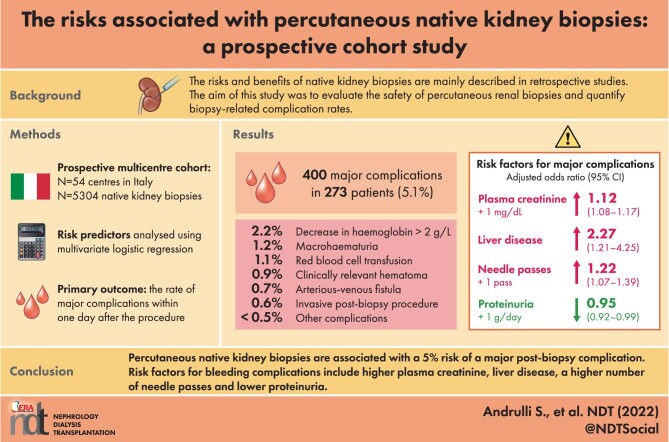
Analysis of 5304 biopsies of patients with a median age of 53.2 years revealed 400 major complication events in 273 patients (5.1%): the most frequent was a ≥2 g/dL decrease in haemoglobin levels (2.2%), followed by macrohaematuria (1.2%), blood transfusion (1.1%), gross haematoma (0.9%), artero-venous fistula (0.7%), invasive intervention (0.5%), pain (0.5%), symptomatic hypotension (0.3%), a rapid increase in serum creatinine levels (0.1%) and death (0.02%). The risk factors for major complications were higher plasma creatinine levels [odds ratio (OR) 1.12 for each mg/dL increase, 95% confidence interval (95% CI) 1.08-1.17], liver disease (OR 2.27, 95% CI 1.21-4.25) and a higher number of needle passes (OR for each pass 1.22, 95% CI 1.07-1.39), whereas higher proteinuria levels (OR for each g/day increase 0.95, 95% CI 0.92-0.99) were protective.
This is the first multicentre prospective study showing that percutaneous native kidney biopsies are associated with a 5% risk of a major post-biopsy complication. Predictors of increased risk include higher plasma creatinine levels, liver disease and a higher number of needle passes.
目前,人们对于经皮肾活检的已知风险和获益主要基于回顾性研究的结果。本多中心前瞻性研究旨在评估意大利经皮肾活检的安全性,并量化活检相关并发症的发生率。
该研究分析了 2012 年至 2020 年间意大利 54 个肾病中心进行的 5304 例经皮肾活检的结果。主要结局为术后 1 天或如果需要评估并发症的进展,则为更长时间内发生的严重并发症发生率。使用多变量逻辑回归分析中心和患者的风险预测因素。
对 5304 例中位年龄为 53.2 岁的患者的活检进行分析,发现 273 例患者(5.1%)发生 400 例严重并发症事件:最常见的是血红蛋白水平下降≥2 g/dL(2.2%),其次是镜下血尿(1.2%)、输血(1.1%)、肉眼血肿(0.9%)、动静脉瘘(0.7%)、侵入性干预(0.5%)、疼痛(0.5%)、症状性低血压(0.3%)、血清肌酐水平快速升高(0.1%)和死亡(0.02%)。严重并发症的危险因素包括更高的血浆肌酐水平[每增加 1mg/dL 的比值比(OR)为 1.12,95%置信区间(95%CI)为 1.08-1.17]、肝病(OR 2.27,95%CI 1.21-4.25)和更多的针道数(每增加一次针道的 OR 为 1.22,95%CI 1.07-1.39),而更高的蛋白尿水平(每增加 1g/天的 OR 为 0.95,95%CI 0.92-0.99)则具有保护作用。
这是第一项多中心前瞻性研究,表明经皮肾活检与 5%的严重活检后并发症风险相关。风险增加的预测因素包括更高的血浆肌酐水平、肝病和更多的针道数。