
颈动脉僵硬度可预测中年人群的心血管风险分层:基于超快超声成像的非侵入性量化分析
Carotid stiffening predicts cardiovascular risk stratification in mid-life: non-invasive quantification with ultrafast ultrasound imaging.
作者信息
Zhu Zhengqiu, Chen Lingshan, Liu Wenjun, Wu Yiyun, Zou Chong, Zhang Xinyi, He Shanshan, Wang Yinping, Shen Bixiao, Ma Xuehui, Gao Hui, Luan Yun, Huang Hui
机构信息
Department of Ultrasound, Affiliated Hospital of Nanjing University of Chinese Medicine, Jiangsu Province Hospital of Chinese Medicine, Nanjing, China.
Department of Radiology, Affiliated Hospital of Nanjing University of Chinese Medicine, Jiangsu Province Hospital of Chinese Medicine, Nanjing, China.
出版信息
Ultrasonography. 2022 Jul;41(3):462-472. doi: 10.14366/usg.21197. Epub 2021 Nov 1.
PURPOSE
The present study investigated the association between Systematic COronary Risk Evaluation (SCORE)-estimated cardiovascular risk and carotid stiffening in a middle-aged population using ultrafast pulse wave velocity (ufPWV).
METHODS
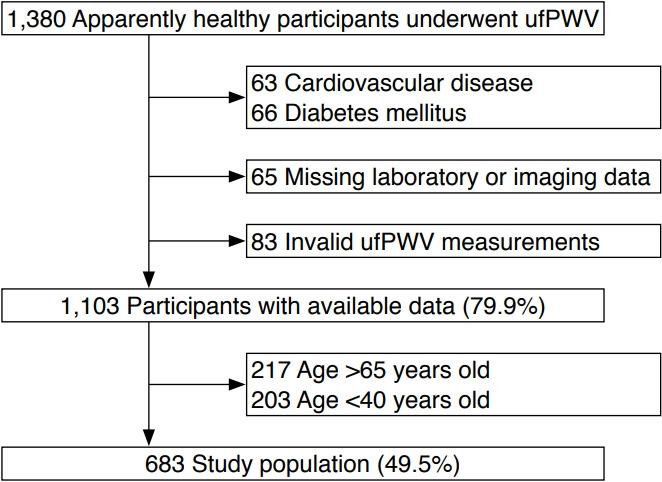
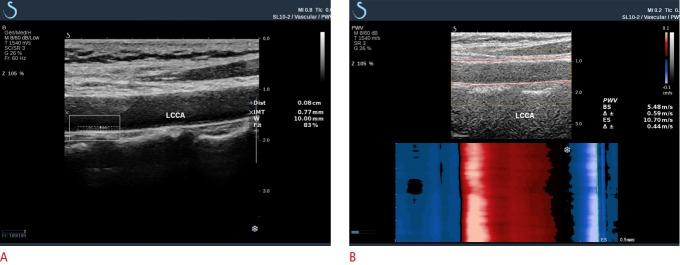
This study enrolled 683 participants without known cardiovascular disease or diabetes mellitus who underwent ufPWV measurements. Clinical interviews, physical examinations, laboratory findings, carotid intima-media thickness (cIMT), pulse wave velocity (PWV) at the beginning of systole (PWV-BS), and PWV at the end of systole (PWV-ES) were assessed. Each participant underwent an assessment of SCORE risk based on major cardiovascular risk factors (CVRFs), including age, sex, smoking, systolic blood pressure (SBP), and total cholesterol (TC). Crude and adjusted odds ratios (ORs) with 95% confidence intervals and ordinal logistic regression were used. Overall CVRFs were adjusted to assess ORs.
RESULTS
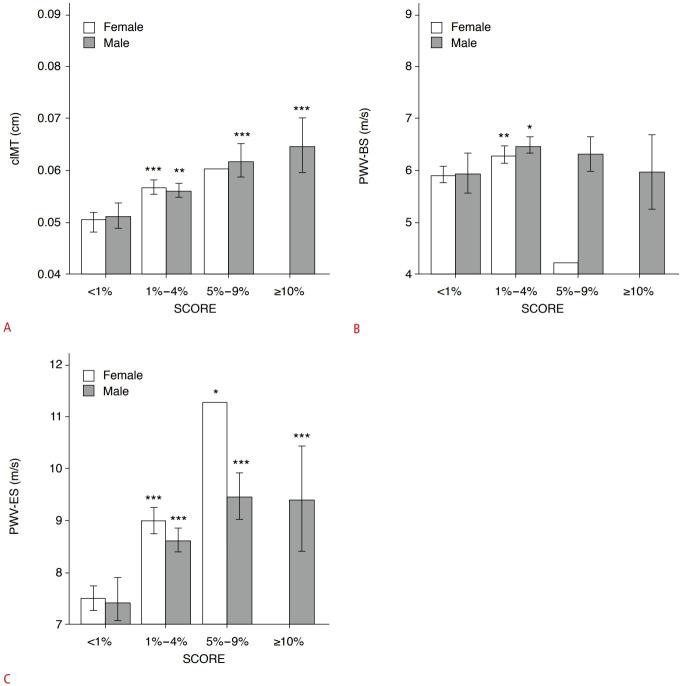
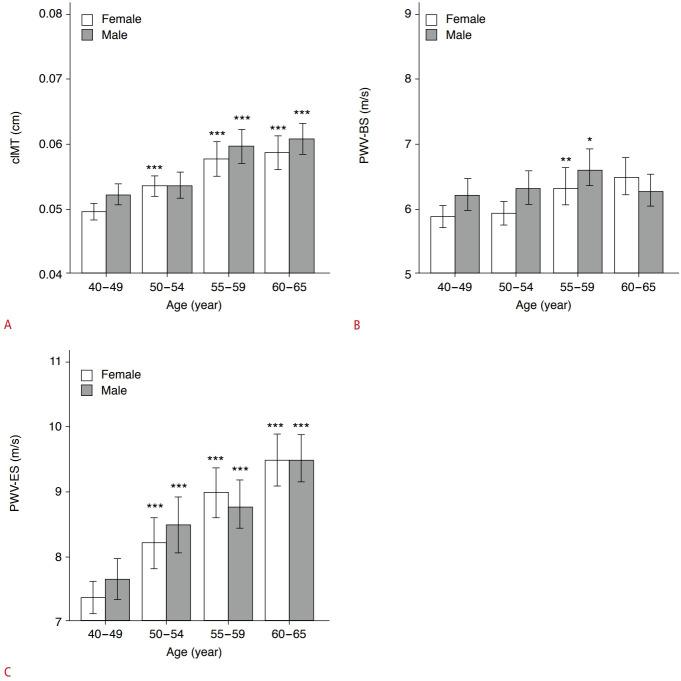
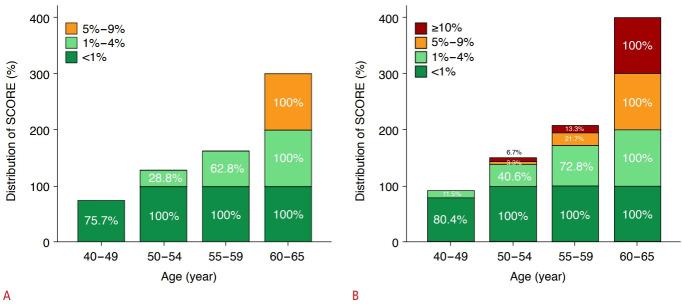
cIMT and carotid stiffening in PWV-BS and PWV-ES were significantly different between sex subgroups (all P<0.05), but only PWV-ES increased gradually in age and SCORE-estimated risk subgroups (all P<0.05). Compared with cIMT (r=0.388, P<0.001) and PWV-BS (r=0.159, P<0.001), PWV-ES was more strongly correlated with SCORE categories (r=0.405, P<0.001). Higher PWV-ES values were associated with SCORE categories independently of sex, SBP, TC, and smoking in moderate-risk and high-risk subgroups (OR, 1.63; P<0.001 and OR, 2.12; P=0.024, respectively), but were not independent of age in all risk subgroups (all P>0.05).
CONCLUSION
Carotid stiffening quantified by ufPWV is linked to SCORE categories, and elevated PWV-ES may aid in cardiovascular risk stratification.
目的
本研究采用超快速脉搏波速度(ufPWV),调查中年人群中系统性冠状动脉风险评估(SCORE)估计的心血管风险与颈动脉僵硬度之间的关联。
方法
本研究纳入了683名无已知心血管疾病或糖尿病的参与者,他们接受了ufPWV测量。评估了临床访谈、体格检查、实验室检查结果、颈动脉内膜中层厚度(cIMT)、收缩期开始时的脉搏波速度(PWV-BS)和收缩期末尾的脉搏波速度(PWV-ES)。根据年龄、性别、吸烟、收缩压(SBP)和总胆固醇(TC)等主要心血管危险因素(CVRF)对每位参与者进行SCORE风险评估。使用了95%置信区间的粗比值比和调整比值比以及有序逻辑回归。对总体CVRF进行调整以评估比值比。
结果
性别亚组之间,cIMT以及PWV-BS和PWV-ES中的颈动脉僵硬度存在显著差异(所有P<0.05),但仅PWV-ES在年龄和SCORE估计风险亚组中逐渐增加(所有P<0.05)。与cIMT(r=0.388,P<0.001)和PWV-BS(r=0.159,P<0.001)相比,PWV-ES与SCORE类别相关性更强(r=0.405,P<0.001)。在中度风险和高风险亚组中,较高的PWV-ES值与SCORE类别独立相关,不受性别、SBP、TC和吸烟影响(比值比分别为1.63;P<0.001和2.12;P=0.024),但在所有风险亚组中与年龄不独立相关(所有P>0.05)。
结论
通过ufPWV量化的颈动脉僵硬度与SCORE类别相关,升高的PWV-ES可能有助于心血管风险分层。
 Zotero 插件