Barwon Medical Imaging, Barwon Health, Geelong, Australia.
GIRADI Research Institute, Geelong, Australia.
Physiother Res Int. 2022 Jul;27(3):e1957. doi: 10.1002/pri.1957. Epub 2022 May 19.
To determine intra-session test-retest reliability, agreement and minimum detectable change (MDC) of the 30 CST across three tests in people with knee osteoarthritis (OA).
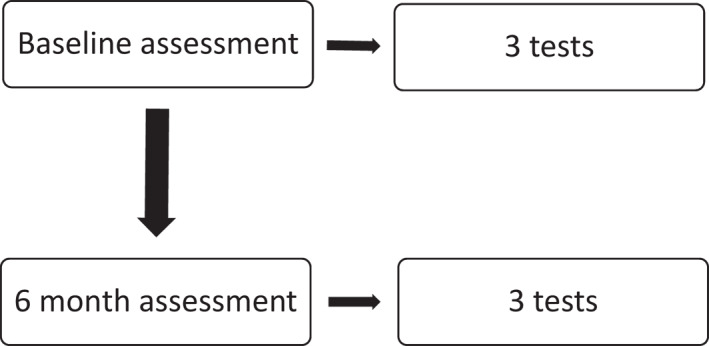
A test-retest reliability study was performed with 93 people with mild radiological knee OA. Participants were asked to complete three attempts of the 30 CST 1-2 min apart according to a standardised protocol. Participants completed three attempts on two occasions: baseline and 6 months later. Change between tests within each session was assessed with ANOVA's and post-hoc t-tests. Reliability was assessed with intra-class correlation coefficients (ICC ). Measurement error was expressed as MDC for an individual (MDC ) and a group (MDC ). Floor effects were considered present if more than 15% of participants scored zero for a test.
Scores increased by 0.5 and 0.8 stands between the first and second test (p < 0.05) at the baseline and 6-month assessments respectively, and then stabilised between the second the third tests at the baseline assessment (p > 0.05) or decreased (0.3 stands) at the 6-month assessment (p < 0.05). Scores demonstrated excellent reliability (ICCs >0.9). MDC was approximately 2.5 stands and MDC was 0.3-0.4 stands. No floor effects were apparent.
The 30CST demonstrated a practice effect between the first and second tests, which was no longer apparent by the third test. Despite this, scores demonstrated excellent intra-session reliability. MDC estimates provide clinicians and researchers with the smallest change that can be detected by the instrument beyond measurement error for individuals and groups in community-dwelling adults with knee OA.
旨在确定膝关节骨关节炎(OA)患者在三次 30 秒连续坐站测试(30CST)中,每个测试内的测试-重测信度、一致性和最小可检测变化(MDC)。
本研究为测试-重测信度研究,纳入 93 例轻度放射学膝关节 OA 患者。参与者按照标准方案,在 1-2 分钟内完成三次 30CST 尝试。参与者在两次就诊时完成三次尝试:基线和 6 个月后。采用方差分析(ANOVA)和事后 t 检验评估每个测试内各次测试之间的变化。采用组内相关系数(ICC)评估可靠性。个体的测量误差表示为个体 MDC(MDC )和组 MDC(MDC )。如果一个测试有超过 15%的参与者得分为零,则认为存在地板效应。
在基线和 6 个月评估时,第一次和第二次测试之间的分数分别增加了 0.5 和 0.8 个站位(p<0.05),然后在基线评估的第二次和第三次测试之间稳定(p>0.05),或者在 6 个月评估时下降(0.3 个站位,p<0.05)。分数显示出极好的可靠性(ICC>0.9)。MDC 约为 2.5 个站位,MDC 为 0.3-0.4 个站位。没有明显的地板效应。
30CST 在第一次和第二次测试之间表现出练习效应,但在第三次测试中不再明显。尽管如此,分数仍表现出极好的测试内可靠性。MDC 估计值为临床医生和研究人员提供了个体和群体在社区居住的膝关节 OA 患者中,除了测量误差之外,仪器可以检测到的最小变化。