University of Wisconsin, Madison, Wisconsin.
Brown University, Providence, Rhode Island.
Arthritis Rheumatol. 2022 Sep;74(9):1569-1579. doi: 10.1002/art.42238. Epub 2022 Aug 3.
Although symptom relief is a critical aspect for successful drug development in Sjögren's disease, patient experiences with Sjögren's-related symptoms are understudied. Our objective was to determine how pain, dryness, and fatigue, the cardinal symptoms of Sjögren's disease, drive cluster phenotypes.
We used data from the Sjögren's International Collaborative Clinical Alliance (SICCA) Registry and a Sjögren's Foundation survey. We performed hierarchical clustering of symptoms by levels of dryness, fatigue, and pain. Using international and US cohorts, we performed multiple logistic regression analysis to compare the clusters, which included comparisons of differences in symptoms, quality of life (QoL), medication use, and systemic manifestations.
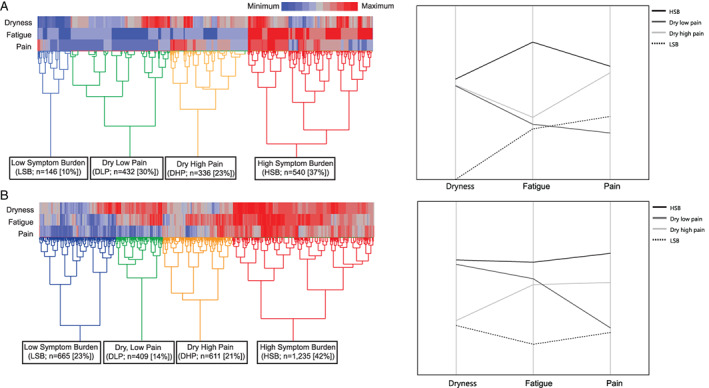
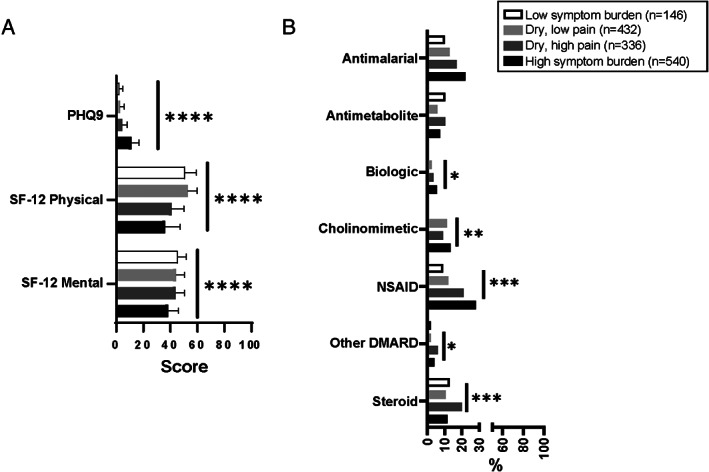
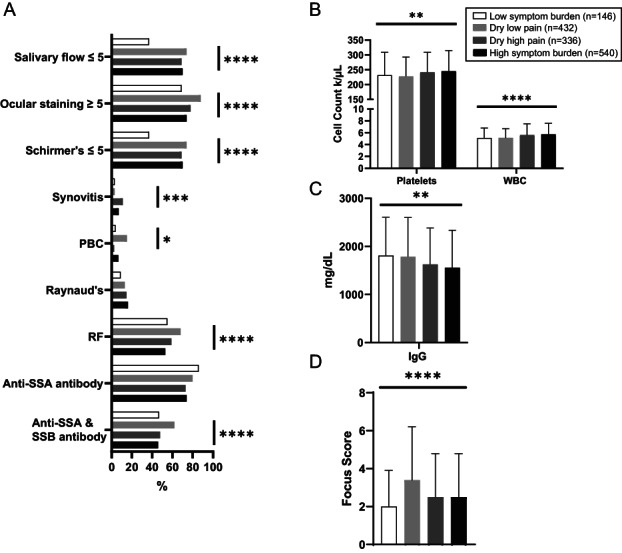
Four similar clusters were identified among 1,454 SICCA registrants and 2,920 Sjögren's Foundation survey participants: 1) low symptom burden in all categories (LSB); 2) dry with low pain and low fatigue (DLP); 3) dry with high pain and low to moderate fatigue (DHP); and 4) high symptom burden in all categories (HSB). Distribution of SICCA registrants matching the symptom profile for each cluster was 10% in the LSB cluster, 30% in the DLP cluster, 23% in the DHP cluster, and 37% in the HSB cluster. Distribution of survey participants matching the symptom profile for each cluster was 23% in the LSB cluster, 14% in the DLP cluster, 21% in the DHP cluster, and 42% in the HSB cluster. Individuals in the HSB cluster had more total symptoms and lower QoL but lower disease severity than those in the other clusters. Despite having milder disease as measured by laboratory tests and organ involvement, individuals in the HSB cluster received immunomodulatory treatment most often.
We identified 4 symptom-based Sjögren's clusters and showed that symptom burden and immunomodulatory medication use do not correlate with Sjögren's end-organ or laboratory abnormalities. Findings highlight a discordance between objective measures and treatments and offer updates to proposed symptom-based clustering approaches.
尽管症状缓解是干燥综合征药物开发成功的关键方面,但患者对干燥综合征相关症状的体验研究不足。本研究旨在确定干燥、疲劳和疼痛这三种干燥综合征的主要症状如何驱动聚类表型。
我们使用了干燥综合征国际临床协作联盟(SICCA)注册处和干燥综合征基金会调查的数据。我们通过干燥、疲劳和疼痛的水平对症状进行层次聚类。使用国际和美国队列,我们进行了多项逻辑回归分析以比较聚类,包括比较症状、生活质量(QoL)、药物使用和全身表现的差异。
在 1454 名 SICCA 登记患者和 2920 名干燥综合征基金会调查参与者中,我们确定了 4 种相似的聚类:1)所有类别中低症状负担(LSB);2)干燥伴低疼痛和低疲劳(DLP);3)干燥伴高疼痛和低至中度疲劳(DHP);4)所有类别中高症状负担(HSB)。符合每个聚类症状特征的 SICCA 登记患者的分布为:LSB 聚类为 10%,DLP 聚类为 30%,DHP 聚类为 23%,HSB 聚类为 37%。符合每个聚类症状特征的调查参与者的分布为:LSB 聚类为 23%,DLP 聚类为 14%,DHP 聚类为 21%,HSB 聚类为 42%。HSB 聚类的个体总症状更多,生活质量更低,但疾病严重程度低于其他聚类。尽管实验室检查和器官受累程度较轻,但 HSB 聚类的个体最常接受免疫调节治疗。
我们确定了 4 种基于症状的干燥综合征聚类,并表明症状负担和免疫调节药物的使用与干燥综合征的终末器官或实验室异常无关。研究结果突出了客观测量和治疗之间的不匹配,并为基于症状的聚类方法提供了更新。