
女子柔道运动员从早到晚柔道专项体能测试表现的变化:专项热身对表现及其日波动幅度的影响
Judo specific fitness test performance variation from morning to evening: specific warm-ups impacts performance and its diurnal amplitude in female judokas.
作者信息
Eken Özgür, Clemente Filipe Manuel, Nobari Hadi
机构信息
Physical Education and Sports Teaching, Faculty of Sport Science, Inonu University, Battalgazi, Malatya, Turkey.
Escola Superior Desporto e Lazer, Instituto Politécnico de Viana do Castelo, Rua Escola Industrial e Comercial de Nun'Álvares, 4900-347, Viana do Castelo, Portugal.
出版信息
BMC Sports Sci Med Rehabil. 2022 May 21;14(1):92. doi: 10.1186/s13102-022-00484-4.
BACKGROUND
A number of specific tests are used to standardize competition performance. Specific Judo fitness test (SJFT) can be applied by considering the start of the competition qualifiers in the morning and the continuation of the final competitions in the evening. The improvement of test performances can be achieved with warm-up for elevating heart rate (HR) and muscle temperature such as raise, activate, mobilise, potentiate (RAMP) protocols.
PURPOSE
The aim of this study is to evaluate the effects of different warm-up protocols on SJFT at different times of the day in female judokas.
METHODS
Ten volunteer women participated in this study, who regularly participated in judo training for more than 5 years and actively competed in international competitions. Judokas completed SJFT, either after no warm-up, or RAMP protocols like specific warm-up (SWU), and dynamic warm-up for two times a day in the morning: 09:00-10:00 and in the evening: 16:00-17:00, with at least 2 days between test sessions. The following variables were recorded: throws performed during series A, B, and C; the total number of throws; HR immediately and 1 min after the test, and test index after different warm-ups.
RESULTS
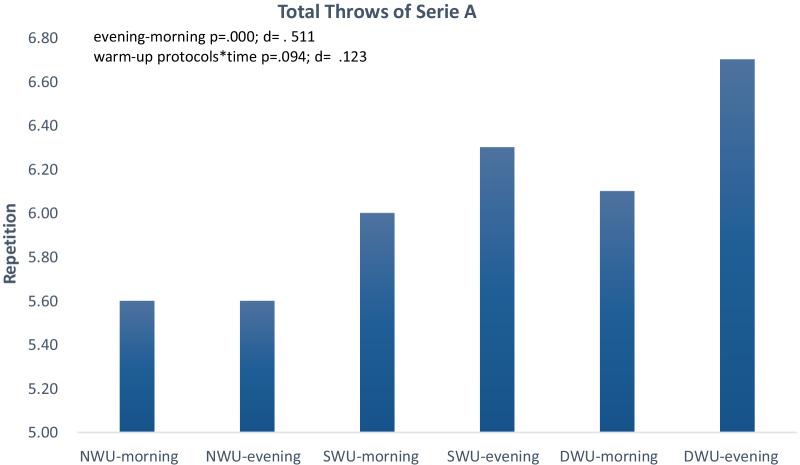
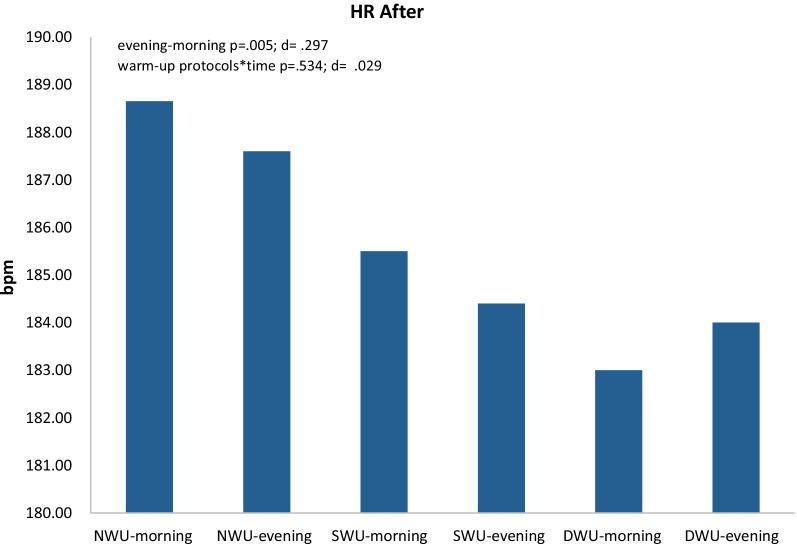
When analyzed evening compared to the morning without discriminating three warm-up protocols, evening results statistically significant number of total throws performed during series A, B, and C, the total number of throws; HR immediately and 1 min after the test, and test index than morning results (p < 0.01). Moreover, RAMP protocols interaction with time have demonstrated an impact on SJFT for index [F = 4.15, p = 0.024, η: 0.19] and changes after 1 min HR [F 7.16, p = 0.008, η: 0.29]. HR after 1 min and test index results were statistically significant in favor of SWU (p < 0.05).
CONCLUSIONS
In conclusion, SJFT performance showed diurnal variation and judo performances of the judokas can be affected more positively in the evening hours especially after RAMP protocols.
背景
多项特定测试用于规范比赛表现。特定柔道体能测试(SJFT)可通过考虑上午比赛资格赛的开始以及晚上决赛的继续进行来应用。通过热身提升心率(HR)和肌肉温度,如提升、激活、动员、增强(RAMP)方案,可实现测试表现的提高。
目的
本研究旨在评估不同热身方案在一天中不同时间对女性柔道运动员SJFT的影响。
方法
十名志愿者女性参与了本研究,她们定期参加柔道训练超过5年且积极参加国际比赛。柔道运动员在未热身、或进行特定热身(SWU)等RAMP方案以及动态热身的情况下,于上午09:00 - 10:00和晚上16:00 - 17:00每天进行两次SJFT,测试 session 之间至少间隔2天。记录以下变量:A、B和C系列中完成的投掷次数;总投掷次数;测试后立即和1分钟后的心率,以及不同热身后的测试指数。
结果
在不区分三种热身方案的情况下,与上午相比,晚上分析时,晚上在A、B和C系列中完成的总投掷次数、总投掷次数;测试后立即和1分钟后的心率以及测试指数的结果在统计学上显著高于上午结果(p < 0.01)。此外,RAMP方案与时间的交互作用已证明对SJFT的指数[F = 4.15,p = 0.024,η:0.19]和1分钟后心率变化[F 7.16,p = 0.008,η:0.29]有影响。1分钟后的心率和测试指数结果在统计学上显著有利于SWU(p < 0.05)。
结论
总之,SJFT表现呈现昼夜变化,尤其是在晚上且特别是在RAMP方案后,柔道运动员的柔道表现可受到更积极的影响。




 Zotero 插件