MOODS Team, INSERM U1178, CESP, Université Paris-Saclay, Faculté de Médecine Paris- Saclay, Le Kremlin Bicêtre, F-94275, France; Service Hospitalo-Universitaire de Psychiatrie de Bicêtre, Mood Center Paris Saclay, Assistance Publique-Hôpitaux de Paris, Hôpitaux Universitaires Paris-Saclay, Hôpital de Bicêtre, F-94275, France; Institute of Psychiatry and Neuroscience of Paris (IPNP), Université Paris Cité, INSERM U1266, F-75014 Paris, France.
Center for Research in Epidemiology and Population Health (CESP), National Institute of Health and Medical Research (INSERM) U1018, Paris-Saclay University, Villejuif, France; Assistance Publique des Hôpitaux de Paris (AP-HP), France.
J Affect Disord. 2022 Aug 15;311:165-172. doi: 10.1016/j.jad.2022.05.087. Epub 2022 May 18.
COVID19 pandemic had a huge impact on global mental health. Health students, because of their age and status, are a more at-risk population. National survey during the first wave already found high levels of psychological distress.
This nationwide study aimed to assess health's student mental health during the third wave in France.
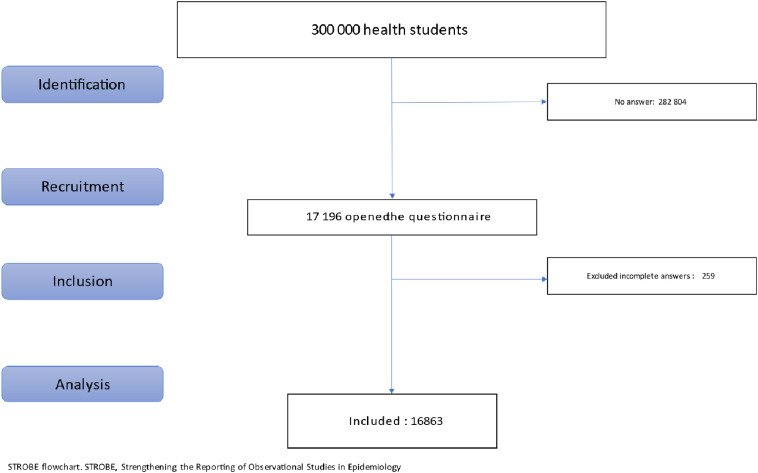
We did an online national cross-sectional study, which addressed all health students from April 4th to May 11th 2021. The questionnaire included sociodemographic and work conditions questions, Kessler 6 scale, and numeric scales.
16,937 students answered, including 54% nurse and 16% medical students. Regarding K6 scale, 14% have moderate (8-12) and 83% high (≥13) level of psychological distress. In multivariate analysis, being a man (OR = 0.54, 95% CI [0.48; 0.60], p < 0.001) and not living alone (OR = 0.71, 95% CI [0.62; 0.82], p < 0.001), are associated with a reduced risk of psychological distress. Not having the ability to isolate themselves (OR = 1.58, 95% CI [1.39; 1.81], p < 0.001), and having low (OR = 2.31, 95% CI [2.08; 2.56], p < 0.001) or important (OR = 4.58, 95% CI [3.98; 5.29], p < 0.001) financial difficulties are associated with an increased risk of psychological distress.
The response rate was low regarding the target population (300,000 health students).
Compared to the first national survey, we noticed mental health deterioration. Psychological distress (83% high level versus 21%), substance use (21% versus 13%), and psychotropic treatment use (18% versus 7.3%) hugely increased. These results highlighted the need to increase support actions for health students.
COVID19 大流行对全球心理健康产生了巨大影响。由于年龄和地位,医学生是一个更易受影响的群体。第一波疫情期间的全国性调查已经发现了高水平的心理困扰。
本项全国性研究旨在评估法国第三波疫情期间医学生的心理健康状况。
我们进行了一项在线全国性横断面研究,调查对象为 2021 年 4 月 4 日至 5 月 11 日期间的所有医学生。问卷包括社会人口学和工作条件问题、Kessler 6 量表和数字量表。
16937 名学生回答了问题,其中包括 54%的护士和 16%的医学生。根据 K6 量表,14%的学生有中度(8-12)和 83%的学生有高度(≥13)心理困扰。多变量分析显示,男性(OR=0.54,95%CI[0.48;0.60],p<0.001)和不住在一起(OR=0.71,95%CI[0.62;0.82],p<0.001)与降低心理困扰的风险相关。无法自我隔离(OR=1.58,95%CI[1.39;1.81],p<0.001)以及经济困难程度低(OR=2.31,95%CI[2.08;2.56],p<0.001)或严重(OR=4.58,95%CI[3.98;5.29],p<0.001)与心理困扰风险增加相关。
针对目标人群(30 万名医学生),回复率较低。
与第一次全国性调查相比,我们发现心理健康状况恶化。心理困扰(83%为高水平,而第一次调查为 21%)、物质使用(21%对 13%)和精神药物治疗使用(18%对 7.3%)大幅增加。这些结果突显了增加医学生支持行动的必要性。