Center for research in epidemiology and population health (CESP), National Institute of Health and Medical Research (INSERM) U1018, Paris-Saclay University, Villejuif, France; Service Hospitalo-Universitaitre de Psychiatrie de Bicêtre, Hôpitaux Universitaires Paris-Saclay, Assistaice Publique-Hôpitaux de Paris, Hôpital de Bicêtre, F-94275 Le Kremlin Bicêtre, France.
Institute of Psychiatry and Neuroscience of Paris (IPNP), Université de Paris, INSERM U1266, 75014 Paris, France.
Encephale. 2023 Jun;49(3):219-226. doi: 10.1016/j.encep.2021.12.004. Epub 2022 Feb 4.
In France, care workers and health students have been intensely mobilized during the first wave of the COVID-19 pandemic. But few studies have evaluated psychological distress on non-medical health students, in addition to the challenges posed by pedagogical continuity while universities are closed following health and safety regulations.
This study aims to assess COVID-19's impact on health students in France on different levels: psychological, educational and social.
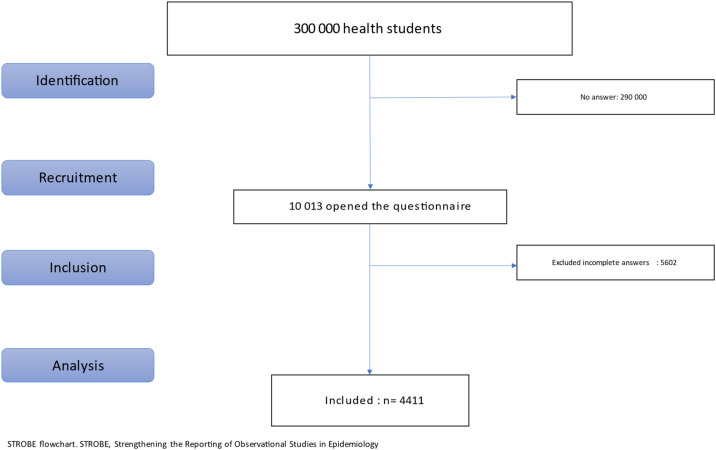
An online national cross-sectional study, from April 11 to May 30 2020, included sociodemographic, work conditions and numeric scales.
A total of 4411 students answered. Regarding the K6 scale, 39% of students had moderate distress, and 21% had a high level of distress. Risk factors of psychological distress included being a woman (P<0.001), being between 19 and 21 years old (P<0.001), living alone (P=0.008), and not having the ability to isolate (P<0.001). Students on the frontline had less psychological distress (57 vs 62%, P=0.003), better quality of sleep (34% vs 28% high quality, P<0.001) but a higher consumption of medical (8.5% vs 6.5%, P=0.044) and non-medical (18% vs 10%, P<0.001) psychotropic drugs. Nurse and medical students had more distress and used more non-medical psychotropic substances than other health students (15% vs 9.2%).
COVID-19' crisis had an important impact on health students' mental health, social life and training with discrepancies regarding the speciality whether they were on the frontline or not. There is an urgent need for psychological and pedagogical support for students, and even more so regarding the prolongation of the COVID-19 epidemic.
在法国,医护人员和卫生专业学生在 COVID-19 大流行的第一波中被大量动员。但是,很少有研究评估非医学卫生专业学生的心理困扰,此外,由于健康和安全法规要求大学关闭,教学连续性也面临挑战。
本研究旨在评估 COVID-19 对法国卫生专业学生在不同层面的影响:心理、教育和社会。
这是一项于 2020 年 4 月 11 日至 5 月 30 日进行的全国性在线横断面研究,包括社会人口学、工作条件和数字量表。
共有 4411 名学生回答了问题。关于 K6 量表,39%的学生有中度困扰,21%的学生有高度困扰。心理困扰的危险因素包括女性(P<0.001)、19 至 21 岁(P<0.001)、独居(P=0.008)和无法隔离(P<0.001)。处于一线的学生心理困扰较少(57%比 62%,P=0.003),睡眠质量更好(34%比 28%为高质量,P<0.001),但使用更多的医疗(8.5%比 6.5%,P=0.044)和非医疗(18%比 10%,P<0.001)精神药物。护士和医学生比其他卫生专业学生更困扰,使用更多的非医疗精神药物(15%比 9.2%)。
COVID-19 危机对卫生专业学生的心理健康、社会生活和培训产生了重大影响,无论是在前线还是非前线,不同专业的学生之间存在差异。学生急需心理和教学支持,尤其是在 COVID-19 疫情持续的情况下。