Department of Gynecology and Obstetrics, University Medicine Greifswald, Ferdinand-Sauerbruch-Straße, 17475, Greifswald, Germany.
Department of Study of Health in Pomerania/Clinical-Epidemiological Research, Institute for Community Medicine, University Medicine Greifswald, Greifswald, Germany.
Arch Gynecol Obstet. 2023 Apr;307(4):1243-1254. doi: 10.1007/s00404-022-06598-x. Epub 2022 May 23.
The aim is to investigate the associations of the mother's socioeconomic and lifestyle factors and life satisfaction with the delivery of a small for gestational age (SGA) infant.
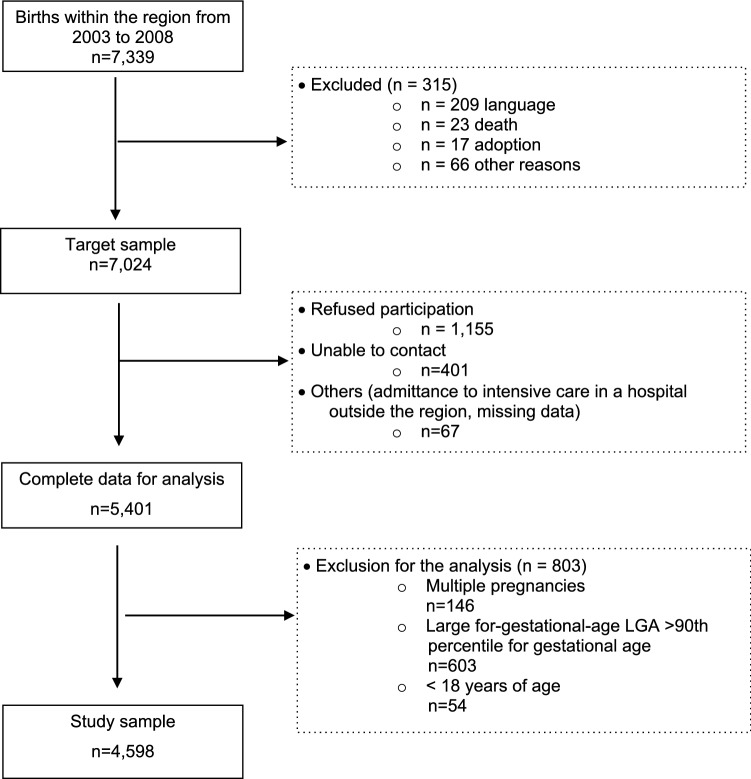
Data from 4598 participants of the population-based birth cohort study Survey of Neonates in Pomerania (SniP) including comprehensive information on pregnancies, mothers, and their offspring in Western Pomerania, Germany were used in this study. The associations were analyzed using linear and logistic regression models.
After logistic regression analysis adjusted for height of the mother, women who delivered SGA infants, had lower education (p < 0.01) and smoked more frequently during pregnancy (p < 0.01) compared with mothers of adequate for gestational age (AGA) neonates. A mother with less than 10 years of education and one who continued smoking during pregnancy had an odds ratio (OR) of 2.23 [95% confidence interval (CI) = 1.44 to 3.46] and 2.68 (95% CI = 2.06-3.49) of having an SGA infant, respectively. There was no association between the employment of the mother (p = 0.28), the monthly income (p = 0.09), the family status (p = 0.80), the number of friendships outside the household that the mother would not wish to relinquish (p = 0.47), the number of people that she could rely on in case of an emergency (p = 0.75), or alcohol consumption prior to (p = 0.14) or during the pregnancy (p = 0.99) with SGA. Finally, women who delivered SGA infants were more frequently dissatisfied with their employment (p = 0.03) and financial status (p < 0.01).
Women who delivered SGA infants had more associated socioeconomic and lifestyle risk factors and were more frequently dissatisfied with their life conditions than mothers of AGA neonates.
旨在研究母亲的社会经济和生活方式因素以及生活满意度与胎儿生长受限(SGA)婴儿分娩的关联。
本研究使用了德国西北部波美拉尼亚地区基于人群的新生儿调查(SniP)的 4598 名参与者的数据,该研究包括了对怀孕、母亲及其子女的综合信息。使用线性和逻辑回归模型分析了这些关联。
经过对母亲身高进行调整的逻辑回归分析,与适当胎龄(AGA)新生儿的母亲相比,分娩 SGA 婴儿的母亲受教育程度较低(p<0.01),且怀孕期间吸烟更频繁(p<0.01)。受教育程度少于 10 年的母亲和怀孕期间继续吸烟的母亲,其 SGA 婴儿的比值比(OR)分别为 2.23(95%置信区间[CI]:1.44-3.46)和 2.68(95% CI:2.06-3.49)。母亲的就业情况(p=0.28)、月收入(p=0.09)、家庭状况(p=0.80)、母亲不愿意放弃的家庭以外的友谊数量(p=0.47)、她在紧急情况下可以依靠的人数(p=0.75)或怀孕前(p=0.14)或怀孕期间(p=0.99)的饮酒量与 SGA 之间没有关联。最后,分娩 SGA 婴儿的女性对其就业(p=0.03)和财务状况(p<0.01)的不满更为频繁。
与 AGA 新生儿的母亲相比,分娩 SGA 婴儿的女性具有更多的社会经济和生活方式相关风险因素,并且对其生活条件的不满更为频繁。