Berrig Christian, Andreasen Viggo, Frost Nielsen Bjarke
Department of Science and Environment, Roskilde University, Universitetsvej 1, 4000 Roskilde, Denmark.
Niels Bohr Institute, University of Copenhagen, Blegdamsvej 17, 2100 Copenhagen, Denmark.
R Soc Open Sci. 2022 May 18;9(5):220129. doi: 10.1098/rsos.220129. eCollection 2022 May.
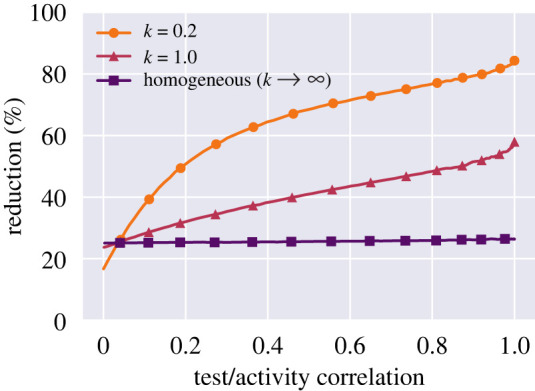
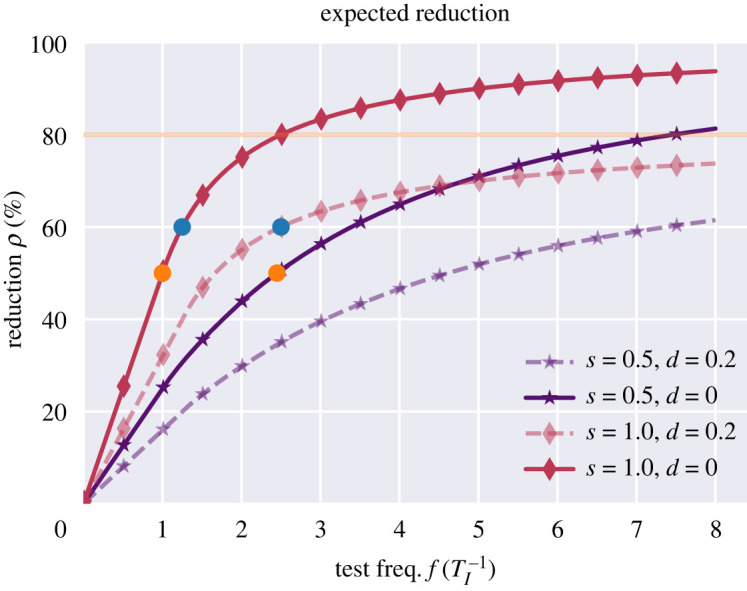
Testing strategies have varied widely between nation states during the COVID-19 pandemic, in intensity as well as methodology. Some countries have mainly performed diagnostic testing while others have opted for mass-screening for the presence of SARS-CoV-2 as well. COVID passport solutions have been introduced, in which access to several aspects of public life requires either testing, proof of vaccination or a combination thereof. This creates a coupling between personal activity levels and testing behaviour which, as we show in a mathematical model, leverages heterogeneous behaviours in a population and turns this heterogeneity from a disadvantage to an advantage for epidemic control.
在新冠疫情期间,各国的检测策略在强度和方法上差异很大。一些国家主要进行诊断检测,而其他国家也选择了对是否感染新冠病毒进行大规模筛查。“新冠通行证”解决方案已经推出,在这种方案下,参与公共生活的多个方面需要进行检测、提供疫苗接种证明或两者结合。这在个人活动水平和检测行为之间建立了一种关联,正如我们在一个数学模型中所展示的,这种关联利用了人群中的异质性行为,并将这种异质性从疫情防控的劣势转化为优势。