Roy Bhaswati, Nunez Alba, Aysola Ravi S, Kang Daniel W, Vacas Susana, Kumar Rajesh
Department of Anesthesiology and Perioperative Medicine, University of California, Los Angeles, Los Angeles, CA, United States.
Department of Medicine, University of California, Los Angeles, Los Angeles, CA, United States.
Front Neurosci. 2022 May 6;16:884234. doi: 10.3389/fnins.2022.884234. eCollection 2022.
Obstructive sleep apnea (OSA) is accompanied by sleep fragmentation and altered sleep architecture, which can potentially hinder the glymphatic system, increasing risks for Alzheimer's disease (AD), but the status is unclear in OSA. Our aim was to investigate the glymphatic system in OSA subjects and examine the relationships between OSA disease severity, sleep symptoms, and glymphatic system indices in OSA using diffusion tensor imaging (DTI).
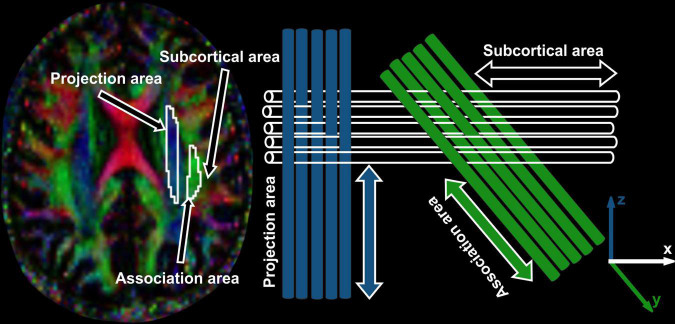
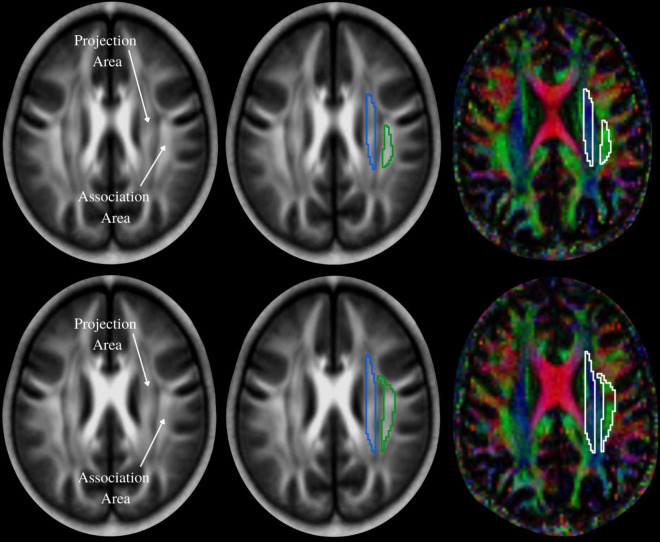
We acquired DTI data from 59 OSA and 62 controls using a 3.0-Tesla MRI and examined OSA disease severity and sleep symptoms with the Pittsburgh Sleep Quality Index (PSQI) and Epworth Sleepiness Scale (ESS). Diffusivity maps in the -axis (D), -axis (D), and -axis (D), as well as in axis (D), axis (D), and axis (D) were calculated, diffusion values for the projection and association fibers extracted, and the DTI analyses along the perivascular space (DTI-ALPS index) were performed. The glymphatic system indices were compared between groups and correlated with disease severity and sleep symptoms in OSA subjects.
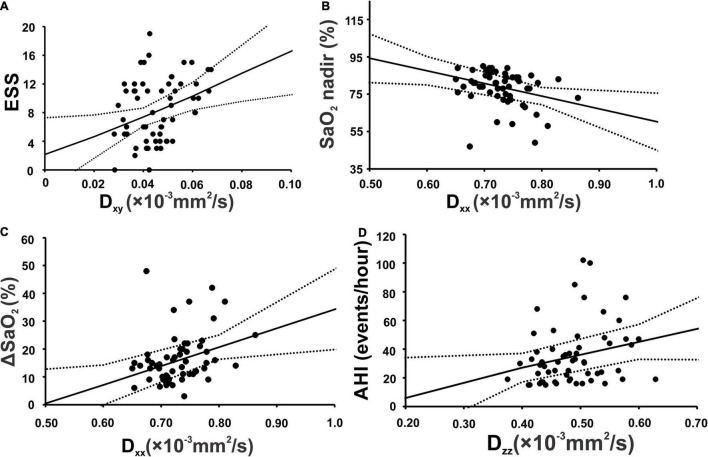
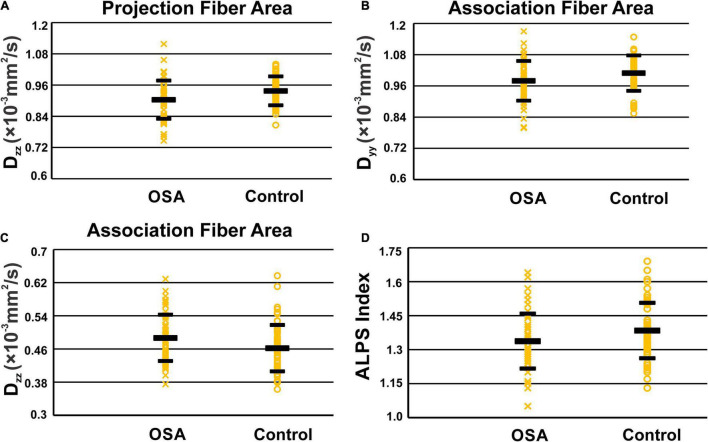
D values, derived from projection fiber areas, D and D values from association fiber areas, as well as ALPS and D values were significantly reduced in OSA over controls. Significant correlations emerged between disease severity, sleep symptoms, and D, D, and D values in OSA subjects.
OSA patients show abnormal glymphatic system function that may contribute to increased risks for AD. The findings suggest that the APLS method can be used to assess the glymphatic system in OSA patients.
阻塞性睡眠呼吸暂停(OSA)伴有睡眠片段化和睡眠结构改变,这可能会潜在地阻碍类淋巴系统,增加患阿尔茨海默病(AD)的风险,但OSA患者中该情况尚不清楚。我们的目的是利用扩散张量成像(DTI)研究OSA患者的类淋巴系统,并检查OSA疾病严重程度、睡眠症状与类淋巴系统指标之间的关系。
我们使用3.0特斯拉磁共振成像从59名OSA患者和62名对照者获取DTI数据,并使用匹兹堡睡眠质量指数(PSQI)和爱泼华嗜睡量表(ESS)检查OSA疾病严重程度和睡眠症状。计算x轴(Dx)、y轴(Dy)和z轴(Dz)以及轴向(Da)、径向(Dr)和切向(Dt)的扩散率图,提取投射纤维和联合纤维的扩散值,并进行沿血管周围间隙的DTI分析(DTI-ALPS指数)。比较两组之间的类淋巴系统指标,并将其与OSA患者的疾病严重程度和睡眠症状相关联。
与对照组相比,OSA患者投射纤维区域的Dx值、联合纤维区域的Dy和Dz值以及ALPS和Da值显著降低。OSA患者的疾病严重程度、睡眠症状与Dx、Dy和Dz值之间存在显著相关性。
OSA患者表现出类淋巴系统功能异常,这可能导致AD风险增加。研究结果表明,APLS方法可用于评估OSA患者的类淋巴系统。