Marusic Uros, Peskar Manca, De Pauw Kevin, Omejc Nina, Drevensek Gorazd, Rojc Bojan, Pisot Rado, Kavcic Voyko
Science and Research Centre Koper, Institute for Kinesiology Research, Koper, Slovenia.
Department of Health Sciences, Alma Mater Europaea - ECM, Maribor, Slovenia.
Front Aging Neurosci. 2022 May 3;14:819576. doi: 10.3389/fnagi.2022.819576. eCollection 2022.
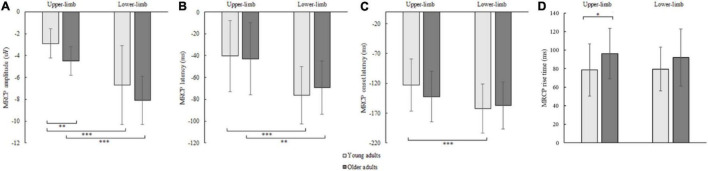
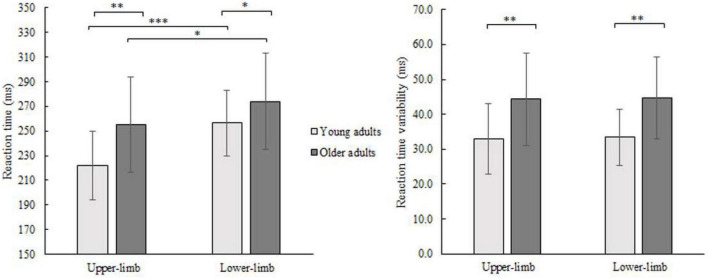
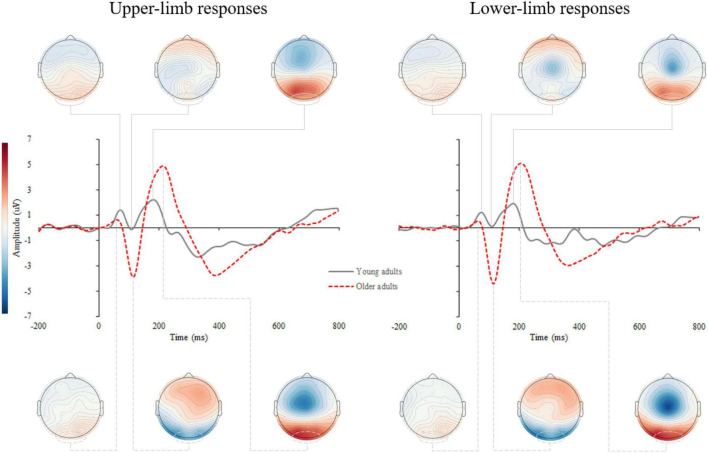
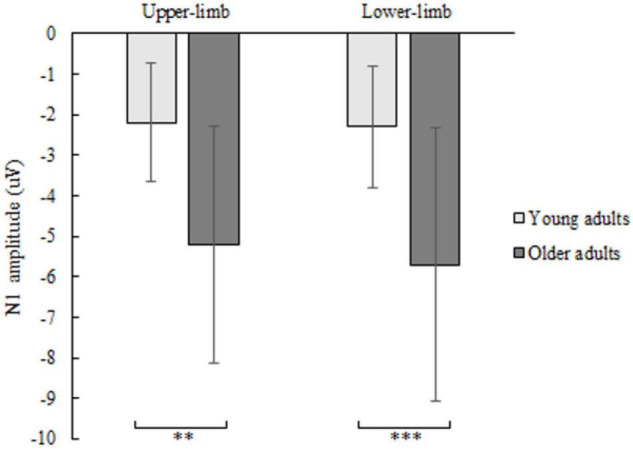
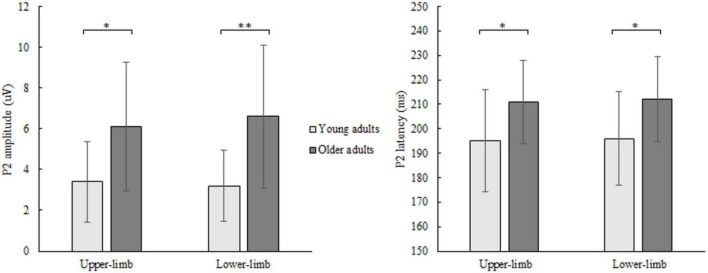
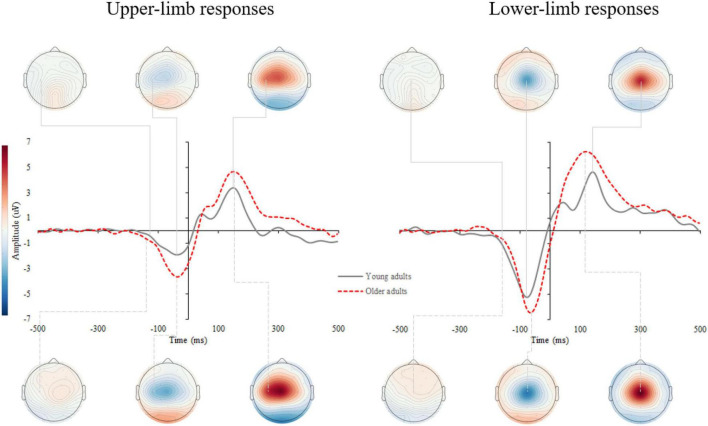
With advanced age, there is a loss of reaction speed that may contribute to an increased risk of tripping and falling. Avoiding falls and injuries requires awareness of the threat, followed by selection and execution of the appropriate motor response. Using event-related potentials (ERPs) and a simple visual reaction task (RT), the goal of our study was to distinguish sensory and motor processing in the upper- and lower-limbs while attempting to uncover the main cause of age-related behavioral slowing. Strength (amplitudes) as well as timing and speed (latencies) of various stages of stimulus- and motor-related processing were analyzed in 48 healthy individuals (young adults, = 24, mean age = 34 years; older adults, = 24, mean age = 67 years). The behavioral results showed a significant age-related slowing, where the younger compared to older adults exhibited shorter RTs for the upper- (222 vs. 255 ms; = 0.006, respectively) and the lower limb (257 vs. 274 ms; = 0.048, respectively) as well as lower variability in both modalities ( = 0.001). Using ERP indices, age-related slowing of visual stimulus processing was characterized by overall larger amplitudes with delayed latencies of endogenous potentials in older compared with younger adults. While no differences were found in the P1 component, the later components of recorded potentials for visual stimuli processing were most affected by age. This was characterized by increased N1 and P2 amplitudes and delayed P2 latencies in both upper and lower extremities. The analysis of motor-related cortical potentials (MRCPs) revealed stronger MRCP amplitude for upper- and a non-significant trend for lower limbs in older adults. The MRCP amplitude was smaller and peaked closer to the actual motor response for the upper- than for the lower limb in both age groups. There were longer MRCP onset latencies for lower- compared to upper-limb in younger adults, and a non-significant trend was seen in older adults. Multiple regression analyses showed that the onset of the MRCP peak consistently predicted reaction time across both age groups and limbs tested. However, MRCP rise time and P2 latency were also significant predictors of simple reaction time, but only in older adults and only for the upper limbs. Our study suggests that motor cortical processes contribute most strongly to the slowing of simple reaction time in advanced age. However, late-stage cortical processing related to sensory stimuli also appears to play a role in upper limb responses in the elderly. This process most likely reflects less efficient recruitment of neuronal resources required for the upper and lower extremity response task in older adults.
随着年龄的增长,反应速度会下降,这可能会增加绊倒和摔倒的风险。避免摔倒和受伤需要意识到这种威胁,然后选择并执行适当的运动反应。本研究的目的是利用事件相关电位(ERP)和简单视觉反应任务(RT),区分上肢和下肢的感觉和运动处理过程,同时试图找出与年龄相关的行为迟缓的主要原因。我们对48名健康个体(年轻人,n = 24,平均年龄 = 34岁;老年人,n = 24,平均年龄 = 67岁)的刺激和运动相关处理的各个阶段的强度(振幅)以及时间和速度(潜伏期)进行了分析。行为结果显示出与年龄相关的显著迟缓,与老年人相比,年轻人在上肢(222 vs. 255毫秒;p分别 = 0.006)和下肢(257 vs. 274毫秒;p分别 = 0.048)的反应时间更短,并且在两种模式下的变异性也更低(p = 0.001)。使用ERP指标,与年龄相关的视觉刺激处理迟缓的特征是,与年轻人相比,老年人内源性电位的潜伏期延迟且总体振幅更大。虽然在P1成分中未发现差异,但记录的视觉刺激处理电位的后期成分受年龄影响最大。这表现为上肢和下肢的N1和P2振幅增加以及P2潜伏期延迟。对运动相关皮质电位(MRCP)的分析显示,老年人上肢的MRCP振幅更强,下肢有不显著的趋势。在两个年龄组中,上肢的MRCP振幅均小于下肢,且峰值更接近实际运动反应。与上肢相比,年轻人下肢的MRCP起始潜伏期更长,老年人有不显著的趋势。多元回归分析表明,MRCP峰值的起始时间始终能预测两个年龄组和所测试肢体的反应时间。然而,MRCP上升时间和P2潜伏期也是简单反应时间的显著预测指标,但仅在老年人中且仅适用于上肢。我们的研究表明,运动皮质过程对高龄时简单反应时间的迟缓贡献最大。然而,与感觉刺激相关的后期皮质处理似乎也在老年人的上肢反应中起作用。这个过程很可能反映了老年人在上下肢反应任务中神经元资源的募集效率较低。