Laboratorio de Referencia de Escherichia coli (LREC), Dpto. de Microbioloxía e Parasitoloxía, Universidade de Santiago de Compostela (USC), Lugo, Spain.
Instituto de Investigación Sanitaria de Santiago de Compostela (IDIS), Santiago, Spain.
Microbiol Spectr. 2022 Jun 29;10(3):e0004122. doi: 10.1128/spectrum.00041-22. Epub 2022 May 23.
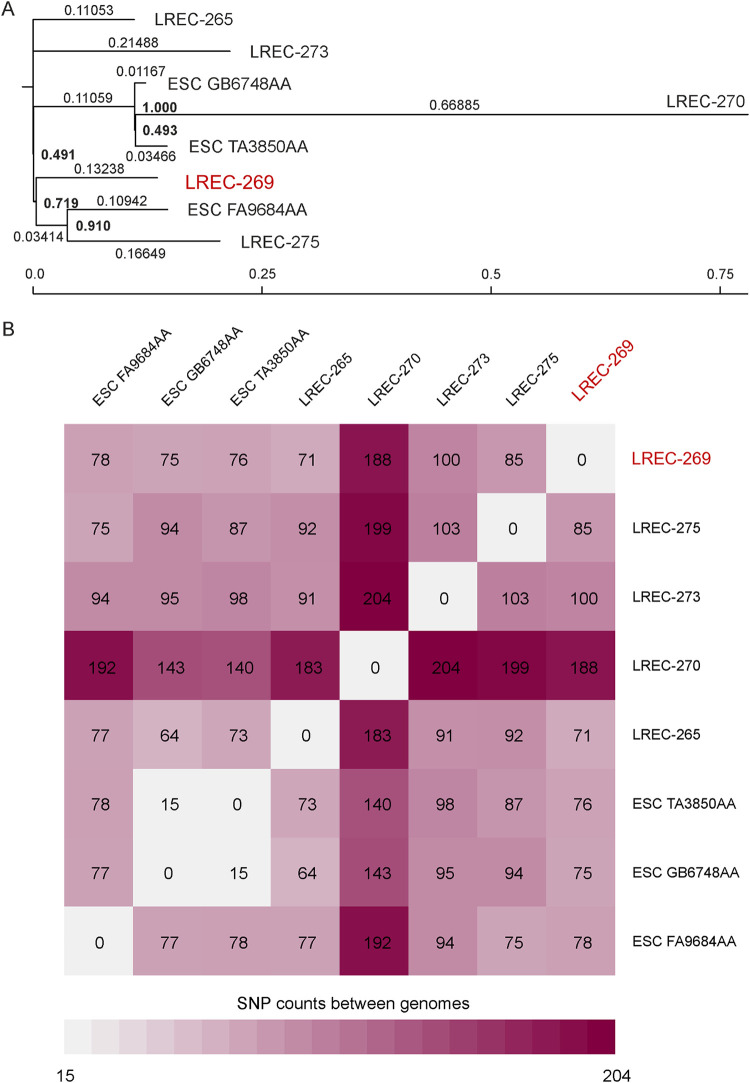
We conducted a prospective, multicenter, specific pilot study on uncomplicated urinary tract infections (uUTI). One-hundred non-duplicated uropathogenic Escherichia coli (UPEC) from uUTI occurred in 2020 in women attending 15 primary care centers of a single health region of northern Spain were characterized using a clonal diagnosis approach. Among the high genetic diversity showed by 59 different phylogroup-clonotype combinations, 11 clones accounted for 46% of the isolates: B2-ST73 (CH24-30); B2-ST73 (CH24-103); B2-ST131 (CH40-30); B2-ST141 (CH52-5); B2-ST372 (CH103-9); B2-ST404 (CH14-27); B2-ST404 (CH14-807); B2-ST1193 (CH14-64); D-ST69 (CH35-27); D-ST349 (CH36-54), and F-ST59 (CH32-41). The screening of the UPEC status found that 69% of isolates carried ≥ 3 of , and genes. Multidrug resistance to at least one antibiotic of ≥ 3 antimicrobial categories were exhibited by 30% of the isolates, with the highest rates of resistance against ampicillin/amoxicillin (48%), trimethoprim (35%), norfloxacin (28%), amoxicillin-clavulanic acid (26%), and trimethoprim-sulfamethoxazole (24%). None extended-spectrum beta-lactamase/carbapenemase producer was recovered. According to our results, fosfomycin and nitrofurantoin should be considered as empirical treatment of choice for uUTI by E. coli (resistance rates 4% and 2%, respectively). We uncover the high prevalence of the pandemic fluoroquinolone-resistant ST1193 clone (6%) in uUTI, which represents the first report in Spain in this pathology. The genomic analysis showed similar key traits than those ST1193 clones disseminated worldwide. Through the SNP comparison based on the core genome, the Spanish ST1193 clustered with isolates retrieved from the Enterobase, showing high genomic similarity than the global ST1193 described in the United States, Canada and Australia. Analyzing the clonal structure and antimicrobial resistance of E. coli isolates implicated in uncomplicated urinary tract infections, one of the most frequent visits managed in primary health care, is of interest for clinicians to detect changes in the dynamics of emerging uropathogenic clones associated with the spread of fluoroquinolone resistance. It can also provide consensus concerning optimal control and antibiotic prescribing.
我们进行了一项前瞻性、多中心、针对单纯性尿路感染(uUTI)的特定试点研究。2020 年,西班牙北部一个单一卫生区域的 15 个初级保健中心就诊的 100 例非重复尿路致病性大肠杆菌(UPEC)采用克隆诊断方法进行了特征描述。在 59 种不同的谱系-克隆型组合显示出的高度遗传多样性中,有 11 种克隆占分离株的 46%:B2-ST73(CH24-30);B2-ST73(CH24-103);B2-ST131(CH40-30);B2-ST141(CH52-5);B2-ST372(CH103-9);B2-ST404(CH14-27);B2-ST404(CH14-807);B2-ST1193(CH14-64);D-ST69(CH35-27);D-ST349(CH36-54)和 F-ST59(CH32-41)。UPEC 状态的筛选发现,69%的分离株携带≥3种 和 基因。30%的分离株对至少一种抗生素表现出多种药物耐药性,对氨苄西林/阿莫西林(48%)、甲氧苄啶(35%)、诺氟沙星(28%)、阿莫西林-克拉维酸(26%)和甲氧苄啶-磺胺甲恶唑(24%)的耐药率最高。未发现产超广谱β-内酰胺酶/碳青霉烯酶的菌株。根据我们的结果,磷霉素和呋喃妥因应被视为大肠杆菌引起的 uUTI 的经验性治疗选择(耐药率分别为 4%和 2%)。我们发现,在 uUTI 中,流行的氟喹诺酮耐药 ST1193 克隆(6%)的患病率很高,这是西班牙在该病理中的首次报告。基因组分析显示出与全球 ST1193 相似的关键特征,全球 ST1193 已在世界各地传播。通过基于核心基因组的 SNP 比较,西班牙 ST1193 与从 Enterobase 中检索到的分离株聚类,与美国、加拿大和澳大利亚描述的全球 ST1193 相比具有高度的基因组相似性。分析单纯性尿路感染中大肠杆菌分离株的克隆结构和抗菌药物耐药性,对于临床医生检测与氟喹诺酮耐药传播相关的新兴尿路致病性克隆的动态变化具有重要意义。它还可以为最佳控制和抗生素处方提供共识。