Human Nutrition Research Centre, Population Health Sciences Institute, Newcastle University, Newcastle Upon Tyne, UK.
Department of Kinesiology, School of Education and Human Development and Division of Cardiovascular Medicine, School of Medicine, University of Virginia, Charlottesville, VA, USA.
Sports Med. 2022 Oct;52(10):2537-2558. doi: 10.1007/s40279-022-01701-3. Epub 2022 May 23.
Dietary inorganic nitrate is a popular nutritional supplement, which increases nitric oxide bioavailability and may improve exercise performance. Despite over a decade of research into the effects of dietary nitrate supplementation during exercise there is currently no expert consensus on how, when and for whom this compound could be recommended as an ergogenic aid. Moreover, there is no consensus on the safe administration of dietary nitrate as an ergogenic aid. This study aimed to address these research gaps.
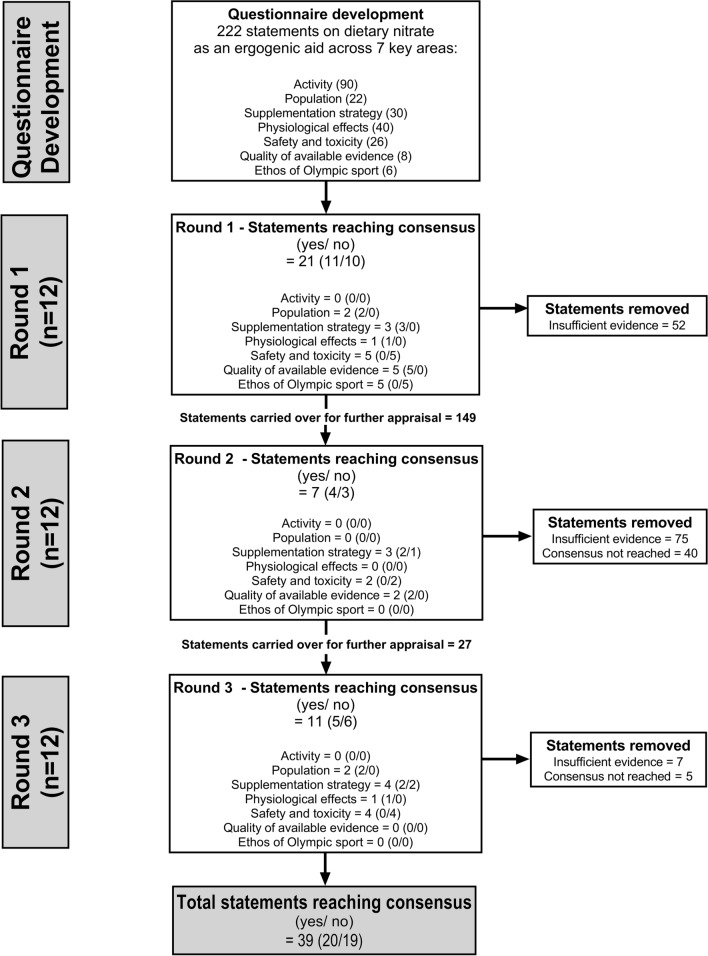
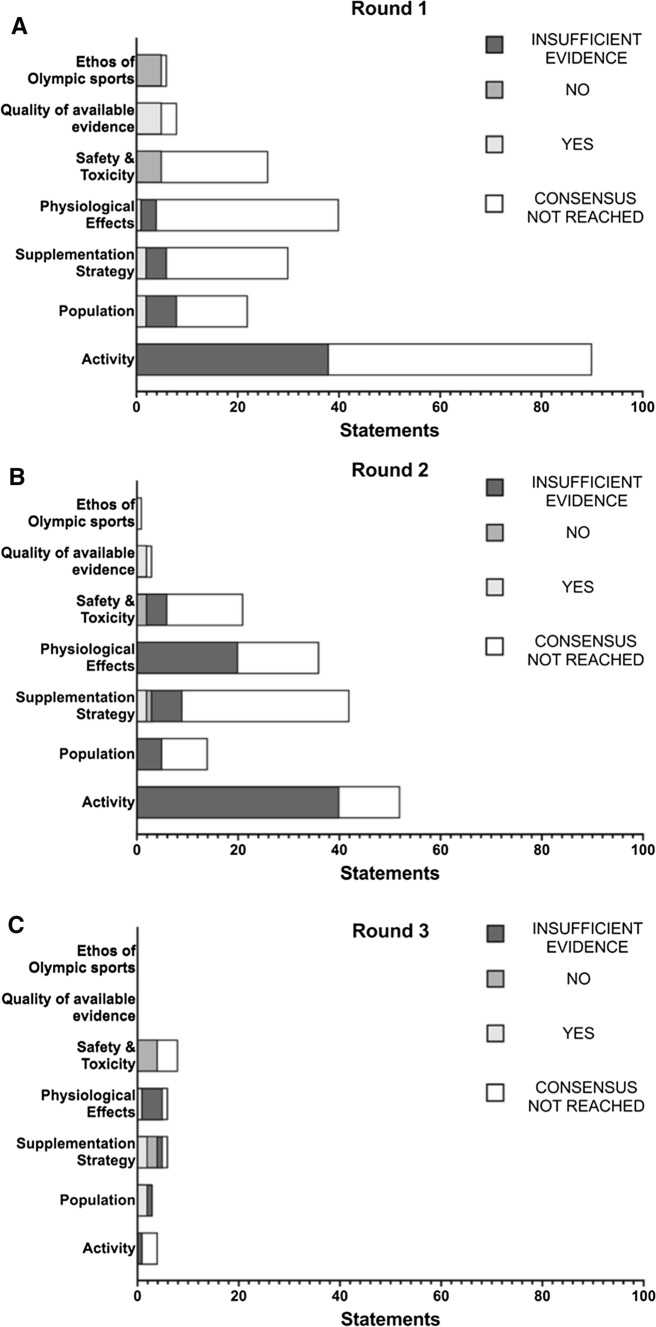
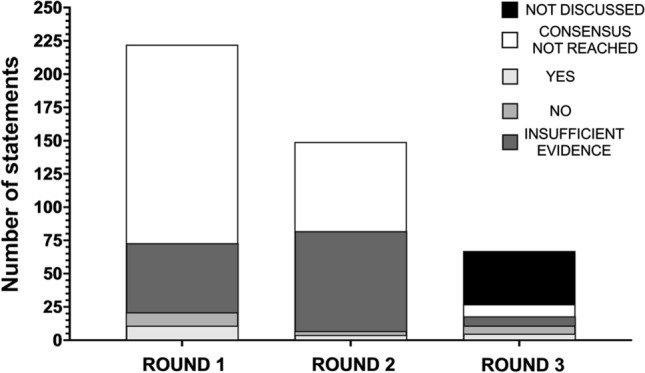
The modified Delphi technique was used to establish the views of 12 expert panel members on the use of dietary nitrate as an ergogenic aid. Over three iterative rounds (two via questionnaire and one via videoconferencing), the expert panel members voted on 222 statements relating to dietary nitrate as an ergogenic aid. Consensus was reached when > 80% of the panel provided the same answer (i.e. yes or no). Statements for which > 80% of the panel cast a vote of insufficient evidence were categorised as such and removed from further voting. These statements were subsequently used to identify directions for future research.
The 12 panel members contributed to voting in all three rounds. A total of 39 statements (17.6%) reached consensus across the three rounds (20 yes, 19 no). In round one, 21 statements reached consensus (11 yes, 10 no). In round two, seven further statements reached consensus (4 yes, 3 no). In round three, an additional 11 statements reached consensus (5 yes, 6 no). The panel agreed that there was insufficient evidence for 134 (60.4%) of the statements, and were unable to agree on the outcome of the remaining statements.
This study provides information on the current expert consensus on dietary nitrate, which may be of value to athletes, coaches, practitioners and researchers. The effects of dietary nitrate appear to be diminished in individuals with a higher aerobic fitness (peak oxygen consumption [V̇O] > 60 ml/kg/min), and therefore, aerobic fitness should be taken into account when considering use of dietary nitrate as an ergogenic aid. It is recommended that athletes looking to benefit from dietary nitrate supplementation should consume 8-16 mmol nitrate acutely or 4-16 mmol/day nitrate chronically (with the final dose ingested 2-4 h pre-exercise) to maximise ergogenic effects, taking into consideration that, from a safety perspective, athletes may be best advised to increase their intake of nitrate via vegetables and vegetable juices. Acute nitrate supplementation up to ~ 16 mmol is believed to be safe, although the safety of chronic nitrate supplementation requires further investigation. The expert panel agreed that there was insufficient evidence for most of the appraised statements, highlighting the need for future research in this area.
膳食无机硝酸盐是一种流行的营养补充剂,它可以增加一氧化氮的生物利用度,可能提高运动表现。尽管十多年来一直在研究运动期间补充膳食硝酸盐的效果,但目前对于如何、何时以及对谁推荐这种化合物作为增强体力的辅助剂,专家们还没有达成共识。此外,对于膳食硝酸盐作为增强体力的辅助剂的安全管理也没有共识。本研究旨在解决这些研究空白。
使用改良德尔菲技术来确定 12 名专家小组成员对将膳食硝酸盐作为增强体力的辅助剂的看法。在三轮迭代(两轮通过问卷,一轮通过视频会议)中,专家小组成员对与膳食硝酸盐作为增强体力的辅助剂相关的 222 个陈述进行了投票。当超过 80%的小组成员给出相同的答案(即“是”或“否”)时,就达成了共识。对于超过 80%的小组成员投票认为证据不足的陈述,将其归类为这种情况,并从进一步投票中删除。这些陈述随后用于确定未来研究的方向。
12 名小组成员在三轮投票中都有参与。在三轮投票中,共有 39 项陈述(17.6%)达成共识(20 项“是”,19 项“否”)。第一轮有 21 项陈述达成共识(11 项“是”,10 项“否”)。第二轮又有 7 项陈述达成共识(4 项“是”,3 项“否”)。第三轮,又有 11 项陈述达成共识(5 项“是”,6 项“否”)。专家组认为,对于 134 项陈述(60.4%)的证据不足,对于其余陈述的结果无法达成一致。
本研究提供了有关膳食硝酸盐的当前专家共识的信息,这可能对运动员、教练、从业者和研究人员有价值。膳食硝酸盐的效果似乎在有氧适能较高的个体中减弱(峰值耗氧量 [V̇O]>60ml/kg/min),因此,在考虑将膳食硝酸盐作为增强体力的辅助剂时,应考虑有氧适能。建议希望从膳食硝酸盐补充中受益的运动员应急性摄入 8-16mmol 硝酸盐或慢性摄入 4-16mmol/天硝酸盐(最后一次剂量在运动前 2-4 小时摄入),以最大限度地发挥其增强作用,同时考虑到从安全性角度来看,运动员最好通过蔬菜和蔬菜汁来增加硝酸盐的摄入量。据信,急性硝酸盐补充高达约 16mmol 是安全的,尽管慢性硝酸盐补充的安全性需要进一步研究。专家组认为,对于大多数评估的陈述,证据不足,这突出表明需要在这一领域进行未来的研究。