School of Health, Leeds Beckett University, Leeds, UK.
Human Nutrition & Exercise Research Centre, Centre for Healthier Lives, Population Health Sciences Institute, Newcastle University, Newcastle upon TyneNE2 4HH, UK.
Public Health Nutr. 2024 Oct 28;27(1):e236. doi: 10.1017/S1368980024002167.
Evaluate knowledge and beliefs about dietary nitrate among United Kingdom (UK)-based adults.
An online questionnaire was administered to evaluate knowledge and beliefs about dietary nitrate. Overall knowledge of dietary nitrate was quantified using a twenty-one-point Nitrate Knowledge Index. Responses were compared between socio-demographic groups.
UK.
A nationally representative sample of 300 adults.
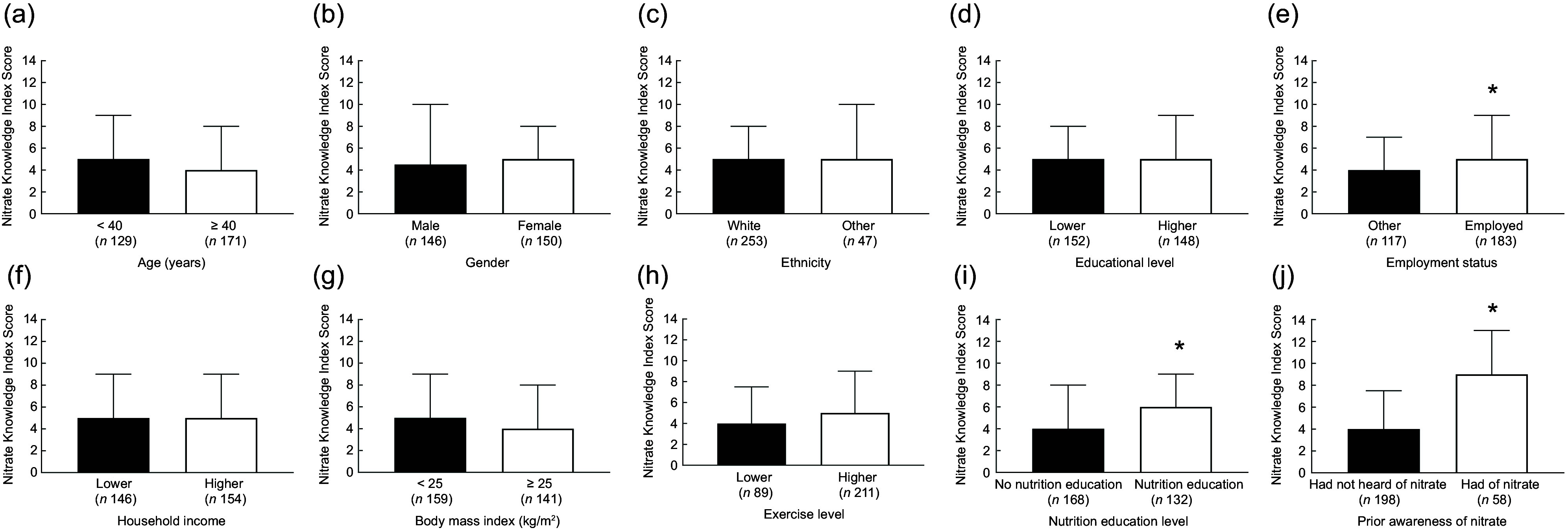
Only 19 % of participants had heard of dietary nitrate prior to completing the questionnaire. Most participants (∼70 %) were unsure about the effects of dietary nitrate on health parameters (e.g. blood pressure, cognitive function and cancer risk) or exercise performance. Most participants were unsure of the average population intake (78 %) and acceptable daily intake (83 %) of nitrate. Knowledge of dietary sources of nitrate was generally low, with only ∼30 % of participants correctly identifying foods with higher or lower nitrate contents. Almost none of the participants had deliberately purchased, or avoided purchasing, a food based around its nitrate content. Nitrate Knowledge Index scores were generally low (median (interquartile range (IQR)): 5 (8)), but were significantly higher in individuals who were currently employed . unemployed (median (IQR): 5 (7) . 4 (7); < 0·001), in those with previous nutrition education . no nutrition education (median (IQR): 6 (7) . 4 (8); 0·012) and in individuals who had heard of nitrate prior to completing the questionnaire . those who had not (median (IQR): 9 (8) . 4 (7); < 0·001).
This study demonstrates low knowledge around dietary nitrate in UK-based adults. Greater education around dietary nitrate may be valuable to help individuals make more informed decisions about their consumption of this compound.
评估英国成年人对饮食硝酸盐的知识和信念。
通过在线问卷评估对饮食硝酸盐的知识和信念。使用 21 分硝酸盐知识指数来量化对饮食硝酸盐的整体知识。根据社会人口统计学特征对回答进行比较。
英国。
300 名成年参与者,具有全国代表性。
只有 19%的参与者在完成问卷前听说过饮食硝酸盐。大多数参与者(约 70%)不确定饮食硝酸盐对健康参数(如血压、认知功能和癌症风险)或运动表现的影响。大多数参与者不确定硝酸盐的平均人群摄入量(78%)和可接受的日摄入量(83%)。对硝酸盐饮食来源的了解通常较低,只有约 30%的参与者正确识别了含较高或较低硝酸盐含量的食物。几乎没有参与者故意购买或避免购买基于硝酸盐含量的食物。硝酸盐知识指数得分普遍较低(中位数(四分位距(IQR)):5(8)),但目前在职的个体得分显著更高 (中位数(IQR):5(7),4(7);<0·001),接受过营养教育的个体高于未接受过营养教育的个体 (中位数(IQR):6(7),4(8);0·012),在完成问卷前听说过硝酸盐的个体高于未听说过的个体 (中位数(IQR):9(8),4(7);<0·001)。
本研究表明,英国成年人对饮食硝酸盐的知识水平较低。围绕饮食硝酸盐开展更多教育可能有助于个体更明智地决定摄入这种化合物。