Multi-Omics Laboratory, School of Pharmacy, Lebanese American University, P.O. Box 36, Byblos 1401, Lebanon.
Center of Scientific Excellence for Influenza Viruses, National Research Centre, Giza 12622, Egypt.
Virus Res. 2022 Aug;317:198824. doi: 10.1016/j.virusres.2022.198824. Epub 2022 May 20.
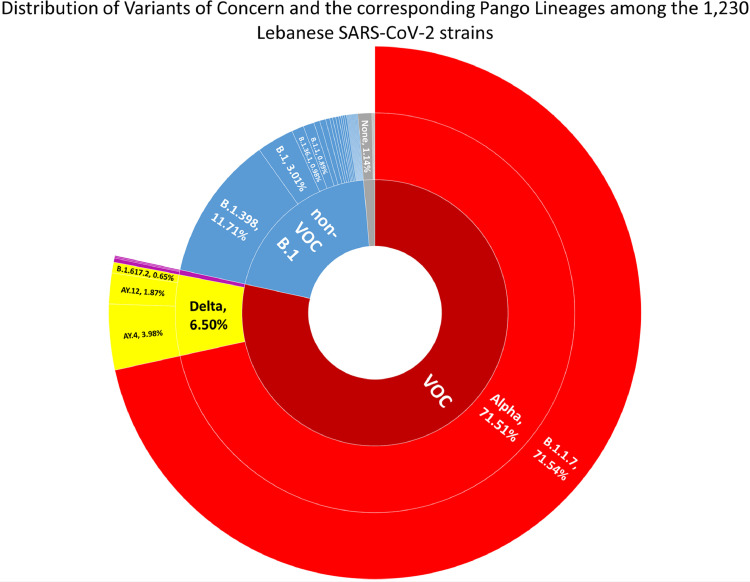
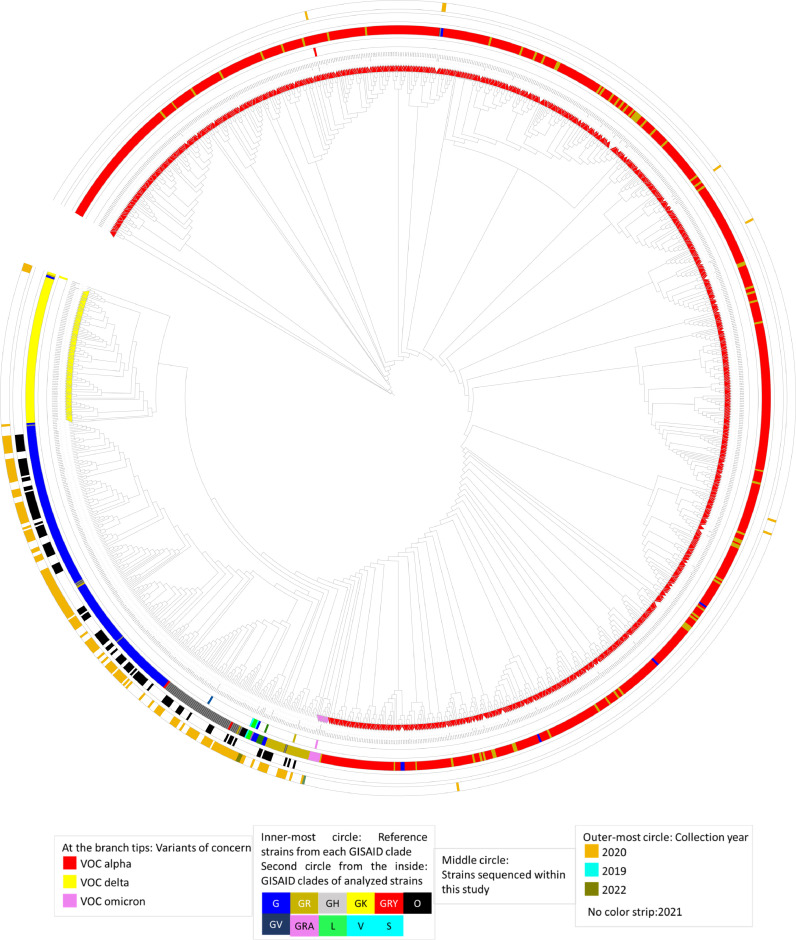
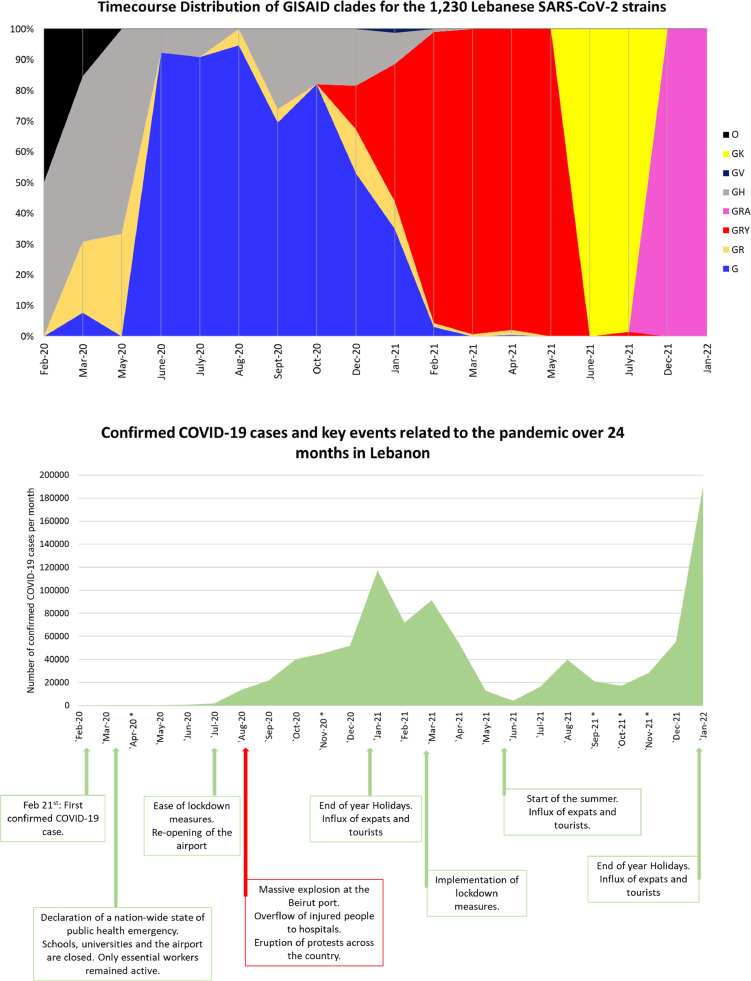
The COVID-19 pandemic continues to pose a global health concern, despite the ongoing vaccination campaigns, due to the emergence and rapid spread of new variants of the causative agent SARS-CoV-2. These variants are identified and tracked via the marker mutations they carry, and the classification system put in place following tremendous sequencing efforts. In this study, the genomes of 1,230 Lebanese SARS-CoV-2 strains collected throughout 2 years of the outbreak in Lebanon were analyzed, 115 of which sequenced within this project. Strains were classified into seven GISAID clades, the major one being GRY, and 36 Pango lineages, with three variants of concern identified: alpha, delta and omicron. A time course distribution of GISAID clades allowed the visualization of change throughout the two years of the Lebanese outbreak, in conjunction with major events and measures in the country. Subsequent phylogenetic analysis showed the clustering of strains belonging to the same clades. In addition, a mutational survey showed the presence of mutations in the structural, non-structural and accessory proteins. Twenty five (25) mutations were labeled as major, i.e. present in more than 30% of the strains, such as the common Spike_D614G and NSP3_T183I. Whereas 635 were labeled as uncommon, i.e. found in very few of the analyzed strains as well as GISAID records, such as NSP2_I349V. Distribution of these mutations differed between 2020, and the first and the second half of 2021. In summary, this study highlights key genomic aspects of the Lebanese SARS-CoV-2 strains collected in 2020, the first year of the outbreak in Lebanon, versus those collected in 2021, the second year of COVID-19 in Lebanon.
尽管正在进行疫苗接种活动,但由于导致 SARS-CoV-2 的病原体的新变种的出现和快速传播,COVID-19 大流行仍然是一个全球健康关注问题。这些变体通过其携带的标记突变来识别和跟踪,并通过巨大的测序工作建立分类系统。在这项研究中,分析了在黎巴嫩爆发的两年中收集的 1230 株黎巴嫩 SARS-CoV-2 菌株的基因组,其中 115 株在本项目中进行了测序。菌株被分为七个 GISAID 进化枝,主要的是 GRY,36 个 Pango 谱系,确定了三种关注变体:alpha、delta 和 omicron。GISAID 进化枝的时间分布允许在黎巴嫩爆发的两年中观察到变化,同时还观察到该国的重大事件和措施。随后的系统发育分析显示,属于同一进化枝的菌株聚类。此外,突变调查显示结构、非结构和辅助蛋白存在突变。有 25 个(25)突变被标记为主要突变,即存在于 30%以上的菌株中,如常见的 Spike_D614G 和 NSP3_T183I。而 635 个被标记为罕见突变,即在分析的菌株以及 GISAID 记录中很少发现,如 NSP2_I349V。这些突变的分布在 2020 年、2021 年第一季度和第二季度之间有所不同。总之,本研究突出了 2020 年和 2021 年黎巴嫩 SARS-CoV-2 株的关键基因组方面,这是黎巴嫩大流行的第一年和第二年。