Department of Psychological and Brain Sciences, Johns Hopkins University, Baltimore, MD, 21218, USA.
Commun Biol. 2022 May 23;5(1):489. doi: 10.1038/s42003-022-03418-5.
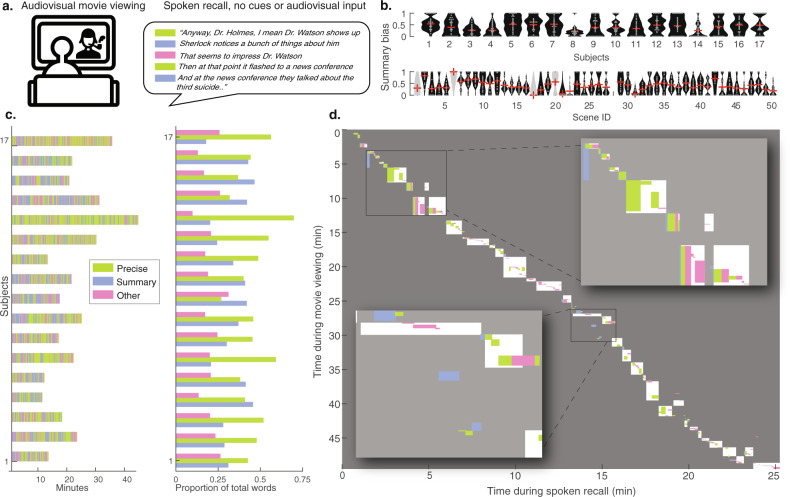
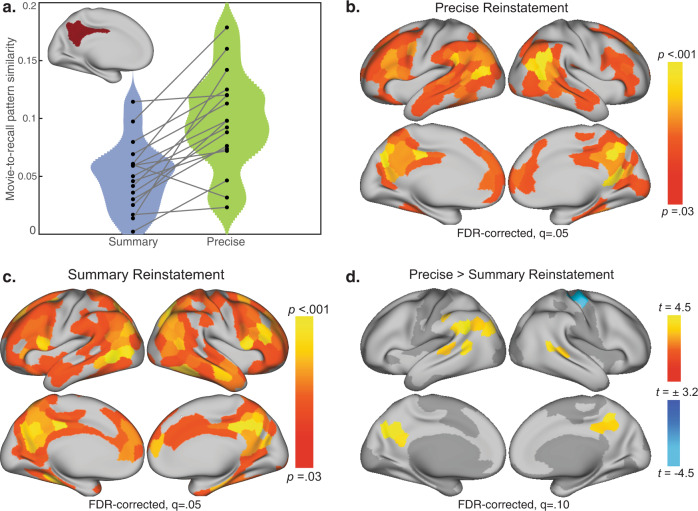
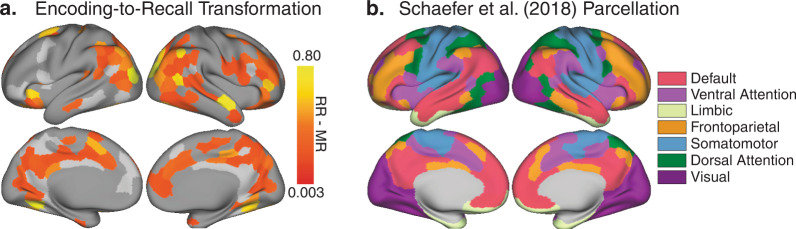
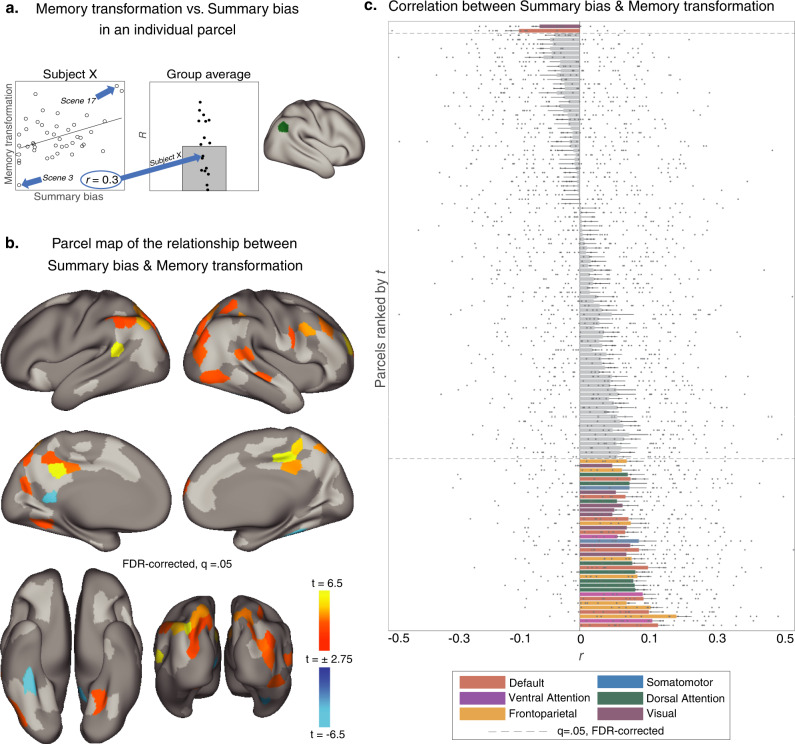
When we retell our past experiences, we aim to reproduce some version of the original events; this reproduced version is often temporally compressed relative to the original. However, it is currently unclear how this compression manifests in brain activity. One possibility is that a compressed retrieved memory manifests as a neural pattern which is more dissimilar to the original, relative to a more detailed or vivid memory. However, we argue that measuring raw dissimilarity alone is insufficient, as it confuses a variety of interesting and uninteresting changes. To address this problem, we examine brain pattern changes that are consistent across people. We show that temporal compression in individuals' retelling of past events predicts systematic encoding-to-recall transformations in several higher associative regions. These findings elucidate how neural representations are not simply reactivated, but can also be transformed due to temporal compression during a universal form of human memory expression: verbal retelling.
当我们复述过去的经历时,我们的目标是再现原始事件的某个版本;这个再现的版本通常相对于原始版本在时间上被压缩了。然而,目前还不清楚这种压缩在大脑活动中是如何表现出来的。一种可能性是,一个被压缩的检索记忆表现为一种与原始记忆相比,更不相似的神经模式,相对于一个更详细或更生动的记忆。然而,我们认为,仅测量原始的不相似性是不够的,因为它混淆了各种有趣和无趣的变化。为了解决这个问题,我们研究了在不同个体中,与记忆再巩固相关的大脑模式变化。我们发现,个体在讲述过去事件时的时间压缩,预测了在几个更高阶的联想区域中,编码到再回忆的系统性转变。这些发现阐明了神经表示是如何不仅被重新激活,而且还可以由于时间压缩而发生转变的,这种转变发生在人类记忆表达的一种普遍形式中:口头复述。