Laboratory of Applied Microbiology, Department of Health Sciences (DiSS), Center for Translational Research on Allergic and Autoimmune Diseases (CAAD), School of Medicine, Università del Piemonte Orientale (UPO), Corso Trieste 15/A, 28100, Novara, Italy.
Laboratory of Biological Mass Spectrometry, Department of Translational Medicine (DiMeT), Center for Translational Research On Allergic and Autoimmune Diseases (CAAD), School of Medicine, Università del Piemonte Orientale (UPO), Corso Trieste 15/A, 28100, Novara, Italy.
Sci Rep. 2022 May 23;12(1):8666. doi: 10.1038/s41598-022-12718-z.
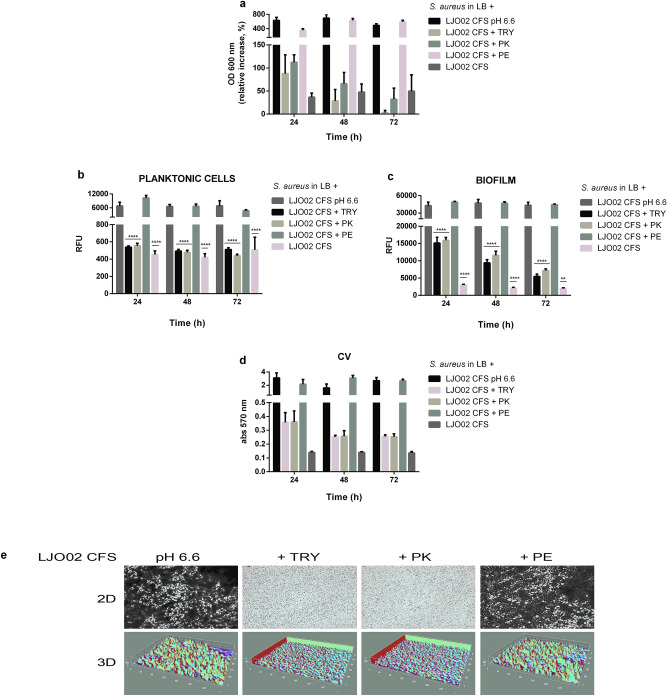
The spread of multidrug-resistant bacteria, such as the skin commensal Staphylococcus aureus, is a worldwide health challenge; new methods to counteract opportunistic pathogen growth and virulence are urgent. We compared the activity of Lacticaseibacillus rhamnosus LR06 (DSM 21981) and Lactobacillus johnsonii LJO02 (DSM 33828) cell-free supernatants (CFSs) produced in the conventional animal derivative-based MRS medium and an innovative animal derivative-free broth (TIL) versus the MDR S. aureus (ATCC 43300). CFS influence was assessed towards the viability, metabolic activity, and ability to form biofilm of the MDR strain through optical density, alamarBlue assay, and crystal violet staining; their content in short-chain fatty acids, lactic acid, and proteins was analysed via high-resolution mass spectrometry and gas chromatography. All CFSs reduce viable and metabolically active S. aureus, being TIL more efficient compared to MRS in stimulating lactic acid bacteria metabolism and decreasing S. aureus biofilm formation. Particularly, the CFS from LJO02 grown in TIL has the best efficacy, revealing a high amount of lactic acid and 59 peculiar proteins; its effectiveness is partially maintained upon trypsin and proteinase K treatments, but not by pepsin and pH basification. Therefore, antagonistic CFSs may represent a strategic prevention approach, with bacteriotherapeutic and bio-repair potential.
耐多药细菌(如皮肤共生菌金黄色葡萄球菌)的传播是一个全球性的健康挑战;急需新的方法来对抗机会性病原体的生长和毒力。我们比较了鼠李糖乳杆菌 LR06(DSM 21981)和约氏乳杆菌 LJO02(DSM 33828)在传统的基于动物衍生物的 MRS 培养基和创新的无动物衍生物肉汤(TIL)中产生的无细胞上清液(CFS)与耐多药金黄色葡萄球菌(ATCC 43300)的活性。通过光密度、alamarBlue 测定和结晶紫染色评估 CFS 对 MDR 菌株活力、代谢活性和生物膜形成能力的影响;通过高分辨率质谱和气相色谱分析它们在短链脂肪酸、乳酸和蛋白质中的含量。所有 CFS 都降低了耐多药金黄色葡萄球菌的活力和代谢活性,与 MRS 相比,TIL 更有效地刺激乳酸菌代谢并减少金黄色葡萄球菌生物膜的形成。特别是,在 TIL 中生长的 LJO02 的 CFS 具有最佳功效,显示出大量的乳酸和 59 种独特的蛋白质;其功效在胰蛋白酶和蛋白水解酶 K 处理后部分保留,但在胃蛋白酶和 pH 碱化处理后不保留。因此,拮抗 CFS 可能代表一种具有抗菌治疗和生物修复潜力的战略预防方法。