School of Public Health, The University of Hong Kong Li Ka Shing Faculty of Medicine, Pokfulam, Hong Kong SAR, China.
MRC Epidemiology Unit, University of Cambridge School of Clinical Medicine, Box 285 Institute of Metabolic Science, Cambridge Biomedical Campus, Cambridge, Cambridgeshire, CB2 0QQ, UK.
BMC Med. 2022 May 24;20(1):188. doi: 10.1186/s12916-022-02380-7.
Whether the associations of time spent in screen-based sedentary activities with CHD vary by genetic susceptibility is currently unknown. The objective of this study was to examine the interplay of genetic susceptibility to CHD and two prevalent types of screen-based sedentary activities (television [TV] viewing and computer use) for CHD incidence.
This prospective cohort study included 373,026 individuals of European ancestry without prevalent CHD/stroke from UK Biobank data. Genetic susceptibility to CHD was assessed using weighted polygenic risk scores, calculated by summing the number of risk-increasing alleles among 300 single-nucleotide polymorphisms, multiplied by their corresponding effect estimates. TV viewing and computer use were assessed through touch-screen questionnaires. CHD incidence (n=9185) was adjudicated over a median 12.6-year follow-up.
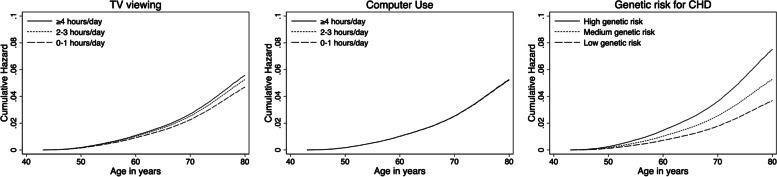
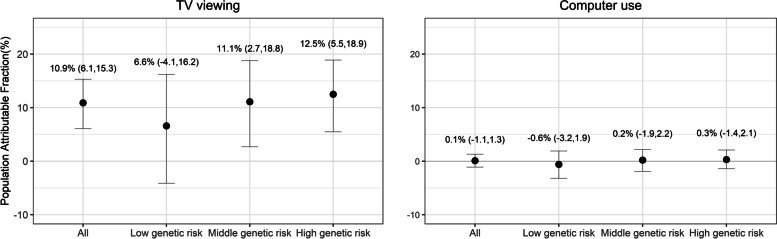
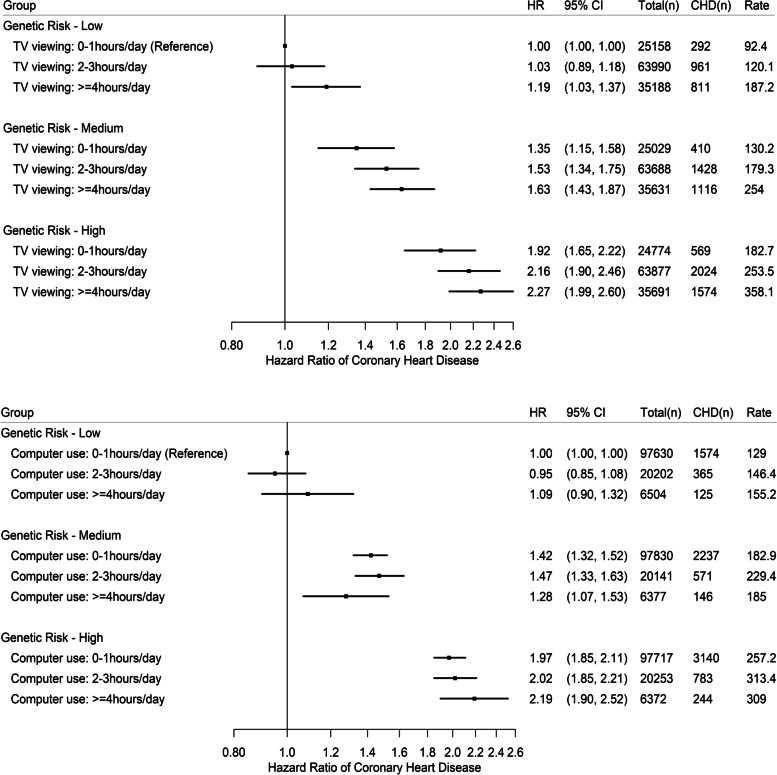
Compared with ≥4h/day of TV viewing, the hazard ratio of CHD was 0.84 (95% confidence interval [CI] 0.79-0.90) and 0.94 (0.90-0.99) for ≤1h/day and 2-3h/day of TV viewing, respectively, after adjusting for confounders including the genetic risk. CHD hazards were higher for medium and high genetic risk than for low genetic risk. Across all levels of genetic risk including high-genetic risk, ≤1h/day of TV viewing had lower CHD hazards, compared with ≥4h/day: no evidence of interaction between genetic risk and TV viewing (p value: 0.362). Estimates of the population attributable fraction (PAF) suggested that 10.9% (95% CI 6.1-15.3%) of CHD could be prevented if TV viewing time were reduced to ≤1h/day, assuming causality. The PAF values were relatively larger for medium-to-high genetic risk than for low genetic risk, although the CIs were wide and overlapping. No associations were observed for computer use.
Less TV viewing time was associated with lower CHD risk independently of genetic risk. Clinical trials targeted at individuals with high genetic susceptibility should consider reducing TV viewing as as a behavioural target for prevention of an early onset of cardiovascular events.
目前尚不清楚屏幕久坐活动与 CHD 的关联是否因遗传易感性而异。本研究的目的是研究 CHD 的遗传易感性与两种常见的屏幕久坐活动(电视[TV]观看和计算机使用)之间的相互作用与 CHD 发病率的关系。
本前瞻性队列研究纳入了来自英国生物库数据的 373,026 名无明显 CHD/中风的欧洲裔个体。CHD 的遗传易感性通过加权多基因风险评分进行评估,该评分通过将 300 个单核苷酸多态性中的风险增加等位基因数量相加,并乘以其相应的效应估计值来计算。通过触摸屏问卷评估 TV 观看和计算机使用情况。在中位数为 12.6 年的随访期间,对 CHD 的发生率(n=9185)进行了裁决。
与每天≥4 小时的 TV 观看相比,调整混杂因素(包括遗传风险)后,每天≤1 小时和 2-3 小时的 TV 观看的 CHD 风险比分别为 0.84(95%置信区间 [CI] 0.79-0.90)和 0.94(0.90-0.99)。中高遗传风险的 CHD 风险高于低遗传风险。在包括高遗传风险在内的所有遗传风险水平上,与每天≥4 小时的 TV 观看相比,每天≤1 小时的 TV 观看的 CHD 风险较低:遗传风险与 TV 观看之间没有交互作用的证据(p 值:0.362)。人群归因分数(PAF)的估计表明,如果将 TV 观看时间减少到≤1 小时/天,可以预防 10.9%(95%CI 6.1-15.3%)的 CHD,假设存在因果关系。中高遗传风险的 PAF 值相对较高,而低遗传风险的 PAF 值相对较低,尽管置信区间较宽且重叠。未观察到计算机使用的关联。
独立于遗传风险,较少的 TV 观看时间与较低的 CHD 风险相关。针对高遗传易感性个体的临床试验应考虑将减少 TV 观看作为预防心血管事件早期发作的行为目标。