Department of Biology, Biotechnical Faculty, University of Ljubljana, Jamnikarjeva 101, 1000, Ljubljana, Slovenia.
Department of Environmental Science, Aarhus University, 4000, Roskilde, Denmark.
Microb Ecol. 2023 Jul;86(1):282-296. doi: 10.1007/s00248-022-02033-5. Epub 2022 May 24.
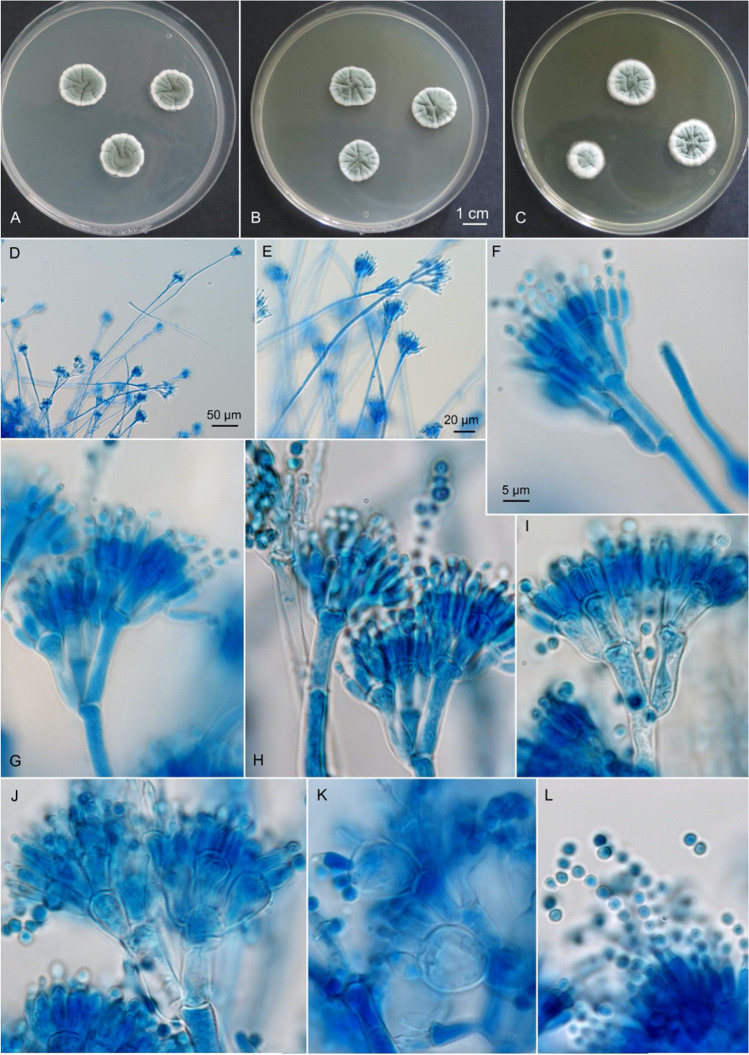
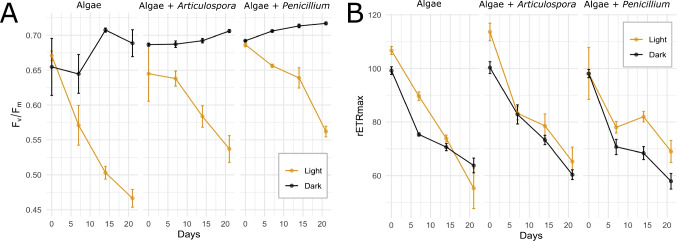
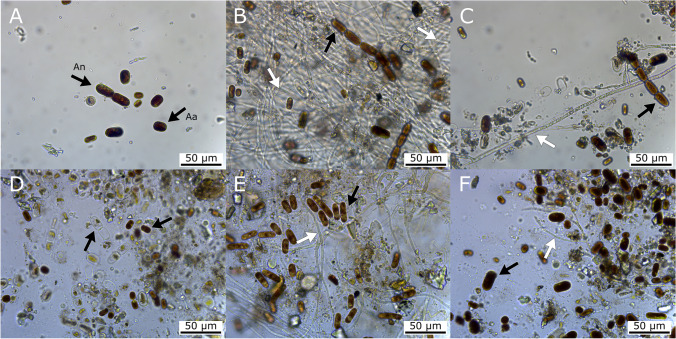
Heavily pigmented glacier ice algae Ancylonema nordenskiöldii and Ancylonema alaskanum (Zygnematophyceae, Streptophyta) reduce the bare ice albedo of the Greenland Ice Sheet, amplifying melt from the largest cryospheric contributor to eustatic sea-level rise. Little information is available about glacier ice algae interactions with other microbial communities within the surface ice environment, including fungi, which may be important for sustaining algal bloom development. To address this substantial knowledge gap and investigate the nature of algal-fungal interactions, an ex situ co-cultivation experiment with two species of fungi, recently isolated from the surface of the Greenland Ice Sheet (here proposed new species Penicillium anthracinoglaciei Perini, Frisvad and Zalar, Mycobank (MB 835602), and Articulospora sp.), and the mixed microbial community dominated by glacier ice algae was performed. The utilization of the dark pigment purpurogallin carboxylic acid-6-O-β-D-glucopyranoside (CHO) by the two fungi was also evaluated in a separate experiment. P. anthracinoglaciei was capable of utilizing and converting the pigment to purpurogallin carboxylic acid, possibly using the sugar moiety as a nutrient source. Furthermore, after 3 weeks of incubation in the presence of P. anthracinoglaciei, a significantly slower decline in the maximum quantum efficiency (F/F, inverse proxy of algal stress) in glacier ice algae, compared to other treatments, was evident, suggesting a positive relationship between these species. Articulospora sp. did uptake the glycosylated purpurogallin, but did not seem to be involved in its conversion to aglycone derivative. At the end of the incubation experiments and, in conjunction with increased algal mortality, we detected a substantially increasing presence of the zoosporic fungi Chytridiomycota suggesting an important role for them as decomposers or parasites of glacier ice algae.
富含色素的冰川冰藻 Ancylonema nordenskiöldii 和 Ancylonema alaskanum(接合藻纲,有胚植物)降低了格陵兰冰盖的裸冰反照率,放大了对全球海平面上升最大的冰原融水的贡献。关于冰川冰藻与冰面环境中其他微生物群落(包括真菌)的相互作用的信息很少,而真菌对于维持藻华的发展可能很重要。为了解决这个重大的知识空白,并研究藻-真菌相互作用的性质,进行了一项离体共培养实验,使用了两种真菌,它们最近从格陵兰冰盖表面分离出来(这里提议的新种 Penicillium anthracinoglaciei Perini、Frisvad 和 Zalar,Mycobank(MB 835602)和 Arthrospira sp.),以及由混合微生物群落主导的冰川冰藻。还在另一个实验中评估了两种真菌对暗色素 purpurogallin carboxylic acid-6-O-β-D-glucopyranoside (CHO) 的利用情况。P. anthracinoglaciei 能够利用并将色素转化为 purpurogallin carboxylic acid,可能将糖部分用作营养源。此外,在存在 P. anthracinoglaciei 的情况下孵育 3 周后,与其他处理相比,冰川冰藻的最大量子效率(F/F,藻应激的逆代理)明显下降缓慢,表明这些物种之间存在正相关关系。Arthrospira sp. 吸收了糖基化的 purpurogallin,但似乎不参与其向苷元衍生物的转化。在孵育实验结束时,并且伴随着藻类死亡率的增加,我们检测到游动孢子真菌 Chytridiomycota 的存在明显增加,这表明它们作为冰川冰藻的分解者或寄生虫具有重要作用。