Department of Neurology, Beijing Tiantan Hospital, Capital Medical University, No.119 South 4th Ring West Road, Fengtai District, Beijing, 100070, China.
Department of Neurology, Beijing Hospital, National Center of Gerontology, Beijing, China.
Neurol Sci. 2022 Sep;43(9):5343-5353. doi: 10.1007/s10072-022-06113-9. Epub 2022 May 24.
Emerging evidence has suggested that lipid metabolism is correlated with Parkinson's disease (PD) onset and progression. However, the effect of lipid metabolism on motor performance in PD patients is still unknown. This study estimated the association between lipid profiles and the severity of motor performance in PD.
This cross-sectional study enrolled 279 idiopathic PD patients from the Department of Neurology of Beijing Tiantan Hospital from May 2016 to August 2018. Serum triglyceride (TG), total cholesterol (TC), low-density lipoprotein cholesterol (LDL-C), high-density lipoprotein cholesterol (HDL-C), apolipoprotein A1 (Apo-A1), and apolipoprotein B (Apo-B) levels were detected in fast serum samples. Motor performance was assessed by Movement Disorder Society-Unified Parkinson's Disease Rating Scale part III (MDS-UPDRS III) total scores and subscores in these patients. The associations of lipid profiles with motor performance were analyzed using multivariable linear regression models.
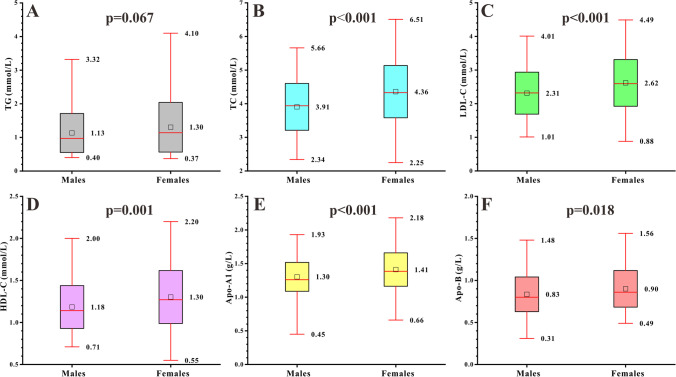
Compared to males, females with PD exhibited significantly higher serum TC, LDL-C, HDL-C, Apo-A1, and Apo-B levels. When accounting for covariates, lower serum TG levels were significantly associated with higher MDS-UPDRS III total scores and gait/postural instability subscores. Additionally, the univariate linear regression model showed that in males with PD, serum HDL-C or Apo-A1 levels were significantly associated with tremor subscores.
Lower serum TG levels were associated with more severe motor performance in patients with PD and TG may be a potential predictive biomarker for motor performance in PD patients.
新出现的证据表明,脂代谢与帕金森病(PD)的发病和进展有关。然而,脂代谢对 PD 患者运动表现的影响尚不清楚。本研究评估了脂谱与 PD 患者运动表现严重程度之间的关系。
本横断面研究纳入了 2016 年 5 月至 2018 年 8 月期间来自北京天坛医院神经科的 279 例特发性 PD 患者。在这些患者中,检测了快速血清样本中的血清甘油三酯(TG)、总胆固醇(TC)、低密度脂蛋白胆固醇(LDL-C)、高密度脂蛋白胆固醇(HDL-C)、载脂蛋白 A1(Apo-A1)和载脂蛋白 B(Apo-B)水平。使用运动障碍协会统一帕金森病评定量表第 3 部分(MDS-UPDRS III)总分和子评分评估这些患者的运动表现。使用多变量线性回归模型分析脂谱与运动表现的关系。
与男性相比,PD 女性的血清 TC、LDL-C、HDL-C、Apo-A1 和 Apo-B 水平显著更高。在考虑了协变量后,较低的血清 TG 水平与较高的 MDS-UPDRS III 总分和步态/姿势不稳子评分显著相关。此外,单变量线性回归模型显示,在 PD 男性中,血清 HDL-C 或 Apo-A1 水平与震颤子评分显著相关。
较低的血清 TG 水平与 PD 患者更严重的运动表现相关,TG 可能是 PD 患者运动表现的潜在预测生物标志物。