Surgical Outcomes Research Centre (SOuRCe), The University of Sydney and Sydney Local Health District, Sydney, NSW, Australia.
Faculty of Medicine, Prince of Wales Clinical School, The University of New South Wales, Sydney, NSW, Australia.
Surg Endosc. 2022 Oct;36(10):7140-7159. doi: 10.1007/s00464-022-09269-9. Epub 2022 May 24.
Previous meta-analyses examining skin closure methods for all surgical wounds have found suture to have significantly decreased rates of wound dehiscence compared to tissue adhesive; however, this was not specific to laparoscopic wounds alone. This study aims to determine the best method of skin closure in patients undergoing laparoscopic abdominopelvic surgery in order to minimize wound complications and pain, while maximize cosmesis, time and cost efficiency.
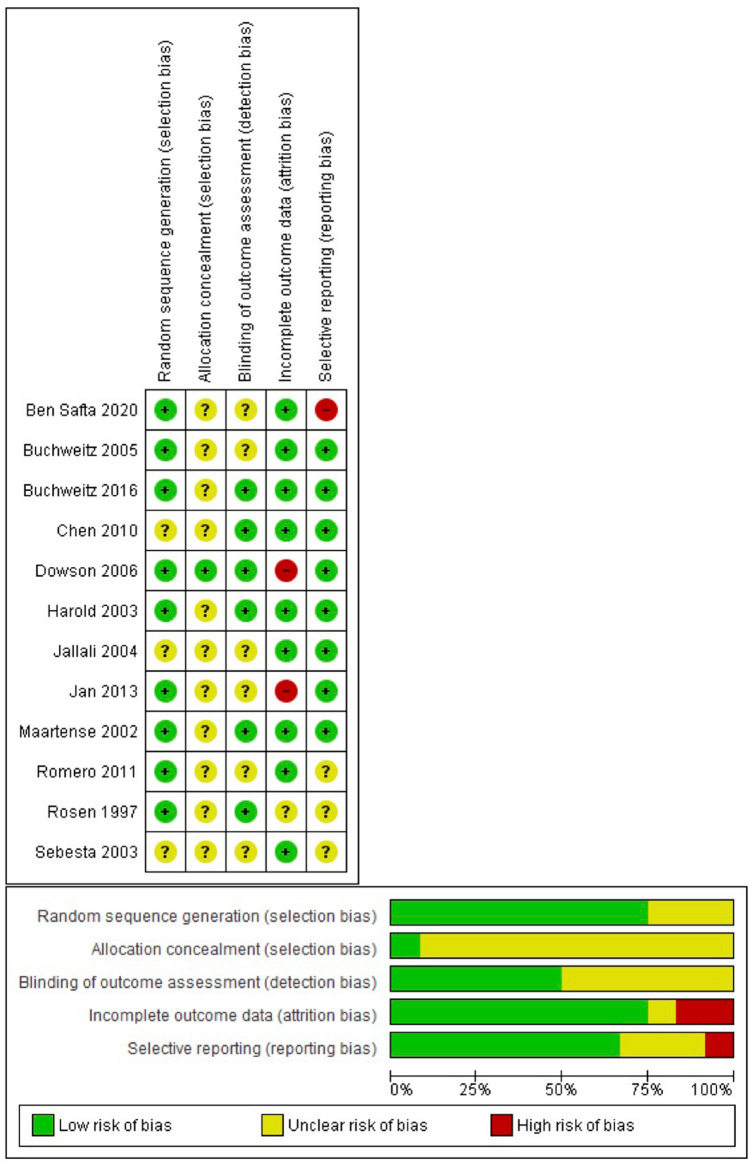
A comprehensive search of EMBASE, Medline, Pubmed, and CENTRAL was conducted from inception to 1st May 2020 for randomized controlled trials (RCTs). Two independent reviewers extracted data and assessed risk of bias. The Grading of Recommendations Assessment, Development and Evaluation (GRADE) system was used to describe the quality of evidence. Meta-analysis was performed using a random-effects model. A summary relative risk (RR) was calculated for dichotomous outcomes where data could be pooled. (Prospero registration number: CRD42019122639).
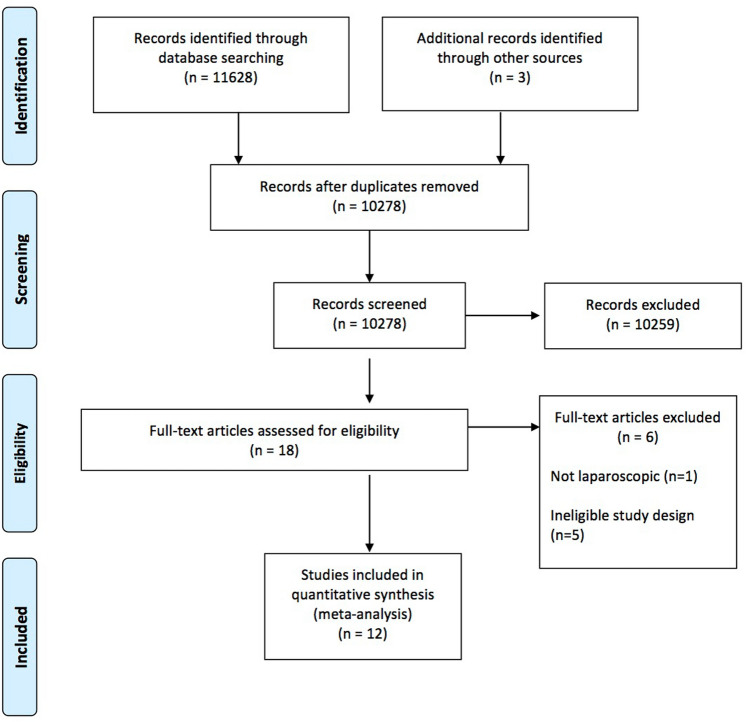
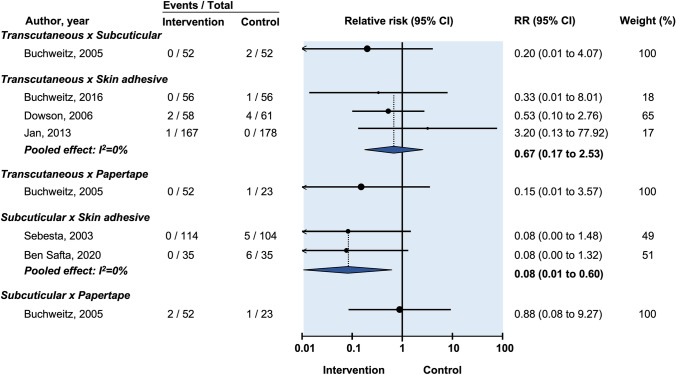
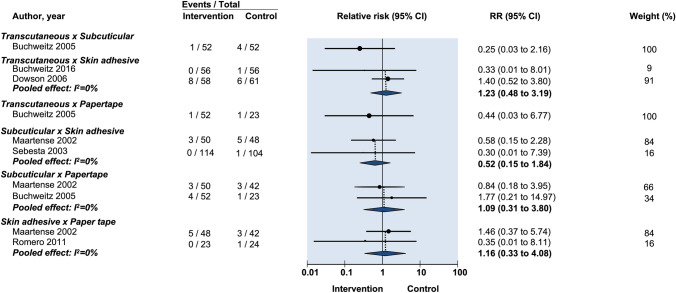
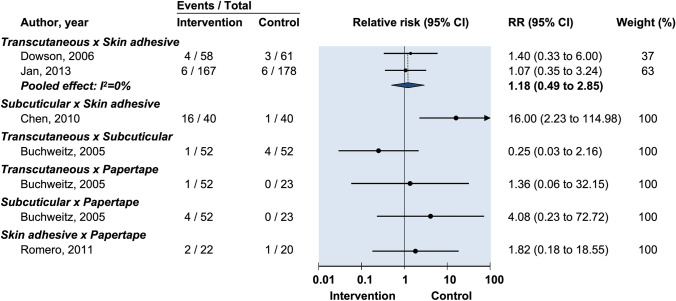
The literature search identified 11,628 potentially eligible studies. Twelve RCTs met inclusion criteria. There was no difference in wound complications (infection, dehiscence, and drainage) between sutures, tissue adhesives nor adhesive papertape. Low-quality evidence found transcutaneous suture had lower rates of wound complications compared with subcuticular sutures (RR 0.22, 95%: CI 0.05-0.98). There was no evidence of a difference in patient-evaluated cosmesis, prolonged pain, or patient satisfaction between the three groups. Closure with tissue adhesive and adhesive papertape was faster and cheaper than suture.
Tissue adhesive and adhesive papertape offer safe, cost and time-saving alternatives to closure of laparoscopic port sites compared to suture.
之前的元分析检查了所有手术伤口的皮肤闭合方法,发现与组织粘合剂相比,缝合显著降低了伤口裂开的发生率;然而,这并不是专门针对腹腔镜伤口的。本研究旨在确定在接受腹腔镜腹部和骨盆手术的患者中,使用最佳的皮肤闭合方法,以最大限度地减少伤口并发症和疼痛,同时最大限度地提高美容效果、时间和成本效率。
从研究开始到 2020 年 5 月 1 日,我们对 EMBASE、Medline、Pubmed 和 CENTRAL 进行了全面检索,以寻找随机对照试验(RCT)。两名独立的审查员提取数据并评估偏倚风险。使用推荐评估、制定和评估(GRADE)系统来描述证据质量。使用随机效应模型进行荟萃分析。对于可以合并数据的二项结局,计算了汇总相对风险(RR)。(前瞻性注册编号:CRD42019122639)。
文献检索确定了 11628 项潜在合格的研究。12 项 RCT 符合纳入标准。缝线、组织粘合剂和粘合纸带之间在伤口并发症(感染、裂开和引流)方面没有差异。低质量证据发现经皮缝线与皮下缝线相比,伤口并发症发生率较低(RR 0.22,95%:CI 0.05-0.98)。三组患者在美容效果、疼痛持续时间和患者满意度方面均无差异。与缝合相比,组织粘合剂和粘合纸带的闭合速度更快,成本更低。
与缝合相比,组织粘合剂和粘合纸带为闭合腹腔镜端口提供了安全、经济和省时的替代方法。